It's been a while since I've posted. Although the summer is the time in the academic calendar when the teaching load subsides and writing can take place, I've had some trouble writing so far this summer. I took on too many side projects in June. Meant to be small jobs to earn some summer income, these projects ended up sapping up my time and creative energy. As I enter July, I'm trying to refocus. I'm trying to capture some quite moments. I'm trying to figure out what I think and what I want to say. I need to make significant progress on my dissertation this summer, and I need to learn to allow myself that time. For now, I'm posting some pictures I've taken this summer of light(s) in various forms.
Tuesday, July 3, 2012
Wednesday, May 16, 2012
A Trip to the Zoo (or, Is it still called sailing if you don't have a sail?)
I just returned from Kalamazoo, Michigan, where I attended this year's fabulous International Congress on Medieval Studies. Kalamazoo (or, as we medievalists fondly call it, "the zoo") has become an annual pilgrimage for me, a time of year as sure as spring, when a caravan of cars from Rochester heads across the midwest to a magical place where people who study the Middle Ages feel for a few days a year like we might actually make up a significant portion of the population. This was my sixth year going and my fifth year presenting; I've enjoyed it each time, but this year I really felt at home. I'm becoming increasingly relaxed at this conference, which can be a bit overwhelming at first. Made up of scholars from a variety of disciplines, around 3,000 people from around the world attend the congress. I saw some great papers, had some wonderful conversations, and got to catch up with friends old and new. My panel, on "Women and their Environments: Real and Imagined" and sponsored by the Society for Medieval Feminist Scholarship, worked beautifully as a whole. The papers moved us from cityscape to forest to ocean in the course of the panel. (For a fascinating discussion of female bodies and landscape, see Kate's recent post on Perceval of Galles.) I came back with pages of notes to fuel my chapter, and am feeling reinvigorated after a long semester/year. Once again, I feel lucky to be in a field with such smart and engaging and generous scholars.
Since I just gave a paper on Chaucer's Man of Law's Tale at Kalamazoo, and I'll be giving another paper on the same tale for the New Chaucer Society later this summer in Portland, Oregon, I thought I'd write a little about the tale and my experience of it. This post combines random musings with pieces from the paper I just gave, the one I'll give this July, and the chapter in progress. For those of you who need a little refresher, the tale is about Custance, a saintly Roman Princess. She first travels east to marry the Sultan of Syria, who's converted for her love, but her new mother-in-law isn't pleased with the plan and sets her to sea in a rudderless ship. Finally reaching Northumbria, she manages to convert and marry the king there (she has a real talent for looking pretty enough to convert any world leader she encounters). But she once again lands herself an evil mother-in-law. This mother-in-law also sends our heroine on a rudderless ship, but this time she makes it back to Rome. Her royal husband also travels to Rome on pilgrimage, and a happy reunion can occur. This brief summary leaves our many important details, but it will do for now. The tale is part of a larger tradition of Constance narratives which feature the same basic story line, though with important distinctions.
The Man of Law's Tale is the most famous Middle English iteration of the rudderless ship tales, and also the most famous of the tales in the so-called Constance-Cycle, so I knew that I would have to tackle it in my dissertation. I found this task daunting for multiple reasons. First, it's Chaucer. There's just so much criticism to contend with. At least it's not the Wife of Bath or the Pardoner but it's still breathtaking to consider how many people have read and written on this story and on The Canterbury Tales more generally. Second, I really didn't know what to do with this tale. I had already figured out my arguments about Gower's version, which features a much more assertive Constance. The Man of Law seems intent on downplaying Custance's free will and in giving her as little agency as possible. I just didn't know what I was going to say beyond contrasting this Constance with other, spunkier Constances, and that didn't seem particularly interesting or original. So I put off this chapter as long as I could.
Last year I included the Man of Law's Tale in my course on Medieval travel, and teaching the tale helped me to see it in a new way. Re-reading a text in order to teach it and discussing it with students who've never before encountered it always helps me to see it anew. I was also really fascinated by the reactions my students had to Custance. I've taught the Wife of Bath's Tale several times now, and I've come to expect strong responses from students to the Wife. I really didn't expect Custance to elicit those kinds of emotions. But the students did respond, to both the story and to its heroine. There were students who, like me, were annoyed by Custance's passivity. But others found in her a role model, a person strong and confident in herself and her beliefs. It was quite a diverse group, especially the first semester I taught it, with people from a variety of countries and religious backgrounds, and there were about the same number of males and females in the class. Two of the students who identified most strongly with Custance, who found in her a role model for themselves, were male. They were both people of faith, but people from very different religious backgrounds, and they saw in her characteristics that they felt all people should strive to possess. These passionate responses made me take a step back and reassess the character. This is not to say that I don't think Custance's faith is gendered or that it doesn't take on specific meanings in the context of the period or of The Canterbury Tales, but rather that there might simply be aspects of it that I hadn't considered. I began to think about other features of the tale that I might have missed.
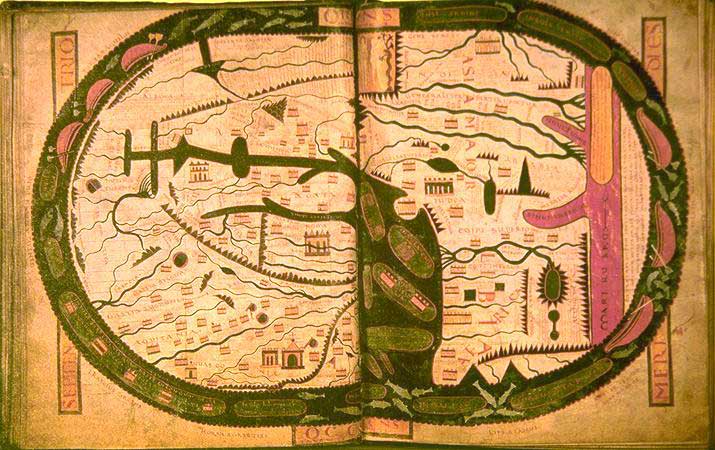
During this time, I was developing my overarching argument about the ocean in the mappae mundi (which you can find more on here and here), and increasingly noticing how blank and marginal a space it was in these maps, on the fringes of the text-covered landscape. The land is history, both linear and cyclical, while the ocean shapes history and yet remains outside of it. Given these features of the mappae mundi, I began to notice something about the oceanic moments of the tale. On Custance's rudderless voyages, the Man of Law makes sense of her survival by comparing her to a litany of Biblical figures. If we wonder how she survives, we might ask who saved Daniel in the lion's den, who saved Jonah from the Whale, and a quite extensive number of similar questions. These long digressions of comparisons to Biblical figures, which I had found frustrating before, suddenly took a new meaning for me. I had really only thought about how they downplayed Custance's free-will, and that's certainly true, but perhaps something else is going on as well in these lengthy interruptions. If the ocean is extrahistorical, then what do we make of all of these comparisons to figures and events who belong in the historical, landed realm?
There is some precedence for seeing Custance's story in terms of medieval cartography. V.A. Kolve notes in Chaucer and the Imagery of Narrative that "the tale creates a residual image that is geographical: a map of Europe with a boat moving upon its waters" (319). Kathy Lavezzo expands this notion in Angels on the Edge of the World by arguing that "since Custance's journey begins in Syria, the cartographic territory evoked in the tale in fact extends beyond Europe and [. . .] suggests a map of the world" (95). David Raybin (who was actually at my talk and who gave me extensive and helpful feedback) joins Custance's geographical marginality with history and time in "Custance and History: Woman as Outsider in Chaucer's Man of Law's Tale." He notes that "[s]he is exiled from the temporal world and thus unconstrained by time, bound to her faith and thus spiritually free, existing in an emblematic position largely outside of human contact, outside history" (69). All of these scholars have made fascinating and apt arguments about Custance, about her placement in the world. I would like to combine the cartographic discussions of Kolve and Lavezzo with Raybin's ideas about Custance's temporal marginalization, and put all of these in terms of the oceanic spaces of the tale. I want to consider the ocean in the tale as a complex kind of narrative space.
Custance's initial voyage to Syria is barely described. She has a clear destination and a clear purpose (and, presumably, a mode of steering). This trip seems to occur squarely in the historical realm. Her subsequent sea voyages are quite different. Pushed into a rudderless ship and sent into the sea, Custance enters a different kind of narrative space, once in which her prayers and her constant faith can serve her well. Unlike the voyage to Syria, her latter travels occur in a zone outside of history and narrative control. The "salte see" becomes a realm dominated by fate. Only Custance, constant as she is, could survive such a voyage in the oceanic realm. She sails without destination or control. The narrator explains that her boat goes "Som-tyme West, som-tyme North and South,/ And som-tyme Est, ful many a wery day" (948-949). Each cardinal direction is given its turn, making this journey one that can be mapped and yet also one that cannot. We know that the ship takes each direction, so directions are available, which seems more like the real ocean than the circle around the mappae mundi. Yet the fact that the boat takes each direction at will and we never know quite where we are leads us to that metaphorical realm. Nor is time less fluid than location. The ship is carried back and forth across the ocean for "Yeres and dayes," a time that seems specific, with the addition of days, and yet is nonetheless vague (463). How many years? How many days? Time, it seems, is hard to quantify on the waves. The precise way in which the events of the tale up to this point have been recounted gives way to a rise and fall of detail in keeping with the movement of the ocean itself. On our heroine's second "stereless" voyage the time is somewhat clearer -- "Fyve yeer and more" (902). We do get a number of years this time, but the "and more" undoes that specificity. Temporalities and teleologies and cycles are all lost amid the waves.
Yet the Man of Law must somehow narrate this "stereless" section of the tale, and he does so by connecting Custance's situation with biblical figures who also survived certain death in the form of natural adversaries. As soon as Custance is afloat at sea, outside of the historical realm and in that blank space off the charted map, the Man of Law begins to make connections between our heroine and the sort of men and women who routinely show up on the landed areas of the map. The Man of Law can only make sense of Custance's foray outside of the historical realm by relating it back to that realm in every way possible. He tells us about how Daniel survived the lion's den, Jonah made it out of the whale's belly, the Hebrews passed through the water thanks to the parting of the waves. The comparisons go on for some time, but I would like to consider the fact that these last two, Jonah and the Red Sea, are watery comparisons. While the ocean comparisons may seem fitting to the ocean realm, I would argue that they remain a part of the historical narrative, the kind that was not written into the oceans of the mappae mundi. By mentioning them here, the Man of Law is simultaneously pulling Custance back into the historical realm and marking the ocean as a space that has contained human history. It is a means of inscribing these events onto the ocean, as so many events were written onto the landscape in medieval world maps.
I argue that these comparisons, extensive and disruptive as they are, serve to reconnect the ocean and land, to renegotiate the tensions involved in a narrative outside of the historical realm. Custance, passive as she is, makes a central and historical narrative out of a blank marginal space. Her story doubles back on itself in the course of her tale; everything occurs more than once, indicating a kind of cyclical history, and yet, as Suzanne Conklin Akbari has noted in a recent talk at the University of Rochester, the story denies us either a complete cycle or a complete teleology. It is both cyclical and linear and it is neither. It moves in and out of historical time, and never allows Custance, or the reader, a clear footing in either realm. The heroine's movements around the earth in her rudderless ship unsettle boundaries and binaries of time and space even as they assert them. The ocean is both vital and distant, encompassing land masses but existing beyond and outside of those realms. It serves as a threshold to other lands, and yet is a distinct conduit, unlike a road, which is built into the land itself. As a conduit not created by humans, it is far more threatening and unpredictable. Because of its placement on mappae mundi, it also exists outside of history, functioning as an extrahistorical realm. Custance’s oceanic travels thus represent a new kind of storytelling that is – like the ocean – a threshold, a liminal space between kinds of narratives. The realms of land and sea, and the types of narratives embodied by each, are not as separate as they might appear on the map; likewise, modes of narrative production intersect in dynamic ways throughout the tale and allow for the passive Custance to reshape the religio-cultural contours of her world.
Since I just gave a paper on Chaucer's Man of Law's Tale at Kalamazoo, and I'll be giving another paper on the same tale for the New Chaucer Society later this summer in Portland, Oregon, I thought I'd write a little about the tale and my experience of it. This post combines random musings with pieces from the paper I just gave, the one I'll give this July, and the chapter in progress. For those of you who need a little refresher, the tale is about Custance, a saintly Roman Princess. She first travels east to marry the Sultan of Syria, who's converted for her love, but her new mother-in-law isn't pleased with the plan and sets her to sea in a rudderless ship. Finally reaching Northumbria, she manages to convert and marry the king there (she has a real talent for looking pretty enough to convert any world leader she encounters). But she once again lands herself an evil mother-in-law. This mother-in-law also sends our heroine on a rudderless ship, but this time she makes it back to Rome. Her royal husband also travels to Rome on pilgrimage, and a happy reunion can occur. This brief summary leaves our many important details, but it will do for now. The tale is part of a larger tradition of Constance narratives which feature the same basic story line, though with important distinctions.
The Man of Law's Tale is the most famous Middle English iteration of the rudderless ship tales, and also the most famous of the tales in the so-called Constance-Cycle, so I knew that I would have to tackle it in my dissertation. I found this task daunting for multiple reasons. First, it's Chaucer. There's just so much criticism to contend with. At least it's not the Wife of Bath or the Pardoner but it's still breathtaking to consider how many people have read and written on this story and on The Canterbury Tales more generally. Second, I really didn't know what to do with this tale. I had already figured out my arguments about Gower's version, which features a much more assertive Constance. The Man of Law seems intent on downplaying Custance's free will and in giving her as little agency as possible. I just didn't know what I was going to say beyond contrasting this Constance with other, spunkier Constances, and that didn't seem particularly interesting or original. So I put off this chapter as long as I could.
Last year I included the Man of Law's Tale in my course on Medieval travel, and teaching the tale helped me to see it in a new way. Re-reading a text in order to teach it and discussing it with students who've never before encountered it always helps me to see it anew. I was also really fascinated by the reactions my students had to Custance. I've taught the Wife of Bath's Tale several times now, and I've come to expect strong responses from students to the Wife. I really didn't expect Custance to elicit those kinds of emotions. But the students did respond, to both the story and to its heroine. There were students who, like me, were annoyed by Custance's passivity. But others found in her a role model, a person strong and confident in herself and her beliefs. It was quite a diverse group, especially the first semester I taught it, with people from a variety of countries and religious backgrounds, and there were about the same number of males and females in the class. Two of the students who identified most strongly with Custance, who found in her a role model for themselves, were male. They were both people of faith, but people from very different religious backgrounds, and they saw in her characteristics that they felt all people should strive to possess. These passionate responses made me take a step back and reassess the character. This is not to say that I don't think Custance's faith is gendered or that it doesn't take on specific meanings in the context of the period or of The Canterbury Tales, but rather that there might simply be aspects of it that I hadn't considered. I began to think about other features of the tale that I might have missed.
During this time, I was developing my overarching argument about the ocean in the mappae mundi (which you can find more on here and here), and increasingly noticing how blank and marginal a space it was in these maps, on the fringes of the text-covered landscape. The land is history, both linear and cyclical, while the ocean shapes history and yet remains outside of it. Given these features of the mappae mundi, I began to notice something about the oceanic moments of the tale. On Custance's rudderless voyages, the Man of Law makes sense of her survival by comparing her to a litany of Biblical figures. If we wonder how she survives, we might ask who saved Daniel in the lion's den, who saved Jonah from the Whale, and a quite extensive number of similar questions. These long digressions of comparisons to Biblical figures, which I had found frustrating before, suddenly took a new meaning for me. I had really only thought about how they downplayed Custance's free-will, and that's certainly true, but perhaps something else is going on as well in these lengthy interruptions. If the ocean is extrahistorical, then what do we make of all of these comparisons to figures and events who belong in the historical, landed realm?
There is some precedence for seeing Custance's story in terms of medieval cartography. V.A. Kolve notes in Chaucer and the Imagery of Narrative that "the tale creates a residual image that is geographical: a map of Europe with a boat moving upon its waters" (319). Kathy Lavezzo expands this notion in Angels on the Edge of the World by arguing that "since Custance's journey begins in Syria, the cartographic territory evoked in the tale in fact extends beyond Europe and [. . .] suggests a map of the world" (95). David Raybin (who was actually at my talk and who gave me extensive and helpful feedback) joins Custance's geographical marginality with history and time in "Custance and History: Woman as Outsider in Chaucer's Man of Law's Tale." He notes that "[s]he is exiled from the temporal world and thus unconstrained by time, bound to her faith and thus spiritually free, existing in an emblematic position largely outside of human contact, outside history" (69). All of these scholars have made fascinating and apt arguments about Custance, about her placement in the world. I would like to combine the cartographic discussions of Kolve and Lavezzo with Raybin's ideas about Custance's temporal marginalization, and put all of these in terms of the oceanic spaces of the tale. I want to consider the ocean in the tale as a complex kind of narrative space.
Custance's initial voyage to Syria is barely described. She has a clear destination and a clear purpose (and, presumably, a mode of steering). This trip seems to occur squarely in the historical realm. Her subsequent sea voyages are quite different. Pushed into a rudderless ship and sent into the sea, Custance enters a different kind of narrative space, once in which her prayers and her constant faith can serve her well. Unlike the voyage to Syria, her latter travels occur in a zone outside of history and narrative control. The "salte see" becomes a realm dominated by fate. Only Custance, constant as she is, could survive such a voyage in the oceanic realm. She sails without destination or control. The narrator explains that her boat goes "Som-tyme West, som-tyme North and South,/ And som-tyme Est, ful many a wery day" (948-949). Each cardinal direction is given its turn, making this journey one that can be mapped and yet also one that cannot. We know that the ship takes each direction, so directions are available, which seems more like the real ocean than the circle around the mappae mundi. Yet the fact that the boat takes each direction at will and we never know quite where we are leads us to that metaphorical realm. Nor is time less fluid than location. The ship is carried back and forth across the ocean for "Yeres and dayes," a time that seems specific, with the addition of days, and yet is nonetheless vague (463). How many years? How many days? Time, it seems, is hard to quantify on the waves. The precise way in which the events of the tale up to this point have been recounted gives way to a rise and fall of detail in keeping with the movement of the ocean itself. On our heroine's second "stereless" voyage the time is somewhat clearer -- "Fyve yeer and more" (902). We do get a number of years this time, but the "and more" undoes that specificity. Temporalities and teleologies and cycles are all lost amid the waves.
Yet the Man of Law must somehow narrate this "stereless" section of the tale, and he does so by connecting Custance's situation with biblical figures who also survived certain death in the form of natural adversaries. As soon as Custance is afloat at sea, outside of the historical realm and in that blank space off the charted map, the Man of Law begins to make connections between our heroine and the sort of men and women who routinely show up on the landed areas of the map. The Man of Law can only make sense of Custance's foray outside of the historical realm by relating it back to that realm in every way possible. He tells us about how Daniel survived the lion's den, Jonah made it out of the whale's belly, the Hebrews passed through the water thanks to the parting of the waves. The comparisons go on for some time, but I would like to consider the fact that these last two, Jonah and the Red Sea, are watery comparisons. While the ocean comparisons may seem fitting to the ocean realm, I would argue that they remain a part of the historical narrative, the kind that was not written into the oceans of the mappae mundi. By mentioning them here, the Man of Law is simultaneously pulling Custance back into the historical realm and marking the ocean as a space that has contained human history. It is a means of inscribing these events onto the ocean, as so many events were written onto the landscape in medieval world maps.
I argue that these comparisons, extensive and disruptive as they are, serve to reconnect the ocean and land, to renegotiate the tensions involved in a narrative outside of the historical realm. Custance, passive as she is, makes a central and historical narrative out of a blank marginal space. Her story doubles back on itself in the course of her tale; everything occurs more than once, indicating a kind of cyclical history, and yet, as Suzanne Conklin Akbari has noted in a recent talk at the University of Rochester, the story denies us either a complete cycle or a complete teleology. It is both cyclical and linear and it is neither. It moves in and out of historical time, and never allows Custance, or the reader, a clear footing in either realm. The heroine's movements around the earth in her rudderless ship unsettle boundaries and binaries of time and space even as they assert them. The ocean is both vital and distant, encompassing land masses but existing beyond and outside of those realms. It serves as a threshold to other lands, and yet is a distinct conduit, unlike a road, which is built into the land itself. As a conduit not created by humans, it is far more threatening and unpredictable. Because of its placement on mappae mundi, it also exists outside of history, functioning as an extrahistorical realm. Custance’s oceanic travels thus represent a new kind of storytelling that is – like the ocean – a threshold, a liminal space between kinds of narratives. The realms of land and sea, and the types of narratives embodied by each, are not as separate as they might appear on the map; likewise, modes of narrative production intersect in dynamic ways throughout the tale and allow for the passive Custance to reshape the religio-cultural contours of her world.
Labels:
Canterbury tales,
cartography,
Constance-Cycle,
dissertation,
geography,
history,
Kalamazoo,
Kolve,
Lavezzo,
Man of Law's Tale,
mappa mundi,
Middle Ages,
narrative,
ocean,
Raybin,
teaching,
topography
Monday, May 14, 2012
Hermeneutics of Consumption in Perceval of Galles
I am looking forward to hearing all about Kalamazoo from Kristi -- so terribly sad to have missed it this year, but the impending move to California made the annual pilgrimage impossible this time around. From the sound of it, the conference was as energizing as ever! I have a feeling that my co-blogger will be posting within the next few days, if not sooner, but in the meanwhile, I thought I'd make a long-overdue contribution . . .
With the looming cross-country move, I'm afraid I haven't had nearly as much time for blogging as I'd hoped for over the past few months. I have several posts (currently in nascent form and backlogged given the pre-move insanity) which will soon find their way over here. At the moment, however, my brain is firing in several different directions, which doesn’t make for lucid blogging! But since I've only been meaning to do this since March, I want to share a paper I presented at this year's NEMLA convention. Writing it was a somewhat hair-raising experience; deciding to present (and, I'll confess, write) a conference paper just a few days after my dissertation filing deadline might have been more than a bit absurd on my part. Miraculously, however, my paper somehow came together despite the time crunch, and I am so glad to have had the opportunity to present in this particular session. The panel, organized by my inimitable co-blogger, Kristi, and the equally lovely Hilarie Lloyd, was both diverse in content and convergent in interests and theme. I am always amazed by these kinds of sessions. The fact that you can manage to have a papers on a medieval romance, Jhumpa Lahiri, Edwidge Danticat, and victory gardens all speak to each other is nothing short of innervating, and a true testament to how interconnected we can be despite our specializations.
And so, without further ado, the paper!
It’s Not Easy Eating
Green: Hermeneutics of Feminine Consumption
in Sir Perceval of Galles.
This map, by Lynton Lamb, appeared on the endpapers to
Charles Williams’ first edition of Taliessin
Through Logres (1938).
From Charles Williams,
edited by David Llewellyn Dodds (Rochester: Boydell, 1991).
This map is not medieval, but it
resonates with the medieval configuration of women and women’s bodies in the
text I’ll be discussing here. It
appeared as the endpapers to a 1938 poetry collection entitled Taliessin Through Logres by Charles
Williams, a member of the famed Inklings and one with a keen investment in
things Arthurian. Here you can find the map of Europe, superimposed by a
woman’s body. At the head, we have England,
the seat of Arthurian power, and further down, we have Jerusalem in a place
would be more shocking if it didn’t align so neatly with medieval
configurations of the Holy City as the navel of the world. This map – however unwittingly – encapsulates
the relationship between feminized corporeal and terrestrial bodies in Sir Perceval of Galles, one that directly
informs and is informed by the instances of ingestion that occur throughout the
narrative.
This paper comes
out of a larger discussion in my dissertation about the emblematic roles that
women play in late middle English romances, especially those concerned with
aspects of crusade and recovery (of territory and from various kinds of
trauma). The Middle English romance Sir Perceval of Galles relies on
imbricated levels of recovery for its narrative momentum, many of which hinge
on the comingling of female bodies and the landscapes they inhabit. Both bodies (corporeal and terrestrial) are
inextricably bound to one another in this romance. Their relationship is
established in its very first lines, and reinforced throughout Perceval’s
martial defense of a placed called “Maydenlande” – a region whose very name
alludes in a charmingly obvious way to the symbolic relationship between female
bodies and feminized landscapes. The
scene that seals this relationship, however, involves a strange act of
ingestion, involving one of the most pivotal women in the text — Perceval’s
mother — consuming nothing but grass and water; consuming, in essence, the very
thing that defines her worth and the worth of the other women in her
society. Her eating seeks a tacit
reversal of the established association of female bodies with territory, but in
the end her eating only reinscribes her in that very circuit of symbolic value.
The significance
of this passage only becomes clear through the establishment of symbolic female
bodies earlier in the romance, and so I’ll begin my discussion by providing you
with a brief summary. The Middle-English Sir
Perceval of Galles is, by all accounts, focused on male action. It centers
on the exploits of Perceval, a young man raised in the wilderness by a mother
afraid of the dangers of chivalric society (which press men into armed conflict
and which resulted in the death of her husband). Perceval grows curious about the broader
world, and eventually abandons his mother to enter society. He fails on numerous occasions to read the
world correctly, inexperienced as he is with its nuances. He learns slowly, but gradually, how to
acculturate himself, and develops from a “fool of the field” who mistakes a
pregnant mare for a destrier to one of Arthur’s elite knights and a king in his
own right. His mother, largely absent
from the story, looms in the recesses of Perceval’s developing identity,
however, and he eventually embarks on a quest to recover her.
Scholars have
often remarked that this version of Perceval’s story lacks the very thing that
defines its source text. Chretien’s Conte du Graal, is, after all, dominated by
Perceval’s Grail quest and all of its failures. Here, however — to draw on an observation of
Russell Peck’s — Perceval’s mother, and his sense of home, becomes his grail. His redemptive and penitential quest to
recover her becomes the final feat he must accomplish before he can end his
life fighting in the Holy Land as a crusader.
Women, then, play a significant role in the romance, even if their
“screen-time” remains remarkably brief.
Perceval of Galles begins with the
marriage of the eponymous hero’s parents, an event that establishes the
interconnectedness of feminized bodies in the romance. King Arthur gives his
sister Acheflour in marriage to a knight, confusingly named Perceval as
well. This passage makes clear, however,
that this marriage comes with more than just a bride:
Tharefore Kyng Arthoure
Dide hym mekill honoure:
He gaffe hym his syster Acheflour,
To have and to holde
Fro thethyn till his lyves ende,
With brode londes to spende,
For he the knyght wele kende. (21-27)
Dide hym mekill honoure:
He gaffe hym his syster Acheflour,
To have and to holde
Fro thethyn till his lyves ende,
With brode londes to spende,
For he the knyght wele kende. (21-27)
[Therefore King Arthur did (Sir Perceval) much honor: he gave him his
sister Acheflour, to have and to hold, from thence until his life's end, with broad
lands to use, for he knew the knight well.]
The wedding then, connects the
bride to the land by making a marriage with her synonymous with territorial
acquisition. Perceval Sr., in the lines
that follow, journeys to the church to — as the narrator tells us – marry the
woman and “win gifts that were good” — yet another reminder that this marriage
indelibly ties women to the tangible goods that they bring into a marriage.
This
dynamic is revisited in the middling portion of the romance, as the young
Perceval wages a war against a Sultan, who threatens to overtake a region
called Maydenlande. Throughout this episode, Lufamore — the
besieged ruler of Maydelande — is consistently bound (both literally and
figuratively) to her territory. The sultan,
for instance, seizes her lands, and — wishing to claim her body as well — forces
her to retreat into her castle while he lays a siege (977-1000). Lufamore herself enacts this binding of
territorial and corporeal bodies by stating that whoever rescues her will
"hafe this kyngdome and me, / To welde at his will” (1339-1340). Her desire to ensure that the right man gains control over her and her
lands trumps any desires for continued autonomy on her part; she finds herself
in control, after all, only because her brothers, her father, and her uncle have
already been killed by the sultan.
The invading Saracen army directly
threatens the Christian landscape in ways that are directly linked to rape. As
the messenger tells Perceval:
Up resyn es a Sowdane:
Alle hir landes hase he tane;
So byseges he that woman
That scho may hafe no pese."
He sayse that scho may have no pese,
The lady, for hir fayrenes,
And for hir mekill reches.
"He wirkes hir full woo;
He dose hir sorow all hir sythe,
And all he slaes doun rythe;
He wolde have hir to wyfe,
And scho will noghte soo.
Now hase that ilke Sowdane
Hir fadir and hir eme slane,
And hir brethir ilkane,
And is hir moste foo.
So nere he hase hir now soughte
That till a castelle es scho broghte,
And fro the walles will he noghte,
Ere that he may hir too. (977-96)
Alle hir landes hase he tane;
So byseges he that woman
That scho may hafe no pese."
He sayse that scho may have no pese,
The lady, for hir fayrenes,
And for hir mekill reches.
"He wirkes hir full woo;
He dose hir sorow all hir sythe,
And all he slaes doun rythe;
He wolde have hir to wyfe,
And scho will noghte soo.
Now hase that ilke Sowdane
Hir fadir and hir eme slane,
And hir brethir ilkane,
And is hir moste foo.
So nere he hase hir now soughte
That till a castelle es scho broghte,
And fro the walles will he noghte,
Ere that he may hir too. (977-96)
["Uprisen is a sultan, all her lands has
he taken; he so besieges that woman that she may have no peace." He says
that she may have no peace, the lady, because of her fairness, and because of
her great riches. "He works her
full woe; he does her sorrow all her days, and everyone he slays straight
away. He would have her to wife, and
would not so. Now has the Sultan her father and her uncle slain, and each of
her brothers, and (he) is her greatest enemy.
So closely he has pursued her now that she has been brought to a castle,
and he will not leave the walls until he might take her.]
The
verb “to take” appears frequently in this passage, and it is one that was
regularly used in medieval literature to refer both to the wrongful acquisition
of land and to rape. The consistent use
of this word in the passage renders coterminous the bodies threatened by the
sultan.
His actions require swift martial —
and marital — action, and Percival brashly charges to the rescue as soon as he
hears word of the sultan’s invasion.
That the contested territory is called Maydenlande firmly solders the
female and territorial bodies in the text, because it recalls all that a knight
such as Perceval can hope to win in the course of chivalric adventures: lands,
a wife, and a heritage. But it also signals the obligations a knight has to
protecting pure and untouched female bodies. As a result, the name inspires the
urgency of Perceval’s quest, actualizing his chivalric potential in the
process. Perceval almost single handedly
routes the Saracen army, beheads the sultan, and subsequently wins the hand of
Lufamour. They are married almost immediately afterwards. As the narrator tells
us:
Now has Perceval the brave
Wedded Lufamour the bright
And is king full right
Of all that broad land. (1745-48).
Like
the marriage of Perceval’s parents that beings the romance, this description
links the woman — in this case Lufamour — with the land itself. Their marriage,
in sum, is important in no small part because of the territory and
knightly/kingly accouterments Perceval acquires though her.
After his full instatement into
chivalric and Arthurian society, Perceval’s thoughts eventually wind his way to
his mother, who as we discover, has been living on a diet of grass and water in
the woods:
He thoghte
on no thyng,
Now on his moder that was,
How scho levyde with the gres,
With more drynke and lesse,
In welles, there thay spryng.
Drynkes of welles, ther thay spryng,
And gresse etys, withowt lesyng!
Scho liffede with none othir thyng
In the holtes hare. (1772-80)
Now on his moder that was,
How scho levyde with the gres,
With more drynke and lesse,
In welles, there thay spryng.
Drynkes of welles, ther thay spryng,
And gresse etys, withowt lesyng!
Scho liffede with none othir thyng
In the holtes hare. (1772-80)
[He thought on nothing, not at all on his
mother, how she lived upon the grass, with more drink and less from wells that sprang.
(She) drinks from wells, that spring there, eats grass without ceasing! So she
lived on no other thing, in the gray woods.]
He
grows concerned for his mother’s well-being and laments that he left her
“manless” in the forest. As he
discovers, her situation is dire indeed. She has gone mad with grief; the
sultan’s brother, the Giant Gollerothirame, attempted to woo her with
Perceval’s ring, causing her to assume that her son is dead. While her insanity is not directly associated
with her ingestion of the earth, retreating to the wilderness in medieval
literature is often configured as a descent into madness. Her flight to the forest with the young
Perceval at the outset of the romance because of her fears of chivalric
violence invite such associations, and her diet of earth and water alone is, I
argue, a uniquely feminine iteration of madness in the romance, and one that
seeks to reverse the significations at play earlier in the narrative.
Her consumption of the earth attempts
(inadvertently) to reverse the previously established association of female
bodies with territory. Whereas the land
serves as a signifier of the woman’s societal worth, here the mother seeks
autonomy over the land that has defined her existence by becoming its devourer. She tries, through this act of consumption,
to transform herself into a signifier rather than one signified, reversing —
in essence — the circuit of value into which she, and
the other women in the romance, have heretofore been inscribed. Jeffrey Jerome Cohen has appropriated Deleuze
and Guattari’s theories of posthuman bodies to explain the relationship between
knights and their horses. In essence, he
argues that the two co-create and perform a so-called inhuman circuit, a
“strange assemblage” in which identity and form are inextricably interlinked,
where “no possibility of concrete embodiment” can be found and where the “best analysis
can only map movements” ("The Inhuman Circuit," 172). I would like to offer here that Perceval’s
mother, in her eating of earth and water, creates a parallel inhuman
circuit. But whereas the relationship
between man and horse is an inherently active one, the relationship between
woman and land is deeply and inexorably passive. Its circuitry requires dominion. And so, while Acheflour, in a presumably
maddened state, hungers for a reversal of this cyclic system of worth, her
symbolic ingestion can only backfire. In
the end, it only literalizes her body’s indelible connection to the land and
the requirements of masculine rule and protection that are also bound to it.
As I already mentioned, Perceval embarks
on his journey to find his mother out of concerns that she lives “manless” in
the woods. Her unusual appetites and rejections
(of traditional demarcations of identity and worth, but also of civilization) ultimately
requires the entrance of a male who can restore proper order. In the world of Perceval of Galles both female and territorial bodies require
protection and governance, benefits that Perceval actively denied his mother
when he abandoned her in the forest.
Their eventual reunion, her subsequent recovery from madness, and their
return to society (to Perceval’s kingdom in Maydenlande) signals both the
mother's return to her rightful place and status, but also the reinscription of
the feminine into the culture and the lands that define her worth. It also enacts a form of domestic recovery
that parallels and facilitates Perceval’s crusading.
This feminized inhuman circuit,
then, primarily endorses the value of the male’s chivalric identity. Acheflour’s aberrant appetites for reversal
and for agency are cut short through her son’s rescue and, compellingly,
through another act of ingestion:
The geant had a drynk wroghte,
The portere sone it forthe broghte,
For no man was his thoghte
Bot for that lady.
Thay wolde not lett long thon,
Bot lavede in hir with a spone.
Then scho one slepe fell also sone,
Reght certeyne in hy.
Thus the lady there lyes
Thre nyghttis and thre dayes,
And the portere alwayes
Lay wakande hir by.
Thus the portare woke hir by -
Ther whills hir luffed sekerly, -
Till at the laste the lady
Wakede, als I wene.
Then scho was in hir awenn state
And als wele in hir gate
Als scho hadde nowthir arely ne late
Never therowte bene.
Thay sett tham down one thaire kne,
Thanked Godde, alle three,
That he wolde so appon tham see
As it was there sene.
Sythen aftir gan thay ta
A riche bathe for to ma,
And made the lady in to ga,
In graye and in grene. (2245-70)
The portere sone it forthe broghte,
For no man was his thoghte
Bot for that lady.
Thay wolde not lett long thon,
Bot lavede in hir with a spone.
Then scho one slepe fell also sone,
Reght certeyne in hy.
Thus the lady there lyes
Thre nyghttis and thre dayes,
And the portere alwayes
Lay wakande hir by.
Thus the portare woke hir by -
Ther whills hir luffed sekerly, -
Till at the laste the lady
Wakede, als I wene.
Then scho was in hir awenn state
And als wele in hir gate
Als scho hadde nowthir arely ne late
Never therowte bene.
Thay sett tham down one thaire kne,
Thanked Godde, alle three,
That he wolde so appon tham see
As it was there sene.
Sythen aftir gan thay ta
A riche bathe for to ma,
And made the lady in to ga,
In graye and in grene. (2245-70)
[The giant had made a drink, the porter soon brought it forth, for he
thought on no one except that lady. They did not wait long then, but poured the
liquid in her with a spoon, right certainly in haste. Thus the lady laid there,
three nights and three days, and the porter always lay watching by her. Thus
the porter watched beside her — because he loved her truly — until at last the
lady woke, as I understand. Then she was in her own state, and as well in her
normal way as she had been neither early nor late. They set them down on their knees and thanked
God, all three, that He would look upon them so, as it was there to see. Then
after they prepared a rich bath, and made the lady go into it, in gray and in grene.]
Perceval
brings his mother to a castle after finding her in the forest, and the porter
supplies a magical elixir, which he and Perceval promptly pour down her
throat. She sleeps for three nights and
three days, with the porter watching over her every moment. When she wakes she
is described as being “in her own state . . . as she had neither formerly nor
recently been before.” This drink,
created, supplied, and administered by males, permanently erases any attempts
of autonomy created by the mother’s previous acts of consumption, and it also
literalizes her inscription into the very system she had attempted to
break. That she is placed in Maydenlande
with her daughter-in-law Lufamore in the closing lines of the romance, then, completes
her reinstatement in the feminized inhuman circuit of the romance.
Acts of ingestion in this romance
are ones that seek either to affirm or deny the coterminous nature of feminized
corporeal and terrestrial bodies and their ties to those who would govern
them. Threatening forms of consumption
exist as well, in the form of the Sultan cast as a literal and figurative
rapist (of lands and of territory), and in his brother, the Giant
Gollerothirame, who causes Acheflour to go mad with grief by attempting to woo
her with her son’s ring (which he procured through a complicated series of
events). Women’s bodies are
synchronously aligned with the lands that they intrinsically promise to the men
in this romance world, and Achefloure’s attempts to short-circuit her ties to
that society in the end only inscribe her more deeply into that symbolic
system. Like Charles William’s drawing,
her body becomes a chivalric roadmap — it gives birth to a hero and must be
rescued by a hero, and any attempts to break it free will ultimately prove
fruitless.
The romance’s consistent return to the
coterminous nature of feminine and territorial bodies informs Perceval's
development as a knight and as a crusader.
It inspires and legitimizes his desires to protect women while
actualizing his social ascension from an outsider to a king and favored member
of Arthur's court. By feminizing its landscapes, this romance amplifies the
hero’s obligations to protect them in ways that prefigure and enhance the
prestige of his final crusade in the Holy Land.
In this way, Sir Perceval of
Galles literalizes the symbolic implications of female bodies and their
consumptive powers as starkly as William’s map, demonstrating women in this
romance are figures superimposed but also forever bound to, the lands that they
inhabit.
Wednesday, May 2, 2012
The Whale and the Deep Blue Sea: Standing Ashore and Imagining OceanSpaces
Last summer I spent an idyllic weekend at Cape Cod with my close friends, Audrey, Ali, and Hilarie. Audrey's parents graciously hosted us at their lovely home. We enjoyed delicious sea food meals cooked by Audrey's mother, spent quiet moments of reading and yoga in the sunlight-filled backyard, explored the main streets of local towns, and splashed and played in the waters of the beaches. Remembering these moments of peace and excitement and friendship has sustained me through a hectic year. I'd never been to Cape Cod before, and I thoroughly enjoyed exploring the area. I also felt relieved to be near the ocean again. Having spent my whole life within an easy drive from the beach, living in Rochester has been an adjustment for me. Sure, the beaches of Lake Ontario are close by, but a lake is not the ocean, no matter how great it is. (And I feel like the area is taunting me by naming everything around Lake Ontario "Sea Breeze.") During our trip, we went on a whale watching excursion one evening, and were surprised and awed by the whales we saw. Our timing must have been right, because the whales were surrounding our boat, leaping and eating and waving their fins at us.
The naturalist on board counted around 50 whales, and said he'd never seen anything like it. I could not have predicted how delighted I was as these whales emerged from the watery depths. And I was not alone. All around the deck I heard gasps of excitement and joy. Perfect strangers were smiling at each other, exchanging gleeful words, and even high-fiving and hugging. A diverse group of people who had never seen each other before, we were suddenly bonded by our experience with these creatures. We forgot polite distances and social codes of behavior in the face of something so massive. Whales do not come from our world. They are of the water. And yet they're mammals. They can visit us and they can breath in our realm.
As I was watching these humpbacks feed and play, it occurred to me that my reaction (indeed the reactions of everyone on board) was based upon our society's views about (and knowledge of) whales. If we had no understanding of these creatures, if we didn't grow up singing "Baby Beluga" and visiting marine parks, our little excursion would have produced a very different response. Instead of being overjoyed by the experience, we would have been terrified. Glimpses of fin and tail in the water could be easily mistaken for a sea monster. These whales, if they had wanted to, could have overturned our boat with ease. I was reminded of the Anglo-Saxon poem about the whale from the Exeter Book in which the whale is described as a fierce creature that terrifies seafarers.
In an image worthy of a Loony Toons cartoon, the poem describes how sailers sometimes mistake the whale's back for an island. Then the poem takes an eerie turn as the whale waits until the sailers are settled and comfortable on his back only to dive deep and drown them. The whale, we are told, is like the devil, who fools us with earthly pleasures only to draw us down to hell. This poem of insular uncertainty, in which the land we seek may really be part of the water, bears little resemblance to our experience of whales today. But it's not unreasonable to fear these massive water-dwellers if we know nothing of them. The ocean is unimaginably vast; its depths are beyond human exploration. Because we cannot know what lies below the waters, because we are never sure what's lurking beneath us, the ocean is a kind of mysterious wilderness zone. Majestic and beautiful, yes, but a little frightening too. We had faith in the benevolence of the whales we saw that day, and I suppose they had faith in our benevolence as well. Two worlds met for a brief moment, and we were changed because of it.
I attempted to contain this transformational experience with my camera, snapping pictures as quickly as I could and trying to capture the fleeting moments of fin and tail. As hard as I tried, I couldn't fit the larger-than-life adventure through my camera lens. I was reminded of Jeffrey Jerome Cohen's discussion of the body in pieces from his book Of Giants. He explains that, "[w]hen placed inside a human frame of reference, the giant can be known only through synecdoche: a hand that grasps, a lake that has filled his footprint, a shoe or glove that dwarfs the human body by its side. To gaze on the giant as more than a body in pieces requires the adoption of an inhuman, transcendent point of view; yet beside the full form of the giant, the human body dwindles to a featureless outline, like those charts in museums that depict a tiny silhouette of Homo sapiens below a fully realized Tyrannosaurus rex" (xiii).
Cohen was surely inspired in part by Susan Stewart's On Longing, which states that "we know the gigantic only partially" (71). Like the giant, the whale is larger than our eyes can fix upon at any one moment. But even beyond that, only pieces of the whale ever emerge from the water at a time. And the camera can catch only miniaturized glimpses of these pieces. The ocean, too, is only available to us in pieces. We can paint blue onto an atlas or globe, but the ocean in its vastness can only be experienced a little at a time: a stretch of beach, an expanse of waves, a bit of horizontal line in which salty green-blue defines itself against azure sky.
The ocean is an overwhelming presence in the world, surrounding and overlapping the land. To conceptualize it, we must shrink it down. Yet medieval British cartographers took this shrinkage to the extreme, depicting the world with decidedly little water. Medieval mappae mundi were aesthetic and ideological creations. They were images of the world that gave a worldview; they might help you find your place in a spiritual or metaphorical sense, but would be of little service planning a road trip. (See my previous posts on maps here and here.) On these world maps, the further you get from the center, the stranger things become. Yet the ocean in these maps is more marginal than even the monsters, a blank ring around the edge of the world, a circle which bounds and shapes the earth and yet is separate from it. The landed realms in these maps are encyclopedic, covered in the text of biblical and classical and contemporary history. They indicate the connections between topographical features and the historical events that occurred there. The ocean, on the other hand, is a blank ring around that visual-textual landscape.
I would caution that the depiction of the ocean in such maps is not due to ignorance -- mapmakers were certainly aware of the vast watery realm that covers much of the earth -- but instead because the water was not integral to the aims of these maps. The land is the space of history. Humans mark the topography on land and specific locations and events can be recorded. Land is the realm of humankind. The ocean is not our realm. We may float or we may sink, but we are always out of our element when in the water.
Yet the land and sea merge and overlap in unsettling and beautiful ways. The waves push and pull at the shore. Tides go in and out, marking the cycles of day and season even as they shift the boundary between land and water. And under the deepest ocean the sea floor can be found. Islands, too, indicate an uncomfortable land to sea ratio. The ocean surrounds islands as it surrounds mappae mundi, and we can only hope that we're on solid ground instead of on the back of a stealthy creature of the deep.
The naturalist on board counted around 50 whales, and said he'd never seen anything like it. I could not have predicted how delighted I was as these whales emerged from the watery depths. And I was not alone. All around the deck I heard gasps of excitement and joy. Perfect strangers were smiling at each other, exchanging gleeful words, and even high-fiving and hugging. A diverse group of people who had never seen each other before, we were suddenly bonded by our experience with these creatures. We forgot polite distances and social codes of behavior in the face of something so massive. Whales do not come from our world. They are of the water. And yet they're mammals. They can visit us and they can breath in our realm.
As I was watching these humpbacks feed and play, it occurred to me that my reaction (indeed the reactions of everyone on board) was based upon our society's views about (and knowledge of) whales. If we had no understanding of these creatures, if we didn't grow up singing "Baby Beluga" and visiting marine parks, our little excursion would have produced a very different response. Instead of being overjoyed by the experience, we would have been terrified. Glimpses of fin and tail in the water could be easily mistaken for a sea monster. These whales, if they had wanted to, could have overturned our boat with ease. I was reminded of the Anglo-Saxon poem about the whale from the Exeter Book in which the whale is described as a fierce creature that terrifies seafarers.
In an image worthy of a Loony Toons cartoon, the poem describes how sailers sometimes mistake the whale's back for an island. Then the poem takes an eerie turn as the whale waits until the sailers are settled and comfortable on his back only to dive deep and drown them. The whale, we are told, is like the devil, who fools us with earthly pleasures only to draw us down to hell. This poem of insular uncertainty, in which the land we seek may really be part of the water, bears little resemblance to our experience of whales today. But it's not unreasonable to fear these massive water-dwellers if we know nothing of them. The ocean is unimaginably vast; its depths are beyond human exploration. Because we cannot know what lies below the waters, because we are never sure what's lurking beneath us, the ocean is a kind of mysterious wilderness zone. Majestic and beautiful, yes, but a little frightening too. We had faith in the benevolence of the whales we saw that day, and I suppose they had faith in our benevolence as well. Two worlds met for a brief moment, and we were changed because of it.
I attempted to contain this transformational experience with my camera, snapping pictures as quickly as I could and trying to capture the fleeting moments of fin and tail. As hard as I tried, I couldn't fit the larger-than-life adventure through my camera lens. I was reminded of Jeffrey Jerome Cohen's discussion of the body in pieces from his book Of Giants. He explains that, "[w]hen placed inside a human frame of reference, the giant can be known only through synecdoche: a hand that grasps, a lake that has filled his footprint, a shoe or glove that dwarfs the human body by its side. To gaze on the giant as more than a body in pieces requires the adoption of an inhuman, transcendent point of view; yet beside the full form of the giant, the human body dwindles to a featureless outline, like those charts in museums that depict a tiny silhouette of Homo sapiens below a fully realized Tyrannosaurus rex" (xiii).
Cohen was surely inspired in part by Susan Stewart's On Longing, which states that "we know the gigantic only partially" (71). Like the giant, the whale is larger than our eyes can fix upon at any one moment. But even beyond that, only pieces of the whale ever emerge from the water at a time. And the camera can catch only miniaturized glimpses of these pieces. The ocean, too, is only available to us in pieces. We can paint blue onto an atlas or globe, but the ocean in its vastness can only be experienced a little at a time: a stretch of beach, an expanse of waves, a bit of horizontal line in which salty green-blue defines itself against azure sky.
The ocean is an overwhelming presence in the world, surrounding and overlapping the land. To conceptualize it, we must shrink it down. Yet medieval British cartographers took this shrinkage to the extreme, depicting the world with decidedly little water. Medieval mappae mundi were aesthetic and ideological creations. They were images of the world that gave a worldview; they might help you find your place in a spiritual or metaphorical sense, but would be of little service planning a road trip. (See my previous posts on maps here and here.) On these world maps, the further you get from the center, the stranger things become. Yet the ocean in these maps is more marginal than even the monsters, a blank ring around the edge of the world, a circle which bounds and shapes the earth and yet is separate from it. The landed realms in these maps are encyclopedic, covered in the text of biblical and classical and contemporary history. They indicate the connections between topographical features and the historical events that occurred there. The ocean, on the other hand, is a blank ring around that visual-textual landscape.
I would caution that the depiction of the ocean in such maps is not due to ignorance -- mapmakers were certainly aware of the vast watery realm that covers much of the earth -- but instead because the water was not integral to the aims of these maps. The land is the space of history. Humans mark the topography on land and specific locations and events can be recorded. Land is the realm of humankind. The ocean is not our realm. We may float or we may sink, but we are always out of our element when in the water.
Yet the land and sea merge and overlap in unsettling and beautiful ways. The waves push and pull at the shore. Tides go in and out, marking the cycles of day and season even as they shift the boundary between land and water. And under the deepest ocean the sea floor can be found. Islands, too, indicate an uncomfortable land to sea ratio. The ocean surrounds islands as it surrounds mappae mundi, and we can only hope that we're on solid ground instead of on the back of a stealthy creature of the deep.
Labels:
beach,
Cape Cod,
cartography,
Cohen,
geography,
mappa mundi,
medieval,
medieval maps,
narrative,
ocean,
Physiologus,
road trip,
sea,
sea monster,
Stewart,
topography,
whale,
whale watch
Friday, April 27, 2012
Tales of Land and Sea: More on Medieval Mappae Mundi
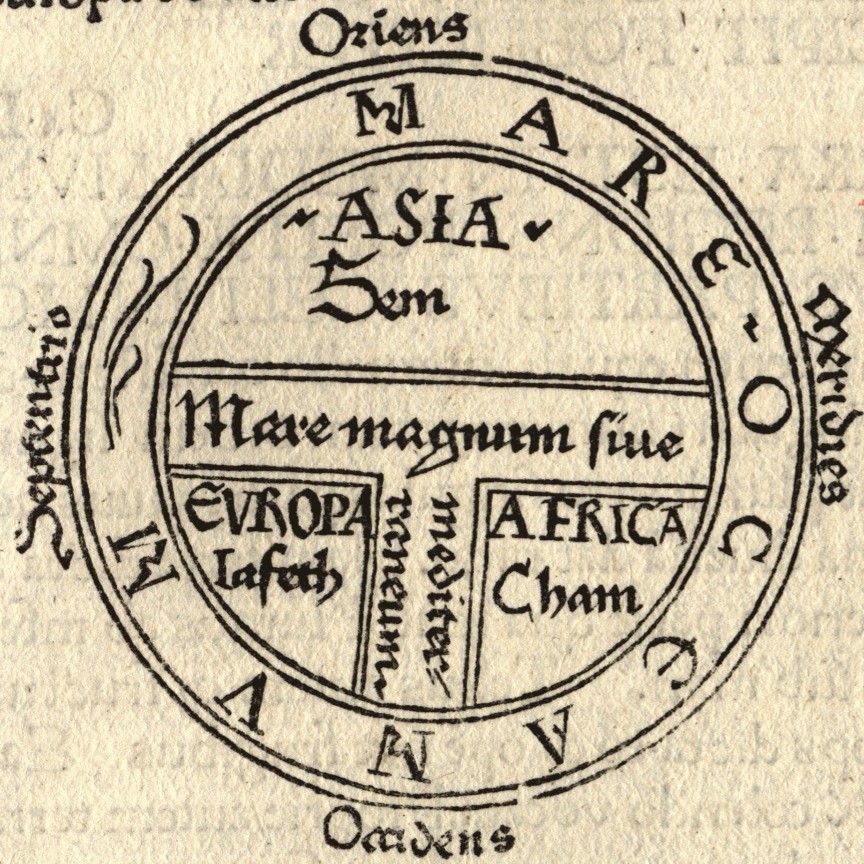
To continue my earlier post on maps, I thought I would go into some of the details of the mappa mundi. As many of you may know, the basic form for these maps is called the T-O map, since the main structure is a "T" inside an "O." The T and O are formed by water, so that the water bounds and shapes and encloses the land, even though the land takes up most of the space and is the focus of the map. The T is the Rivers -- the Mediterranean, the Nile, and the Tanais (i.e. the Don). The O is the ocean, a nameless circle that surrounds the land. The T also separates the continents, with Asia on top, Europe on the bottom left, and Africa on the bottom right. You can see in the above map that each continent is associated with one of Noah's sons: Asia with Sem (Shem), Europe with Iafeth (Japheth), and Africa with Cham (Ham). Jerusalem is at the middle of these maps, where the rivers and continents meet. This location means that Jerusalem was literally the center of the world, the most central and important location available. Move further from that center and things get . . . stranger. On the edges of the map are the so-called monstrous races. Human-like creatures with single feet, or with no heads, or with dog heads, populate the margins of the earth, far from Jerusalem and yet still part of the landed realms. An early (and still very informative) work about the monstrous races is John Bloch Friedman's The Monstrous Races in Medieval Art and Thought. There's also much interesting work being done on the placement of Great Britain on these maps, and more still to do. Both Asa Simon Mittman and Kathy Lavezzo have discussed the meaning for England, and English map-makers, that Great Britain is also on the edge of the world in these maps, and I suggest their work to those interested in the topic.
When I teach these maps, I try to get the students to discover the ways in which modern maps are constructed as well. We look at modern maps and discuss the things that aren't directly representative of the geography the maps depict. We talk about those things we've naturalized to the point of thinking they're just true. Since the aspect that surprises the students the most about medieval maps is that Asia is on top, I like to show them an Australian map which flips our normal sense of north as up. I ask why north is on top other than the fact that we've always seen it that way. Who decided? Maybe the fact that compasses point north (for now) had something to do with it, but it still has become the normal depiction to the point that most people think it's somehow natural. The "upside-down map" looks strange, the shapes of the continents unfamiliar, and this defamiliarization is useful for a number of reasons. One is that it helps us to see the geography anew, to attend to the details, since we rarely look as closely at the familiar (like the art assignment where students draw the human face upside-down). Another is that it allows us to think through the implications of the choices the mapmaker has made. What does it mean for north to be on top? What does it mean for Europe to be in the center? What does it mean to choose a projection which contracts and expands different parts of the world? I'm reminded of an episode of West Wing in which "The Organization of Cartographers for Social Equality" take their case to C.J. Cregg. At first, she laughs at the idea of maps having anything to do with social justice. But they show her how different projections alter the image of the earth, and her jaw drops as she realizes that they have a point.
Maybe I'll show that clip next time I teach this material.In any case, looking at different projections and different versions of world maps is a useful exercise, and we're all more ready to discuss the mappae mundi when we return to them. Yes, they're strange, but they're not stupid. And there's nothing inherently wrong with putting east on top. The verb orient comes from the fact that maps were originally oriented to the East (the Orient).
There is much to say about all of this, but I want to focus here on what is barely apparent on the maps: the ocean. Though the ocean forms the "O" and bounds the circle of the land, it nonetheless takes up very little space on the maps. We moderns, used to maps that depict the ocean as more than 70% of the earth's surface, may be surprised to see just how little ocean there is on these medieval world maps. I argue that this is not because medieval mapmakers misunderstood the ocean's vastness, but rather because their maps were ideological, encyclopedic, and aesthetic creations, and the ocean's place around the edges suited these purposes. It left the map symmetrical, but also left the land, and therefore those things that had happened on land, as the primary focus. The land in these maps is covered in classical and biblical and historical details associated with the various spaces on the earth. Humans are at the center of this narrative, and the land is humanity's realm.
There were other kinds of maps for navigating the ocean, and portolan charts helped seafarers from the 13th century on. The fact that mappae mundi and navigational maps were being produced simultaneously indicates that neither was meant to supersede or replace the other; they were simply for different purposes. The mappae mundi did precisely what they were meant to do -- they gave order to geographical and historical and spiritual information. And the land, and all of the things that had happened there in human history, was the focal point. The ocean is an unmarked space surrounding and outside of the land, more marginal indeed than the monsters that populate the edges of the world. The story is on the land, not the ocean, and thus the ocean depicts nothing; it is simply there to gird the earth. Unlike land, the ocean's topography cannot be marked or altered. It's both vast and unaffected (unaffectable) by humans. The contours of the ocean are ever-changing waves. How can you point to a historical location on the shifting contours of the water? How do you make your presence known to later people when you're floating on the sea? Humans may venture out onto the waters of the world in little wooden vessels, but these vessels will either be brought back to harbor or they will sink into the deep. (See my last post on Titanic for more about that.) No man-made contraptions can stay on the ocean's surface, none can leave a trace of human presence except in the depths of the ocean floor, subsumed by the ocean itself.
So the ocean is a blank space on these mappae mundi. It does not partake in the narrative domain of the land, nor does it participate in the historical or ideological aims of the land. It is a realm apart.
When I teach these maps, I try to get the students to discover the ways in which modern maps are constructed as well. We look at modern maps and discuss the things that aren't directly representative of the geography the maps depict. We talk about those things we've naturalized to the point of thinking they're just true. Since the aspect that surprises the students the most about medieval maps is that Asia is on top, I like to show them an Australian map which flips our normal sense of north as up. I ask why north is on top other than the fact that we've always seen it that way. Who decided? Maybe the fact that compasses point north (for now) had something to do with it, but it still has become the normal depiction to the point that most people think it's somehow natural. The "upside-down map" looks strange, the shapes of the continents unfamiliar, and this defamiliarization is useful for a number of reasons. One is that it helps us to see the geography anew, to attend to the details, since we rarely look as closely at the familiar (like the art assignment where students draw the human face upside-down). Another is that it allows us to think through the implications of the choices the mapmaker has made. What does it mean for north to be on top? What does it mean for Europe to be in the center? What does it mean to choose a projection which contracts and expands different parts of the world? I'm reminded of an episode of West Wing in which "The Organization of Cartographers for Social Equality" take their case to C.J. Cregg. At first, she laughs at the idea of maps having anything to do with social justice. But they show her how different projections alter the image of the earth, and her jaw drops as she realizes that they have a point.
Maybe I'll show that clip next time I teach this material.In any case, looking at different projections and different versions of world maps is a useful exercise, and we're all more ready to discuss the mappae mundi when we return to them. Yes, they're strange, but they're not stupid. And there's nothing inherently wrong with putting east on top. The verb orient comes from the fact that maps were originally oriented to the East (the Orient).
There is much to say about all of this, but I want to focus here on what is barely apparent on the maps: the ocean. Though the ocean forms the "O" and bounds the circle of the land, it nonetheless takes up very little space on the maps. We moderns, used to maps that depict the ocean as more than 70% of the earth's surface, may be surprised to see just how little ocean there is on these medieval world maps. I argue that this is not because medieval mapmakers misunderstood the ocean's vastness, but rather because their maps were ideological, encyclopedic, and aesthetic creations, and the ocean's place around the edges suited these purposes. It left the map symmetrical, but also left the land, and therefore those things that had happened on land, as the primary focus. The land in these maps is covered in classical and biblical and historical details associated with the various spaces on the earth. Humans are at the center of this narrative, and the land is humanity's realm.
There were other kinds of maps for navigating the ocean, and portolan charts helped seafarers from the 13th century on. The fact that mappae mundi and navigational maps were being produced simultaneously indicates that neither was meant to supersede or replace the other; they were simply for different purposes. The mappae mundi did precisely what they were meant to do -- they gave order to geographical and historical and spiritual information. And the land, and all of the things that had happened there in human history, was the focal point. The ocean is an unmarked space surrounding and outside of the land, more marginal indeed than the monsters that populate the edges of the world. The story is on the land, not the ocean, and thus the ocean depicts nothing; it is simply there to gird the earth. Unlike land, the ocean's topography cannot be marked or altered. It's both vast and unaffected (unaffectable) by humans. The contours of the ocean are ever-changing waves. How can you point to a historical location on the shifting contours of the water? How do you make your presence known to later people when you're floating on the sea? Humans may venture out onto the waters of the world in little wooden vessels, but these vessels will either be brought back to harbor or they will sink into the deep. (See my last post on Titanic for more about that.) No man-made contraptions can stay on the ocean's surface, none can leave a trace of human presence except in the depths of the ocean floor, subsumed by the ocean itself.
So the ocean is a blank space on these mappae mundi. It does not partake in the narrative domain of the land, nor does it participate in the historical or ideological aims of the land. It is a realm apart.
Labels:
cartography,
Friedman,
geography,
Lavezzo,
mappa mundi,
medieval,
medieval maps,
Middle Ages,
Mittman,
narrative,
ocean,
portolan charts,
sea,
teaching,
topography,
West Wing
Saturday, April 14, 2012
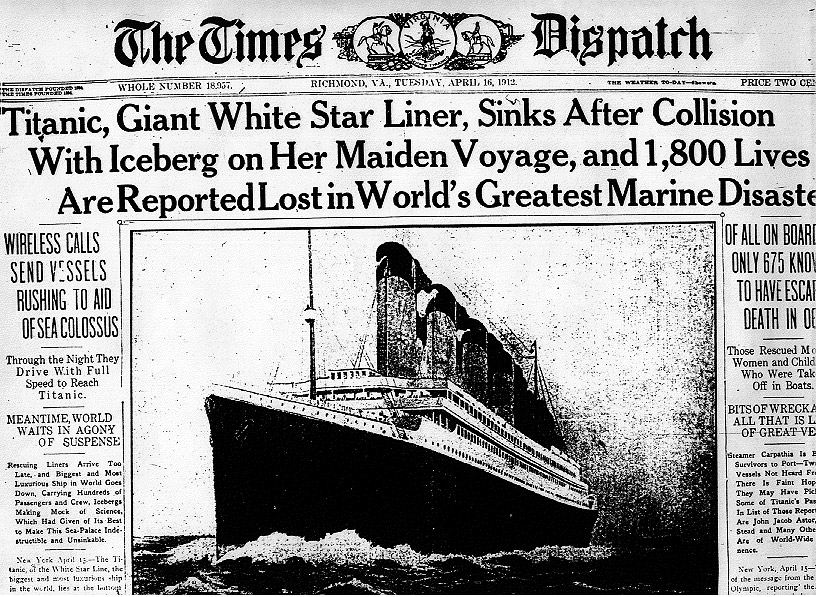
Dredging up the Past: Titanic and the Body of Memory
I just saw Titanic in 3D. I hadn't thought much about going to see it, and had even laughed at this rerelease as an easy money-making endeavor. Yet when some friends asked me to join, I went. I hadn't seen the film since it was in theaters the last time, before it won too many awards and became a parody of itself (i.e. "I'm king of the wooorld!"). I saw it on my first real date, cliche as that may be, and watched it with a mixed response. For the teenaged me, it was sad and awkward and romantic and manipulatively emotional. Then, as now, I loved the costumes. Even then, though I enjoyed the movie, I felt inklings of things I noticed this evening. I could talk, for instance, about the probably well-meaning but not very subtle way in which the film attempts to engage with issues of class or gender. The way that the rollicking party below decks lets us know that people with less money are more authentic, or at least more fun. The way that Rose's mother declares that women's choices are never easy just as she pulls Rose's corset strings tight. Yet something else caught my attention tonight, something I'd missed completely before. Seeing it after all these years, I still remembered the main Rose and Jack plot quite clearly, but the frame narrative hadn't stuck with me as well. Yet tonight I was fascinated by that frame.
The film opens with images of the submerged ship. Mundane objects are strewn about the ocean floor, the only testament to the lived experience of that drowned and broken metal hull. Eyeglasses, a baby-doll, a pair of boots exist in ghostly perpetuity, everyday items made strange by their decontextualization. The ocean, these objects seem to say, is not the natural realm for humans. It swallows us up. Unlike the topography on land, which can be marked by people, the contours of the sea shift continuously, and we can either float to shore or sink to the sandy depths. One must delve deep, quite literally, in order to find any traces of human existence in the ocean. The crew that opens the film, seeking history, fame, and fortune in the wreck, can reconstruct the sinking via computer, but they can't really understand it. They only see material value when they look at the submerged debris. As their inability to interpret the underwater landscape becomes apparent, a drawing of a young woman slowly emerges. They're not sure what to make of that either, except that the woman in the drawing is wearing the costly diamond they want to find.
It is at this point that a sweet elderly woman enters the picture, as if the re-emerged drawing had conjured her from the depths. She joins the crew and tells them all about her memories of the night the Titanic went down. Their fancy equipment can't help them to really understand, but this ancient lady appears just in time to interpret the objects and events for them. All of our images of the original ship and crew and passengers are through this elderly Rose's memory. The primary narrative is therefore invoked by her verbal recollections. For someone who has never spoken of the events before, who never even told her family about Jack, this lady sure can tell her story without a stutter. The men, who've only looked at the wreck for the fortune it could bring them, sit transfixed. They finally see the Titanic.
All of this reminds me of the Middle English poem Saint Erkenwald, which tells the story of an excavation that unearths an ancient tomb. As builders erect a cathedral atop the ruins of a pagan temple, they find a mysterious sarcophagus marked with ancient script. I think it's no accident that this image of palimpsestic architecture unearths such a living relic. While trying to build over history, the workers dig it back up in the form of this strange tomb. All of the most learned men attempt to read the mysterious writing on the tomb and to interpret its meaning. They look at the garments of the body inside the tomb and make conjectures about who he was, perplexed that none of their chronicles mention such a person. None of them can figure it out. As they begin to give into their frustration, they call in Bishop Erkenwald. He prays for guidance, and the long-dead judge buried inside the tomb arises and tells his story from the grave, explaining to them who he was and when he lived. And they finally understand. Erkenwald's understanding and empathy for the dead pagan man get represented physically in the tear he sheds upon learning that the good judge has been in hell all these years, and that tear serves as a kind of baptism that allows the judge's body to dissolve and his soul to rise to heaven. I never understood how the judge can speak English (or some language that the people recognize) when the writing on his tomb is in a language so foreign as to be completely unknown. But that is, I guess, beside the point. The material object from the past is illegible, even the writing from the past is unreadable, so the past needs to be literally revived in order to tell its own story. The resuscitated body of the past can help the people understand in a way that objects and letters never could. Or perhaps the revived body is representative of our attempts to get at that past via the objects and narratives we have. As Christine Chism argues in Alliterative Revivals, "death grants ghosts an interrogative force, imbuing the impossible, unceasing communication between the dead and the living, the past and the present with fearful intimacy" (1). The past is zombie-like in such texts; it rises from the grave and speaks aloud in order that we may hear it.
Though this film is quite different from that Middle English poem, it nonetheless features a past that becomes accessible through a figure emerging and speaking for it. The shot of young Rose's eye morphing into old Rose's eye (again, the film is not trying to be subtle) depicts the direct and physical link between the experience of the sinking ship and the story being narrated today. Though all is mediated via Rose's perspective and memory of long-past events, I suppose we are meant to trust her. If we have any doubts, the fact that she appears at the end with the diamond indicates that she's been conveying the events accurately. She's someone interested in tangible recollections, someone who carries all of her photographs with her when she travels. Yet she admits that she has no photograph of Jack, that there's no record of Jack. He lives on only in her memory. Jack has sunk deep into the sea, not to be brought back to the surface except through Rose's words. For the duration of her tale, the living, breathing, steaming love story can resurface. The captain and Mr Andrews and all the people above and below decks can breathe and speak and live and die as they did so many years ago.
The film could have simply told the story without the frame. It could have begun with Rose and Jack getting on the ship and ended with Jack's death or Rose's survival. It could have even been made from Rose's current perspective, but only in private recollection or more vaguely to us the viewers. Instead, the frame is of people today explicitly seeking something in the wreck and finding it in the person of an old women who once walked the decks of the ship they search. The past emerges bodily and memory is conveyed in color and sound and state-of-the-art special effects. Rose even opens with a description of the smell of fresh paint aboard the ship, a sensory contrast to the rusted and peeling metal we see today. When elderly Rose is finished with her tale, she can finally return to Titanic and to Jack, in dreams or perhaps in death. The narrative has not only brought those around to the ship, but it has returned her to it as well. She rose from the wreckage to tell the story, and then returned to it, along with her heart-shaped necklace.
The past, like the ocean, is never fully accessible to us. We can try to see what lies beneath the waves and we can pull a few things up to the surface, but it is never completely in reach. As a medieval scholar, I understand the frustrations of trying to access the past. And there is no one alive from the 14th century to tell me about it. The image of a body from the past emerging to speak to us is a tantalizing fantasy, as even people's narrations of the past can't actually take us there. Yet it's a fantasy that speaks to our continued longing to plumb those depths, to understand what lies beneath and beyond our own existence as we pass over the same land and through the same waters as people of long ago.
As I sit watching the same film as I did 15 years ago, I see the impossibility of fully understanding or reliving the past, even when that past is my own. On a superficial level, the film is now rendered 3-dimensional, but time has wrought its changes on me as a viewer as well. I notice different things and respond in different ways. My colleagues and I discussed the ways in which films and viewers have changed more broadly. My friend Amanda noted that this movie is situated in its time and place. Post-9-11, its disaster narrative would have meant something very different than it did to us all in 1997. Now we picture the twin towers or think about the socioeconomic realities that allowed some to escape Hurricane Katrina while others could not. I look at pictures of flood and remember the horrifying images from Japan after the recent earthquakes there. The film, already a heavily mediated image of history, is now filtered through all the disasters we've witnessed on the evening news in the past decade and a half. All of these connections make the film and the history it attempts to depict both more and less immediate. And yet it remains as an artifact and we engage with it and with both Roses and with our past selves as we sit in the theater. And we narrate the memories of our previous experiences with the film even as the film gives memory a tangible existence in the person of an elderly lady with a story to tell.
The film opens with images of the submerged ship. Mundane objects are strewn about the ocean floor, the only testament to the lived experience of that drowned and broken metal hull. Eyeglasses, a baby-doll, a pair of boots exist in ghostly perpetuity, everyday items made strange by their decontextualization. The ocean, these objects seem to say, is not the natural realm for humans. It swallows us up. Unlike the topography on land, which can be marked by people, the contours of the sea shift continuously, and we can either float to shore or sink to the sandy depths. One must delve deep, quite literally, in order to find any traces of human existence in the ocean. The crew that opens the film, seeking history, fame, and fortune in the wreck, can reconstruct the sinking via computer, but they can't really understand it. They only see material value when they look at the submerged debris. As their inability to interpret the underwater landscape becomes apparent, a drawing of a young woman slowly emerges. They're not sure what to make of that either, except that the woman in the drawing is wearing the costly diamond they want to find.
It is at this point that a sweet elderly woman enters the picture, as if the re-emerged drawing had conjured her from the depths. She joins the crew and tells them all about her memories of the night the Titanic went down. Their fancy equipment can't help them to really understand, but this ancient lady appears just in time to interpret the objects and events for them. All of our images of the original ship and crew and passengers are through this elderly Rose's memory. The primary narrative is therefore invoked by her verbal recollections. For someone who has never spoken of the events before, who never even told her family about Jack, this lady sure can tell her story without a stutter. The men, who've only looked at the wreck for the fortune it could bring them, sit transfixed. They finally see the Titanic.
All of this reminds me of the Middle English poem Saint Erkenwald, which tells the story of an excavation that unearths an ancient tomb. As builders erect a cathedral atop the ruins of a pagan temple, they find a mysterious sarcophagus marked with ancient script. I think it's no accident that this image of palimpsestic architecture unearths such a living relic. While trying to build over history, the workers dig it back up in the form of this strange tomb. All of the most learned men attempt to read the mysterious writing on the tomb and to interpret its meaning. They look at the garments of the body inside the tomb and make conjectures about who he was, perplexed that none of their chronicles mention such a person. None of them can figure it out. As they begin to give into their frustration, they call in Bishop Erkenwald. He prays for guidance, and the long-dead judge buried inside the tomb arises and tells his story from the grave, explaining to them who he was and when he lived. And they finally understand. Erkenwald's understanding and empathy for the dead pagan man get represented physically in the tear he sheds upon learning that the good judge has been in hell all these years, and that tear serves as a kind of baptism that allows the judge's body to dissolve and his soul to rise to heaven. I never understood how the judge can speak English (or some language that the people recognize) when the writing on his tomb is in a language so foreign as to be completely unknown. But that is, I guess, beside the point. The material object from the past is illegible, even the writing from the past is unreadable, so the past needs to be literally revived in order to tell its own story. The resuscitated body of the past can help the people understand in a way that objects and letters never could. Or perhaps the revived body is representative of our attempts to get at that past via the objects and narratives we have. As Christine Chism argues in Alliterative Revivals, "death grants ghosts an interrogative force, imbuing the impossible, unceasing communication between the dead and the living, the past and the present with fearful intimacy" (1). The past is zombie-like in such texts; it rises from the grave and speaks aloud in order that we may hear it.
Though this film is quite different from that Middle English poem, it nonetheless features a past that becomes accessible through a figure emerging and speaking for it. The shot of young Rose's eye morphing into old Rose's eye (again, the film is not trying to be subtle) depicts the direct and physical link between the experience of the sinking ship and the story being narrated today. Though all is mediated via Rose's perspective and memory of long-past events, I suppose we are meant to trust her. If we have any doubts, the fact that she appears at the end with the diamond indicates that she's been conveying the events accurately. She's someone interested in tangible recollections, someone who carries all of her photographs with her when she travels. Yet she admits that she has no photograph of Jack, that there's no record of Jack. He lives on only in her memory. Jack has sunk deep into the sea, not to be brought back to the surface except through Rose's words. For the duration of her tale, the living, breathing, steaming love story can resurface. The captain and Mr Andrews and all the people above and below decks can breathe and speak and live and die as they did so many years ago.
The film could have simply told the story without the frame. It could have begun with Rose and Jack getting on the ship and ended with Jack's death or Rose's survival. It could have even been made from Rose's current perspective, but only in private recollection or more vaguely to us the viewers. Instead, the frame is of people today explicitly seeking something in the wreck and finding it in the person of an old women who once walked the decks of the ship they search. The past emerges bodily and memory is conveyed in color and sound and state-of-the-art special effects. Rose even opens with a description of the smell of fresh paint aboard the ship, a sensory contrast to the rusted and peeling metal we see today. When elderly Rose is finished with her tale, she can finally return to Titanic and to Jack, in dreams or perhaps in death. The narrative has not only brought those around to the ship, but it has returned her to it as well. She rose from the wreckage to tell the story, and then returned to it, along with her heart-shaped necklace.
The past, like the ocean, is never fully accessible to us. We can try to see what lies beneath the waves and we can pull a few things up to the surface, but it is never completely in reach. As a medieval scholar, I understand the frustrations of trying to access the past. And there is no one alive from the 14th century to tell me about it. The image of a body from the past emerging to speak to us is a tantalizing fantasy, as even people's narrations of the past can't actually take us there. Yet it's a fantasy that speaks to our continued longing to plumb those depths, to understand what lies beneath and beyond our own existence as we pass over the same land and through the same waters as people of long ago.
As I sit watching the same film as I did 15 years ago, I see the impossibility of fully understanding or reliving the past, even when that past is my own. On a superficial level, the film is now rendered 3-dimensional, but time has wrought its changes on me as a viewer as well. I notice different things and respond in different ways. My colleagues and I discussed the ways in which films and viewers have changed more broadly. My friend Amanda noted that this movie is situated in its time and place. Post-9-11, its disaster narrative would have meant something very different than it did to us all in 1997. Now we picture the twin towers or think about the socioeconomic realities that allowed some to escape Hurricane Katrina while others could not. I look at pictures of flood and remember the horrifying images from Japan after the recent earthquakes there. The film, already a heavily mediated image of history, is now filtered through all the disasters we've witnessed on the evening news in the past decade and a half. All of these connections make the film and the history it attempts to depict both more and less immediate. And yet it remains as an artifact and we engage with it and with both Roses and with our past selves as we sit in the theater. And we narrate the memories of our previous experiences with the film even as the film gives memory a tangible existence in the person of an elderly lady with a story to tell.
Labels:
14th century,
9-11,
alliterative revivals,
body,
Chism,
disaster,
Erkenwald,
film,
history,
Hurricane Katrina,
medieval,
memory,
middle english,
narrative,
ocean,
sea,
shipwreck,
St. Erkenwald,
Titanic
Tuesday, April 3, 2012
"And we all shine on . . ."
A lot has happened since I last wrote, and I have a list of posts (on dissertating, on NEMLA) that I plan on submitting to the blog very soon.
For now, however, I want to talk about something else. Two years ago today, my beloved father-in-law passed away. This anniversary is hitting me particularly hard, so I don't honestly have all that much that I can say right now -- words aren't coming that easily, and there are so many stories that I could tell. Too many for a single post though, and they deserve more justice than I can give to them right now.
What I do want to announce, however, is that my incredible mother-in-law has written a beautiful book about Mark, and it's going to be released tomorrow. It's called The Humanity of Medicine: A Journey from Boyhood to Manhood, and you can find it here.
For those of you who don't know, Mark survived what should have been terminal cancer as teenager, and went on to have a miraculously long and rich life. He was diagnosed again with malignant melanoma in October 2009, and while the months (and especially the weeks leading up to his passing) were among the most brutal our family has ever experienced, I will never forget what he told us when we saw him shortly after the diagnosis. He reminded us, in his gentle way, of all the cards stacked against him throughout his life. He was told he wouldn't survive cancer as an eighteen-year-old, and yet he did. He was then told that he wouldn't have children because of the chemo, but he went on to marry the love of his life and they have not one, but three amazing kids. He was told he wouldn't live long, but he lived cancer-free for about thirty years. He reminded us of all of these things, and he told us that he was going to fight hard to beat the cancer again, just as he did before; but if it turned out that this was his time, he told us that in his mind he felt he'd already lived a truly blessed and rich life. Here he was, facing down his own fears and confronting them with grace, but also finding a way to lead his family through the storm; truth be told, he never stopped being a healer, not even on his death bed . . . one of his last lucid conversations involved him asking his doctor (who had known him a long time) how she was holding up. He somehow found it within himself to be strong in the face of immeasurable sorrow and fear -- and not even just then, in 2009, but throughout his entire life. He chose to live his life by looking forward rather than over his shoulder, and that was, in no small part, what he sought to give and instill in all of us in the last months that we were able to spend with him.
I can't express how glad I am that this book is going being released tomorrow. I just made the discovery a few moments ago, and it struck an immediate chord. Loudly and clearly, it reminded me to spend tomorrow/today trying not just to remember and grieve for the amazing person I was so blessed to know, but to live by his example, to try -- as best I can -- to "take a sad song and make it better" (Mark's motto). Because truthfully, we control precious little in this life. The only thing we seem to have any control over is the way in which we digest and respond to our circumstances. True joy lies within those choices -- even in the face of sorrow and loss. This was a truth that Mark knew deeply and well, and I hope that I can do him proud by striving to live in that awareness.
Subscribe to:
Posts (Atom)