Showing posts with label conference paper. Show all posts

Tuesday, May 26, 2015

Writing Across Time and Space: My Paper about Elaine of Astolat at Kalamazoo 2015

*Before you read my Kalamazoo post, check out Kate's excellent Kalamazoo 2015 Round-up.*

I am just now recovering from the joyful exhaustion that characterizes the International Congress on Medieval Studies. Each year brings a more hectic schedule of events and reunions to the congress, with more people to see and more people I don't see enough. It always reminds me how lucky I am to be a part of such a wonderful and inclusive academic community. This congress was especially delightful and especially tiring. It's been a busy year for me so far. For those who don't yet know, I have some exciting news -- I've accepted a tenure-track position at Lyndon State College in Vermont, and I am focusing on finishing my dissertation and preparing to move. Perhaps, then, it makes sense that my Kalamazoo paper dealt with anxieties about writing and traveling. I presented on Elaine of Astolat, a woman who goes to great lengths to ensure that her words travel where/how she wants them to even after her death. I presented on a panel called "Sacred and Secular Road Trips in Middle English Romance," presided over by Eve Salisbury and organized by David Eugene Clark, Gina Marie Hurley, and Justin Lynn Barker. My panel was fantastic, featuring my co-blogger Leila (Kate) Norako, who presented on Virtual Pilgrimage, Elizabeth A. Williamsen, who presented on Sir Isumbras, and Amber Dove-Clark, who presented on Guy of Warwick.

My paper was called "Ascolat to Camelot, Guildford to Winchester: Narrative Travel in Malory’s Morte d'Arthur," and I've only just begin thinking on the topic. The q and a really gave me a lot of ideas, so the paper I give you here only represents my initial sketches on the geotemporalty in Elaine's story. Any ideas, questions, or critiques would be very welcome.

 *     *     *     *     *     *     *     *     *     *     *     *     *

Arthur Rackham image (1917)
courtesy of the Camelot Project
Elaine of Astolat may be dead, but she seems to be everywhere. Even as I speak, she is wending her watery way across the walls of museums, poster stores, and college dorm rooms worldwide. Her mythic status both fixes and unfixes her in time, allowing her to be always setting out for Camelot, always floating there, always arriving. She lives in the romance world and moves in romance time. Yet Malory's version of her tale connects her romance rivertrip from Ascolat to Camelot with real places, as Malory clarifies that Ascolat corresponds to contemporary Guildford and Camelot to Winchester. Elaine’s journey is a moment of geographical specificity in a text that often unfolds in a geotemporal haze. Her journey, despite its more fantastical elements, is granted a sense of real possibility, since the trip from Guildford to Winchester can be traced on a map. Guildford and Ascolat share the same ground, bringing the romance world and the historical world into startling proximity. Ever since Geoffrey of Monmouth, and perhaps before, Arthurian narrative has been sitting on the line between history and literature. How many of us have received questions from well-meaning friends and family members about whether or not Arthur was real? But the dynamic tension between history and romance takes new significance in Malory's version of Elaine's story, since her journey collapses clear boundaries between image and word, passive and active, here and gone.

I connect this overlapping with medieval world maps, in which historical timelines are arranged geographically, the meaning of each piece of text rooted in spatial relation to other pieces of text. (Here's where Lot's Wife looked back, here's where Alexander the Great camped, etc. [You can find more of my thoughts on medieval maps here and here.]) The visual and narrative are mutually constitutive on these mappae mundi. In Malory, space and time collapse in ways similar to medieval maps, as Elaine’s body and letter are inextricable as she moves through a romance landscape that looks very much like a real one (or, perhaps, a real landscape that looks like romance). Multiple geographies and temporalities overlap as she becomes both visual spectacle and narrative conduit. She chooses to travel by river, a linear, teleological mode of transportation in which currents lead to her destination. She moves into a center of power, and yet asserts her own version of events so strongly that they are literally set in stone on her tomb. I contend that the simultaneity of multiple geographic and temporal modes in Elaine’s story call attention to the complicated and contradictory way in which her most powerful moment is also the end of her life, her most visible moment is also the pinnacle of her narrative authority. The fact that Elaine is most active and authoritative when she is dead and unable to move or speak works well with the convergence of historical and mythic time, since she is static and in motion, an image and a narrative. She embodies her letter, and her body and her story find their resting place in Camelot.

Though Elaine’s story is linear in that she floats from one location to another, Malory’s telling is also cyclical. (Again, like the world maps, which presented a linear narrative in a spatial way.) In essence, we get her story three times (at least) and in different ways. As soon as we meet her, Malory tells us that “she keste such a love unto sir Launcelot that she cowde never withdraw hir loove, wherefore she dyed,” giving us the tragic end to her story before it even begins (623). This particular Elaine exists inside the larger myth of the fair maiden of Astolat. There is thus a cyclical quality to this narrative defined by clear teleology. The tale, which itself has been retold, is retold in the text. The first version is simply part of her introduction, but important because it renders her introduction narrative rather than visual. We learn who she is and what she does (and notice how active these verbs are — she cast her love, she died), but not what she looks like. And, for the first time in her tradition, we get a name for her character, which allows her a subject position to go with all those active verbs. 

As we continue with the largest portion of the narrative, Elaine consistently communicates her own thoughts and wishes. She tells Launcelot (and Gawain, and everyone else, for that matter) directly of her love. She asks Launcelot to wear her favor, and later asks him to be her husband ... or at least her lover. She seeks him in a quest when she takes over Gawain's search, and then she directly interacts with his body as she heals it. Even as she performs the more traditionally feminine role of healer, she is only able to do so because she has taken on a knight's quest given by King Arthur himself. Launcelot's body is the object of both her quest and of her healing. Though her most famous (and most illustrated) voyage is her post-mortem one, she also seeks Launcelot on land (while alive) and succeeds in reaching him where Gawain fails.

Launcelot tries to give her options other than death, but she'll have none of it. He, not seeing the insult in his offer, attempts to provide her with a dowry to marry another, but she responds matter-of-factly: "Alas! Than', seyde she, 'I must dye for youre love'" (638). Her assertion troubles the world of the romance, since she is not imperiled in a way that allows for masculine rescue. As Dorsey Armstrong explains, "the Pentecostal Oath constructs male and female in terms of a binary which opposes active, aggressive masculinity to passive, helpless femininity" (45). Knights gain honor by saving damsels in distress. Yet neither Launcelot nor her brothers nor her father nor anyone else can save her once she asserts her coming demise. Molly Martin has pointed out that Perceval's sister, another lady in a boat, chooses to die in such a way that her brother cannot rescue her, and Elaine’s death is similarly outside of the chivalric system.

Instead, her death forms a new narrative all her own. Walsh notes that "Malory does not let Elaine die offstage, as she does in both the sources" (144). And it is in fact her death (and the related fact that we see her voyage from her perspective and thus vicariously journey with her to Camelot rather than just seeing her arrive) in Malory's version that creates such a strong sense of her character. As Martin points out, "Malory carefully reworks the material surrounding her death to show a particularly active Fayre maydyn creating an image of her own dead body" (154). Knowing that she'll die, she first requests to dictate a letter, and then describes the way in which her father and brother should arrange her body.  All of these requests are meant to prepare a narrative for the court, and all are meant to give her authorial control. The fact that she mentions the letter first means that all arrangements are in terms of that letter. Gawain may send a deathbed missive to Launcelot, but Elaine sends her deathbed. Her deathbed is in fact part of the missive. She requests, "'And whyle my body is hote lat thys letter be put in my ryght honde, and my honde bounde faste to the letter untyll that I be colde" (640). The letter thus provides the link between living and dead maiden. The willful clasp of warm hand will be  followed by the inert touch of cold fingers, but the letter will witness the moment of transition and remain. The further details she requests, to be put on a bed with rich clothes, to be taken to the Thames, and to have her barge covered in black samite, all function as extensions of this request for a written message (640). All these details are meant to be read and understood by the court in conjunction with the letter and to properly convey her version of herself and her story. She'll make a spectacular entrance, but also an epistolary one.

There are a number of ways that she maintains control over her letter. She asks that a mute oarsman row her barge, assuring that someone will be present to ensure the barge goes where she wants but that no one can provide an alternate version of her story. She travels by river, which, unlike an ocean voyage, has a specific direction. If we see the linear movement of the river as historical time, then Elaine's movement in history is brief and tragic. Martin B. Shichtman points out that Elaine “has no real story beyond that which can be summed up in two sentences. Her entrance into the realm of historical time is brief, incomplete, and fatal” (261). And this is certainly true. Yet it's also true that historical time here is not wholly separate from a-historical romance time. Joseph D. Parry discusses the way in which Malory locates Elaine's story in both Guildford, specifically locatable to a 15th century reader, and also Astolat, "a place firmly inscribed in the Arthurian landscape of surprise adventures" (159). He notes that the text "locates the river down which the Fair Maid's funerary procession travels, in two settings. One can locate the river – the Thames . . . in Malory's fifteenth-century world. But Elaine's final river trip is also a journey elevated to mythical status." Her journey thus complicates both spatiality and temporality. Meg Rowland calls Malory's manner of pairing mythical and 15th century locations "pluralistic geography," in conjunction with the coexistence of chronicle and romance time. Elaine's journey functions in such geographically and temporally complex ways. The movement of a river is narrative in itself, and combines the static quality of Elaine's dead body with the narrative quality of her story. Word and image, text and body, fuse as she makes her first and last trip to Camelot. 

As she floats to Camelot, everyone's talking about her, and she is ultimately able to squash all the rumors and give the last word on the subject. At fist, Arthur only notices the spectacle -- the corpse's great beauty and riches -- without understanding its full import. He does observe that "she lay as she had smyled" (640). Sue Ellen Holbrook points out that "the smile . . . is the sign of a soul at rest," and I think this sign is legible to the knights of the court (177). It is the queen who notices the letter and points it out to Arthur and the knights, thus recognizing the body's full narrative potential. The letter then gets a public audience, her version of the story read directly to all. Alan Lupack explains that "her arrival is . . . an elaborately staged performance. … The public display is important because it provides the setting for Elaine's letter" (260). I would even argue that the performance, the spectacle of it all, is part of the letter. Her letter is inextricable from her cold hand, from her beautiful face, from her smile, from her lovely garments, from the strange mode by which she enters the court.

The letter is Malory's third iteration of the Fair Maiden's tale; as a deathbed epistle, Elaine's version of events holds some authority. Malory expands upon this authority by giving us the letter in its entirety:
'Moste noble knyght, my lorde sir Launcelot, now hath dethe made us two at debate for youre love. And I was youre lover, that men called the Fayre Maydyn of Astolate. Therefore unto all ladyes I make my mone, yet for my soule ye pray and bury me at the leste, and offir ye my masse-peny: thys ys my laste requeste. And a clene maydyn I dyed, I take God to wytnesse. And pray for my soule, sir Launcelot, as thou arte pereless.' (641) 
As many critics have noted, this version of her letter differs from those that place blame on Launcelot. Malory's version focuses not on vengeance, but rather on asserting Elaine’s own character and providing her personal narrative. As Georgiana Donavin explains, "Where the letter's narratio, or news, would ordinarily be, there is, instead, her assertion of identity . . . Elaine's subject position is the story in her epistle" (7). She wants a proper burial, she wants a mass-penny, and she wants everyone to know that she loved Launcelot and died a clean maiden. That she wants a mass-penny and prayers for her soul indicates a connection between the body in the barge and the soul of the maiden, even as her earlier deathbed assertion to a priest that she was a worldly woman coincided with preparation for her departure from the world. In short, the journey itself is a boundary collapse between sacred and secular road trips. Thus Elaine can not only assure that her story is understood but she can tell that story in such a way that it will have real efficacy for her, even after her death.

And Elaine's letter certainly rouses the crowd. By the time they call in Launcelot, "the kynge, the quene and all the knyghtes wepte for pité of the dolefull complayntes" (641). Public feeling is on the maiden's side before Launcelot even enters the scene. Even the queen pities Elaine and blames Launcelot. It's telling that even an audience as prejudiced against Elaine as the queen can see the pity in her narrative. It also seems that the queen can’t see outside of the chivalric system, assuming that Launcelot could have saved Elaine somehow, whereas Elaine herself resisted this model. Camelot is the geographical heart of the round table narrative, and the people of the court, epitomized by the queen, live by the chivalric system that Elayne has rejected. When she enters the court, her own identity and story collide with a realm she never knew in life, and her words become part of the official narrative.

Thus, the maiden's tale does not end with her death, but instead with her version of her story. The tale ends with a retelling of itself from her perspective only made possible by her journey in death. This cyclical method of telling a story with such a clearly linear direction (i.e. the river) furthers the complicated way in which Elaine's body and letter function as image-text. Simultaneous cyclical and linear movements render the maiden's story both ever-happening and ever-new, while the contemporary geographical details place it in the past as well. The past tense and the literary present collide and verbs fail to express the temporal possibilities of Malory's version of the tale. Elaine is both a static image and a moving narrative. Just as she has the ability to travel when she can no longer move and to communicate when she can no longer speak, her story is characterized by contradiction.We gain proper nouns to allow Elaine a subject position, but our verb tenses explode between already-happened and always-happening. Disrupting time and space in this way allows her to be fixed and moving, visual and narrative, all at once. Her funeral literally fixes the story she has told in stone and gives both her body and her tale a permanent place in the land to which she sailed.

Wednesday, July 30, 2014

Is that a riddle in your pocket? Apollonius of Tyre and The Third International Congress of the John Gower Society

We had our own watery voyage.
(A boat ride on the Genesee River.)
This summer has combined conferences both far away and very near. I got to travel to Iceland for the New Chaucer Society Conference (about which I'll blog later), and I got to present at home in Rochester at The Third International Congress of the John Gower Society: "John Gower: Language, Cognition, and Performance." Traveling to Iceland was magical, but it was also a joy to welcome scholars from around the world to my own institution. The Gower conference was all that I hoped, combining scholarship, camaraderie, and creativity.

I presented a paper entitled "'Bot in writinge it mai be spoke': Intratextual Desire in Gower's Tale of Apollonius of Tyre." The paper was new topic for me. Just as I'm finishing up my dissertation, this paper helps bring a second project into focus (which also connects to work I've been doing on Elaine of Astolat, the Camelot Project page on whom I published recently). As is inevitable at the beginning of a project, I feel like I need to think through it much more fully, but I'm excited about where it will take me. Despite my nerves, the paper went well. The whole panel fit together beautifully, our ideas mingling in surprising and delightful ways, and the discussion afterward continued throughout the conference. As with the best presentation experiences, I feel like the enthusiasm and questions and discussions I encountered will help me continue to develop my ideas.

For those who aren't familiar with the Tale of Apollonius of Tyre, I recommend reading the tale (just scroll down to line 271 of Confessio Amantis book 8). If you've seen/read Shakespeare's Pericles, then you have a basic sense of the plot. The story begins with a king, Antiochus, who has lost his wife and tries to replace her with his daughter. It's a disturbing beginning, and Gower doesn't shy away from the trauma of the princess as her own father violates her. As suitors begin to vie for the princess's hand, Antiochus devises an impossible riddle for them to answer.  Many suitors try, and many suitors fail. Finally, Apollonius arrives to try his hand at the riddle. He correctly guesses that the answer is the
Gower's main hobby is shooting the world.
He's basically the opposite of Atlas.
incest between Antiochus and his daughter, but this correct guess sends him running for his life. After many adventures, he lands on Pentapolis, where he gets a position as tutor to the king's daughter. Many suitors are vying for this princess's hand as well, but this father tries to facilitate his daughter's marriage. He asks the suitors to write bills, which the princess will read and compare. The princess, however, has fallen in love with Apollonius and is ill with lovesickness. The king is worried about his daughter, and she writes him a letter explaining her condition. The king brings the letter first to his wife and then to Apollonius, carefully arranging the marriage his daughter wants. Apollonius and the princess are married and the princess soon becomes pregnant, a sure sign that things are going well. When they hear that Antiochus and his daughter have been destroyed in a storm and it is safe for Apollonius to return home to Tyre, it almost seems like we've reached a happy ending. But there are a lot of lines, and a lot of troubles, left in the tale. While sailing to Tyre, the princess gives birth to a baby girl but dies in chil
dbirth. Apollonius, heartbroken over the loss of his wife, puts her in a coffin with jewels and a letter begging for her proper burial and then sends the coffin to sea. The coffin, miraculously, reaches land, and, even more miraculously, the clerk who reads the letter discovers that the princess is only mostly dead. Reviving her and hearing her story, he sets her up for the chaste life she requests. A lot more happens in the story, and we get wonderful adventures of the daughter as she grows up as well, but this brief summary will get us through the parts of the tale I had time to discuss in my paper.

I began outside the tale (and a few hundred years earlier), with riddle 44 from the Exeter Book: 
Swings by his thigh a thing most magical!
Below the belt, beneath the folds

of his clothes it hangs, a hole in its front end, 
stiff-set & stout, but swivels about.

Levelling the head of this hanging instrument,
its wielder hoists his hem above the knee:
it is his will to fill a well-known hole
that it fits fully when at full length.   


He has often filled it before. Now he fills it again.1
The answer, of course, is a key. What, were you thinking something else? The moment where the room shares a stifled laugh and represses the obvious dirty answer in favor of thinking through less obvious and more innocuous possibilities is the heart of such riddles. The pleasure lies in the simultaneity of the answer we don’t say and the one that we do.

The riddle at the beginning of Apollonius of Tyre, on the other hand, distorts this tradition by denying the pleasures of the genre. Antiochus gives suitors a riddle in which the sexual answer is correct. Centuries of riddles would suggest that there must be a clever trick here, but there isn’t. And yet speaking the real answer is a dangerous option as well. To declare publically that the king and his daughter share an incestuous relationship seems a good way to separate your head from your shoulders. No wonder so many suitors get it wrong. This twisted form of a twisted genre is well-suited to such a taboo desire as the king’s for his daughter.

The riddle in Apollonius of Tyre is the first of many expressions of as many varieties of desire. Characters in the text articulate their desires by crystallizing them in language. I argue that the genre that each linguistic expression takes directly represents the type of desire being expressed. From the opening incestuous riddle to the body wrapped lovingly in a letter, characters solidify their desires in language that can then be examined and distributed. At each instance of linguistic desire, language takes on a more corporeal quality, until letter and body are interconnected. Throughout the tale, then, language does not merely convey emotion, but embodies it, rendering it both tangible and communicable. Like the key from our opening riddle, language is both the thing to be unlocked and the means to unlock it; it is a passageway between the private and the public, one’s one thoughts and desires and the rest of the world. The fact that the genres of the linguistic expressions I discuss match the desires they communicate gives language an increasing material reality that renders it increasingly productive.

The tale begins with an inappropriate and traumatic desire, that of a father for his own daughter. The private world that Antiochus creates for himself, in which he may do as he pleases, is a world where desires cannot be clearly articulated. As María Bullón-Fernández explains, “incest is equated not just with ignorance but also with secrecy; can keep being performed as long as it is kept private” (49).2 Antiochus’s daughter weeps, but doesn’t know how to express herself so that he will hear her. Afterward, “sche lay stille, and of this thing,/ Withinne hirself such sorghe made” (314-15). The daughter’s emotions and desires become trapped in her motionless, soundless body. Not only is she silent, but R.F. Yeager points out “that Antiochus's daughter has no name, in a tale in which even the least servants and functionaries … are made known. … Thus the namelessness of Antiochus's daughter … bears a message we should ponder: that … sexual gluttony has no acceptable side” (228).3 Although the second princess, whom I will discuss later, also has no name, namelessness here seems to deny the princess any possibility of a subject position. She has no language; she cannot articulate her position. 


As offspring becomes consumed by progenitor, desire feeding upon that which it engendered, it’s fitting that the verbal form for these forbidden feelings is a riddle, a tricky trap of language to represent something to taboo to express. If, as Yeager suggests, “sexual gluttony has no acceptable side,” then it makes sense that its linguistic representation is a genre that both reveals and conceals. Antiochus recites, 

'With felonie I am upbore,
I ete and have it noght forbore
Mi modres fleissh, whos housebonde
Mi fader for to seche I fonde,
Which is the sone ek of my wif.
Hierof I am inquisitif;
And who that can mi tale save,
Al quyt he schal my doghter have;
Of his ansuere and if he faile,
He schal be ded withoute faile.' (405-14) 
The riddle puts the desire itself into first person. If the “I” is Antiochus himself, then by sexually consuming his daughter he renders himself his own father-in-law and thus his daughter becomes his mother-in-law. His daughter is his wife is his mother. Family titles multiply to the point of chaos. As Gary Lim explains, "While the riddle evokes familiar subject positions of the family … these terms are thrown into an incomprehensible jumble, except when incest is offered as an interpretive key. Yet if incest indeed governs these relations, it would render the conventionally accepted significance of these subject positions meaningless” (334).4 According to Larry Scanlon, the pleasure of riddles “lies in drawing a single, unambiguous solution out of what initially appears to be an irresolvable confusion. Thus, though they are founded on the possibility of instability, they depend just as much on the capacity of language to stabilize meaning as they do on the capacity to destabilize. In this riddle, by contrast, instability is all” (124).5

Although the riddle is difficult to parse, as family titles multiply and feed back on themselves, there is something inherently incestuous about it. Unlike riddles like the key from the Exeter book, this one is uncomfortably suggestive precisely so that no one would guess the answer. Even Apollonius never mentions the word incest, only stating that 

‘The question which thou hast spoke,
If thou wolt that it be unloke,
It toucheth al the priveté
Betwen thin oghne child and thee.’ (423-6) 
The answer to the riddle is that the answer is a secret. The riddle represents something that can be unlocked, but that perhaps shouldn’t be, a private space of taboo that can only be put into language when that language resists naming it. Bullón-Fernández points out that “the moment of incest might seem to have assumed a nature/culture opposition, or an opposition between the pre-linguistic and the linguistic, … Such an assumption postulates the existence of an original ‘natural’ state that culture acts upon,” but she argues that  “It is impossible … to go back to that origin, because … the moment we try to conceptualize an original moment, a moment before language, we must use language” and thus Antiochus’s “actions are thus not pre-legal or prelinguistic; rather, they change the existing law and they produce a new type of discourse, the riddle” (59; 60).6 This inextricability of language, prohibition, and transgression suits the riddle well, since its very messiness marks it as a link between the desire, the inexpressibility of the desire, and the desire’s expression. If desires are not prediscursive, then it makes sense that linguistic expressions in this tale fundamentally embody the desires of the characters who voice them.

After Apollonius, right about the riddle and yet running for his life, makes his way to Pentapolis, we get is very different scene of wooing. The bills created by suitors for the hand of the princess of Pentapolis are diametrically opposed to the riddle. The king recommends that “ech of hem do make a bille/ He bad, and wryte his oghne wille,/ His name, his fader and his good” (875-877). The bills are formal documents; they are straightforward, listing name, father's name, and possessions. The desire they represent is proper, but more practical than emotional. The twisted form of the riddle mirrored the twisted physical interactions between Antiochus and his daughter, her flesh proceeding from his and then being pulled backward, whereas the lineage related by the bills is appropriately linear, an overly determined teleology. Further, the bills only represent the suitors themselves, no physical or even linguistic interactions having taken place between them and the object of their attentions. The too-private desire of Antiochus is replaced by the too-public desire of these suitors. Rather than meeting her suitors, the princess will compare their petitions. They are interested in making a good match to a princess they neither know nor who knows them. But her love for the mysterious Apollonius, whom she knows in person but about whom she knows nothing, exceeds these other princes, who have given her clear information but with whom she has no personal connection. 


The letter the princess writes in response to these bills is neither direct information, like the bills, nor is it a riddle. Russell Peck explains that “[i]n Gower's source the daughter, when approached by the suitors, replies with a riddle, saying that she will marry the one who was shipwrecked ... The riddle in the source is a felicitous touch in that it makes more emphatic the parallel with Apollonius' first courtship when he encountered Antiochus' riddle. … Gower's reason for the change is probably to set off the motif of movement from will to reason, a motif we have already seen in a negative way with Antiochus, and now put positively in the growth of both Apollonius and his bride-to-be” (170-71).7 Not only does this second scene, as Peck suggests, give us a more positive version of the movement from will to reason, but it also gives us a linguistic expression more suited to this positive desire. 


The response the princess gives is romantic desire crystallized into language, a letter voicing her love for Apollonius that convinces her parents and her beloved to forge a marriage according to her wishes. As Peter Nicholson explains, “Apollonius' kin … are more virtuous … not because they don't fall in love but precisely because they do, and it is worth pointing out how fully the effects of romantic love are celebrated this late in the poem” (371-72).8 Whereas Antiochus’s desire was destructive and traumatic, the princess’s romantic desire is mutual and fruitful. And unlike the private desire of the riddle or the public desire of the bills, the princess’s letter is a point of access between the private and the public; it renders private emotions publically intelligible. We learn that she loves Apollonius “malgré wher sche wole or noght,” and this lack of control might connect us uncomfortably back to the unwieldy desire that opened the tale (829). Yet even those physical conditions that seem out of her control—being fevered or chilled, for example—proceed from “Riht after the condicion/ Of hire ymaginacion” (849-50). Her imagination, then, becomes physically manifest in her body, and these feelings take shape in the words of her letter. 


A carefully-reared young woman who is unfamiliar with such feelings and who “wolde hire goode name kepe/ For feere of wommanysshe schame,” the letter is a suitable method of articulating her desires in tangible, controllable form (854-5). Her letter opens with reference to maidenly shame as a bar to verbal communication: 

'The schame which is in a maide
With speche dar noght ben unloke,
Bot in writinge it mai be spoke;
So wryte I to you, fader, thus:
Bot if I have Appolinus,
Of al this world, what so betyde,
I wol non other man abide.
And certes if I of him faile,
I wot riht wel withoute faile
Ye schull for me be dowhterles.' (894-903)
Her words are not addressed to the object of her affection, but rather to her father, which fits within her sense of maidenly shame. Shame makes verbal communication impossible, and the rhyme between the words “spoke” and “unlock” indicates that there’s something hidden away that she must reveal through the letter. Apollonius used the same rhyme earlier, but in that case it was his job to unlock the riddle that had been spoken, whereas here the princess will unlock her own desires by writing the letter. The riddle obscured desire, while the letter clarifies it. Bullón-Fernández notes that words like “schame,” “unloke” and “privete” link this courtship scenario to the one in Antioch, but argues that “Unlike Antiochus, even though she falls madly in love, Artestrathes's daughter is aware of the public … the scenes and vocabulary are parallel to the story of Antiochus, but in these instances … privacy and secrecy are ultimately handled wisely and for public purposes” (51-2).9 The princess’s act of writing brings about a royal marriage, and the princess is clear about what she wants. Though much of the letter is conditional, using words like “but” and “if,” there is an ultimatum in her final statement. Either she’ll have Apollonius, or her father won’t have a daughter any longer. The role of daughter in her world is clear – it’s the only relationship possible between her father and herself, and it can only be maintained if she has her way. 

By voicing her emotion via letter, the princess is able to choose how and to whom she will grant her body and heart. The letter becomes a tangible, distributable form of her emotion, and it functions to facilitate her marriage in spite of the fact that the suitors have followed the proper procedure. Even as Apollonius was denied his initial suit after he correctly guessed the riddle, the princes here are denied their suit even after they write the bills. In the first case, Antiochus’s desire outweighs the suitor’s wishes, and in this case the princess communicates her desire to outweigh the bills. As Georgiana Donavin points out, “In contrast to Antiochus who controls his daughter’s sexuality, Arestrathes allows his daughter to choose her own mate; indeed, in her letter she demands the right to choose herself” (79).10 Scanlon agrees that “[a]t Antioch the desires of the daughter were obliterated; at Pentapolis they are determinative” (116).11 I would argue that this shifted emphasis onto the desires of the daughter is directly related to the ability of this daughter to express herself linguistically and the ability of this father to heed her words. Scanlon notes a contradictory element in the second father-daughter relationship:  “Antiochus’s riddle revealed the ‘privete’ he intended to hide. The king of Pentapolis, by contrast, wholeheartedly offers to Apollonius, 'The lettre and al the privete, / The which his dowhter to him sent' (VIII.918-19). What is striking about this gesture is its radically antithetical double meaning. On the one hand, it is an assertion of patriarchal privilege of the most [brutal] and naked sort. He displays his daughter’s ‘privete’ as if she were livestock at auction. One the other hand, this gesture also constitutes a radical abdication. The king reduces his role to that of obedient go-between. He becomes the transparent signifier of his daughter’s desire. Neither of these meanings can be subsumed by the other; they are irreducible components of the same act” (121).12 Whether the father here is displaying his daughter like livestock via the letter or whether he is “a transparent signifier” of her desire, her letter manages to directly stand in for her body and desires. 


Although this letter allows her to distribute her body as she chooses, the next letter comes when she has no voice left to speak her wishes. Believing her dead while they are at sea, Apollonius wraps her body in a letter and places her in a casket to float to land. The letter pleads for her burial, but leads instead to her resuscitation. 

'I, king of Tyr Appollinus,
Do alle maner men to wite,
That hiere and se this lettre write,
That helpeles withoute red
Hier lith a kinges doghter ded:
And who that happeth hir to finde,
For charité tak in his mynde,
And do so that sche be begrave
With this tresor, which he schal have.' (1110-1130) 
The fact that the subject of the letter is the body that lies “here” renders the message only meaningful if read in conjunction with the body, making text and body mutually constitutive. It’s as if the body is a text in its own right and the letter is a gloss to explain its meaning. 

The coffin also becomes a form of communication, since the men who find it “Which that thei finde faste stoke,/ Bot thei with craft it have unloke” (1175-6). As the princess used her letter to unlock and reveal her desire, the men here unlock the casket to reveal the letter and body. And, luckily for the princess, those who find the casket are able to read both the letter and the body. The letter is visible immediately upon opening the casket, and the letter leads the men to unsew the body from its shroud, another layer of unlocking that reveals crucial information. A learned clerk examines the princess’s seemingly lifeless body, “And with the craftes whiche he couthe/ He soghte and fond a signe of lif.” (1188-9). In order to find this sign of life, the clerk not only needs to be able to read both letter and body, but also must be open to a disjunction between the meaning of the two. Though the letter states that the princess is dead, the physician discovers that he can revive her. Written communication, it seems, can only unlock within the limitations of the writer’s perspective. The princess’s letter stated that she would die without Apollonius, and we believed her because she was describing her own body, but Apollonius’s letter about her can only state what he can see of her. 


Thanks to the physician, the princess regains both consciousness and linguistic expression. And her simultaneous reintroduction into both life and language allows her to situate herself and her needs properly once again. That her husband's written words can give way to her spoken ones extends the possibilities of the letter, even as this final letter is inextricably bound to her body. Her desire to be chaste while she believes her husband dead, like her earlier desire to choose her husband, is granted. Though coming from a place of limited narrative control, because of her death-state, her enclosed position, and her powerlessness to steer on her impromptu ocean voyage, the princess again succeeds in dictating her own terms for her life and body. Her husband's love for her, voiced in the letter he places with her body, allows her to continue her life as she chooses until their surprise reunion. Her facility with language thus creates for her the life of her choosing; it allows her to shape the world according to her desires. 


The tale begins not only with incest, but with rape. Gower presents us with the trauma of the rape victim, the woman who could neither articulate nor enact her own desires but rather had desires enacted upon her. The riddle is her father’s, the “I” of the riddle is him; she is silenced and fated to feel the pain of lightning strike along with her rapist. The rest of the tale, however, shows us how desire can be communicated and love can be expressed. The second princess uses writing to choose her own husband, and her own daughter, of whom I don’t have time to speak, is able to use both tears and words to maintain her chastity even when kidnapped by pirates and brought to a bordello. Language, both as a thing to be interpreted and an interpretive key in its own right, is inextricable from material realities it represents in the tale. The concordance between the language and what it represents allows for efficacious communication and thus greater autonomy and reciprocity for characters who can both speak and listen.


1 The Earliest English Poems. Translated and introduced by Michael Alexander. Harmondsworth, England: Penguin Books, 1991.

María Bullón-Fernández. Fathers and Daughters in Gower’s Confessio Amantis: Authority, Family, State, and Writing. Cambridge: D. S. Brewer, 2000.


3 R.F. Yeager. John Gower's poetic: The Search for a New Arion. Woodbridge, Suffolk; Rochester, NY, USA: D.S. Brewer, 1990. 


4 Gary Lim. "Constructing the Virtual Family: Socializing Grief in John Gower's 'Tale of Apollonius of Tyre.'" Exemplaria, Vol. 22 No. 4, Winter, 2010, 326–48. 


5  Larry Scanlon. “The Riddle of Incest: John Gower and the Problem of Medieval Sexuality.” Re-Visioning Gower. Ed. R. F. Yeager. Asheville, NC: Pegasus Press, 1998. 93–127. 


6 María Bullón-Fernández. Fathers and Daughters.


7 Russell A. Peck. Kingship & Common Profit in Gower's Confessio Amantis. Carbondale: Southern Illinois University Press, 1978


8 Peter Nicholson. Love & Ethics in Gower's Confessio Amantis. Ann Arbor: University of Michigan Press, 2005. 


María Bullón-Fernández. Fathers and Daughters.


10 Georgiana Donavin. Incest Narratives and the Structure of Gower’s Confessio Amantis. Victoria, B.C.: English Literary Studies, 1993.


11 Larry Scanlon. “The Riddle of Incest."


12 Ibid.

Friday, May 30, 2014

Even Outlaws Love the Springtime

Now that winter is over and green has returned to the land, I am thinking again of the greenwood, something I presented on last fall at the 9th Biennial Conference of the International Association of Robin Hood Studies at Saint Louis University. 


I really love spring
I was presenting on a new topic (and one I am still struggling to understand), but one that may have been influenced somewhat by my teaching Shakespeare that semester. As I was preparing my presentation on the ballad of Robin Hood and the Monk, I was teaching Midsummer Night's Dream and As You Like It, both plays involving escape to the world of the greenwood. As You Like It even features Shakespeare's only reference to Robin Hood, when Charles explains that the exiled Duke and his men live in the Forest of Ardenne "like the old Robin Hood of England" (1.1.101). The difference between these plays and the early ballads, however, is in the liminal nature of the greenwood space. Like The Tale of Gamelyn, after which As You Like It's plot was partly based (and one of my cats is named as well), and Anthony Munday's Downfall of Robert, Erle of Huntington and Death of Robert, Erle of Huntington, Shakespeare describes a temporary movement away from urban space. The greenwood in these texts allows for freedom and resolution and the ultimate return to the city. In the early ballads like Robin Hood and the Monk, on the other hand, the greenwood is the permanent residence of the outlaws. 


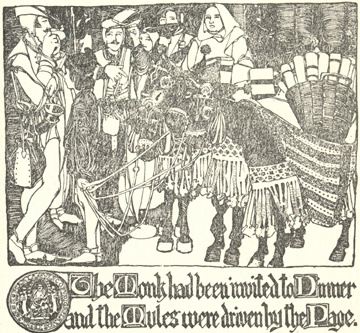
My paper, "'As light as lef on lynde': Dangerous Play in Robin Hood and the Monk," grappled with the fact that the forest in Robin Hood and the Monk is a space of beauty and joy, and yet the ballad is filled with terrible violence. I felt disturbed by the disjunction between the tone of the ballad and its content. I had been thinking a lot about the ballad as I worked on the Much the Miller's Son page for the Robin Hood Project. It features one of Much's most memorable (and terrible) moments, when Little John murders a monk and Much murders the monk's little page, presumably a child. Yet the opening of the ballad gives us no sense of the carnage to come, but rather invites us into a merry springtime world:
In somer, when the shawes be sheyne,
And leves be large and long,
Hit is full mery in feyre foreste
To here the foulys song. (1-4)

       [In summer, when the woods are bright,
       And leaves are large and long,
       It is full merry in fair forest
       To hear the birds' song.]

It's May, the season in which lovers and outlaws alike can rejoice, and birdsong fills the forest with music and our hearts with delight. The short ballad (we have 358 lines, and there were originally around 406) spends the first 12 lines, in fact, on how merry the forest is, and then, when we are finally introduced to a character on line 13, it is Little John, announcing that "'This is a merry mornyng'" ['This is a merry morning'] and continuing with more discussion of the joys of summer in the greenwood. The idyllic realm with which the poem opens, however, belies the violence underlying the carefree lifestyle of this outlaw band. One of the earliest extant ballads, Robin Hood and the Monk is best remembered not for the beauty and delight to be found in the greenwood, but instead for the shocking violence perpetrated by the outlaws who reside there. Many men are slain over the course of the ballad, and, in a moment that unsettles modern fans and critics alike, Much beheads a child without a second thought. Although it might seem that the playful tone of the ballad ill-suits such grim content, I have begun to think that the ballad instead promotes a specific kind of violence that is playful in nature, a kind of violence that, like the ballad itself, can trick a person outside of the outlaw band even as it can lead to shame, discomfort, or death. The ballad does not contrast violence with harmony, but instead contrasts varieties of violence to show that merry and playful violence is the most successful for those residing in the greenwood world. This playful violence is in turn indicative of the link between outlaw identity and greenwood space.

"In Somer, when the shawes be sheyne"
(Sun through the trees at Letchworth Park)
As the ballad opens, Little John is immediately aligned with the greenwood environment; he speaks the language of Sherwood itself. His initial speech about the "merry morning" mirrors the language that the opening of the ballad uses to describe the setting. His enthusiasm for the space around him and his irrepressible merriness represent a respect for the greenwood life. Little John's initial emphasis on the merriness of the surrounding, corresponding as it does to the merriness inherent in the ballad descriptions, contrasts starkly with Robin Hood’s anxious speech. In response to Little John's enthusiastic monologue, Robin replies that “on thyng greves” [one thing grieves] him and does his “hert mych woo” [heart much woe] (21; 22). The forest may be nice, but Robin is focused instead on what he’s missing back at Nottingham; he wants to attend mass, which the greenwood can’t provide. Much introduces the dangers that attend a known outlaw back in town when he advises Robin to 

       'Take twelve of thi wyght yemen,
        Well weppynd, be thi side.
        Such on wolde thi selfe slon,
        That twelve dar not abyde.' (31-4) 

       ['Take twelve of your strong yeomen,
       Well armed, by your side.
       Such a person as would slay you,
       Would not dare face those twelve.']

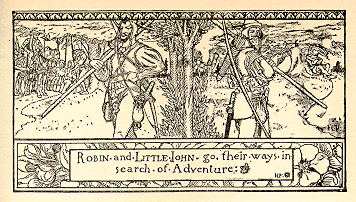
I suppose you know you’re an outlaw when going to church requires twelve bodyguards. Robin’s rejection of this plan is also a rejection of the group mentality. He separates himself from his men not only by his attitude and his plan to depart from the greenwood, but also by his unwillingness to bring members of the greenwood band with him. His subsequent squabbling with Little John, a character who represents the merry greenwood world, cements his role in this ballad; he is out of sync with the outlaw realm, neither merry nor attuned to the natural world around him. Stephen Knight and Thomas Ohlgren note in their introduction to the text that "[t]he forest setting seems a state of harmony to which the outlaws return after urban disruptions. But just as violence enters this Edenic world, the communal calm of the outlaw band is disrupted by conflict." I would add to this that the conflict comes when Robin is not aligned with the greenwood space and outlaw band; it is this internal "ferly strife" that serves as a catalyst for the larger violence (and notably high body count) of the ballad (51). When Robin and John part, the ballad explains that, 

Then Robyn goes to Notyngham,
       Hym selfe mornyng allone,
And Litull John to mery Scherwode,
The pathes he knew ilkone. (63-66)

        [Then Robin goes to Nottingham,
        Mourning to himself alone,
        And Little John goes to merry Sherwood,
        The paths he knew each one.]

Howard Pyle image (1883) courtesy of the
  Robin Hood Project
Their parting of ways sends Robin to town alone, while it leads Little John back into the forest, a place he knows so intimately that all of its paths are clear to him. Robin and John thus appear as contrasting figures, but not just in that John is merry while Robin is brooding. As the ballad progresses, each exhibits a propensity for violence, but Little John uses playfulness to accomplish his violent acts, and it is this playful violence that succeeds repeatedly over the course of the ballad where Robin's more straightforward violence fails.

Robin’s most violent moment, a scene in which he slays twelve men and wounds “mony a moder son” [many a mother's son] caps off a succession of astonishingly reckless actions on his part. (109). Not only does he head to mass alone, but strolls right in with no disguise and kneels to pray in front of the whole congregation so that “[a]lle that ever were the church within/ beheld wel Robyn Hode” [all who were ever within the church/ beheld Robin Hood well] (73-74). By the time he starts fighting and killing, it’s because he’s surrounded, and he can’t save himself from imprisonment regardless. It may be an impressive show of prowess, but his solitary sword breaks and leaves him without recourse. The very fact that he could kill and wound so many men indicates the impossible odds he was facing. Unlike John’s more subtle tactics, Robin chooses to enter the scene as himself and ends up playing a desperate defense. It is not surprising that Robin chooses this moment to announce, “Alas, alas! ... Now mysse I Litull John” ['Alas, alas! ... Now I miss Little John'] (101-102). Separation from Little John and the kind of behavior and thinking that Little John represents leads Robin straight to a dungeon. And it is only Little John’s bold trickery that can bring him back to the forest.

Little John, on the other hand, delights in tricking and playacting. He and Much have the monk convinced that they’re fellow travelers, innocent men with a shared fear of Robin’s gang. They approach the monk and page “[a]s curtes men and hende” [as courteous and gracious men] while commiserating with the monk over Robin Hood’s murderous crew of  “many a wilde felow” [many a wild fellow] (160; 179). Because Little John's identity as an outlaw is so clear to him, because Sherwood is in his very being, he can take on new personas as he pleases. He has freedom of movement and role precisely because he is inextricably bound to the greenwood and to his place as outlaw there. He and Much act the part of friendly, courteous men while contrasting their own behavior with that of the wild outlaws, but they are far more dangerous in their amicable guise than they would be in their own outlaw roles. Where Robin walks into church as himself and raises immediate suspicion, Little John aligns himself with the monk even as he plays upon the monk’s fears of outlaw attack. John can win such games easily because non-outlaws don’t even know they’re playing. His confident playfulness allows him to overcome his opponents time and again, employing such subtle offense that the defense never enters the field. The only moment of the ballad in which Little John reveals his identity to those he's tricked is in fact the moment in which he beheads the monk. The ballad explains that,

  The munke saw he shulde be ded,
Lowd mercy can he crye.
'He was my maister,' seid Litull John,
'That thou hase browght in bale;
Shalle thou never cum at oure kyng,
For to telle hym tale.' (197-202)

        [The monk saw he should be dead,
        Loud mercy he did cry.
        'He was my master,' said Little John,
        'That you have brought to harm;
        You shall never come to our king,
        In order to tell him the tale.']

The beheading isn't instantaneous; John gives the monk time to see his imminent peril and cry mercy, and the outlaw responds to the cry for mercy with his own identity as Robin's man and with his reasons for killing the monk—apparently a blend of vengeance and expediency. In this way, Little John makes utterly clear that his playacting is always within the context of his true role as an outlaw of Robin's band.
Charlotte Harding image (1903) courtesy of the
Robin Hood Project

The moment in which Little John beheads the monk and Much beheads the little page has managed to lodge itself firmly in readers' minds, a horrifying scene emblematic of the violent nature of these early ballads. Derek Pearsall writes in "Little John and the ballad of Robin Hood and the Monk" (In Robin Hood: Medieval and Post-Medieval. Ed. Helen Phillips. Dublin: Four Courts Press, 2005. Pp. 42-50) that the murder of the little page “is the truly shocking moment of the ballad” and goes on to say that the episode serves to remind  us “of a world of brutal and unsentimental saga-heroes in which decency, a respect for the lives of the innocent, what we usually call a sense of honor and fair play, are not part of the code of behavior in the way we might expect” (46). It is true that this is a brutal and unsentimental scene, that the beheading of a child is simply a smart cautionary move to these men, but this is not straightforward violence. Brutal it may be, but it is couched in play and trickery, and those very traits are part of a different kind of code. The scene of clever trickery and dramatic irony could be funny or cute if it didn’t lead to a double execution. (It occurs to me that an alternate title for my paper could have been "It’s all fun and games until someone gets beheaded" ... ) What really makes the incident so shocking is not just the violence, but that the violence exists in a ballad filled with such joyful language and during a scene of such playful disguise. The ballad lulls the reader even as Little John lulls the monk. 

Once John and Much exact their revenge on monk and page, the stakes of Little John’s trickery grow higher with each scene. Initially he just impersonates a friendly traveler, a courteous fellow. But then he has the monk’s letters and takes on the role of emissary from the sheriff. The letters functions as tangible proof of his assumed role, and they gives him direct access to not just the court but to the king’s person. The king responds with trust, providing John and Much with a twenty pound reward, making them “yemen of the crown,” and giving Little John the royal seal (229). His dangerous game thus leads directly to a promotion in class from the king himself. Carrying the royal seal is not to impersonate the king, but it is to impersonate the king’s messenger, to claim that your words are his. At every stage, John more boldly uses his words to trick, and his tricks increasingly give him access to information and spaces that would otherwise have been unavailable to him. As the letters ushered him into the king’s company, the seal renders the boundaries of both city and prison permeable to him. Whereas Robin’s overbold actions lead to imprisonment, John’s brand of boldness breaks through prison walls. John is no less violent, no less willing to kill and wound, but he does so with a spirited playfulness that Robin never manages in this ballad. The king may get the final word in the ballad, but he only admits that Little John has won the game: "'Speke no more of this mater,' seid oure kyng,/ 'But John has begyled us alle'" ['Speak no more of this matter,' said our king,/ 'But John has beguiled us all'] (353-354). Focusing on John's success in beguiling everyone rather than on the murders committed along the way, the king's final words sum up the ballad's interest in John's trickery above the moments of violence.
"As light as lef on lynde"

The outlaws, for their part, aren't phased by the high death count. When Robin escapes jail and returns to the greenwood, the ballad explains that he is "[a]s light as lef on lynde" [as carefree as a leaf on a tree], connecting his joy at returning to the greenwood with the very leaf imagery associated with that space (302). He's a part of the green world again in a way that he wasn't at the beginning of the ballad, when he interrupted the merry tone with his worries about attending mass. His freedom is both stemming from the natural world and bound to it. His very lightness is not just like a leaf, but like a leaf on a tree, linked to the greenwood at its very core. The opposite of being locked in "depe prison," the ballad indicates, is the tenuous and yet stable bond that links foliage to branch and branch to root and root to the larger network of the forest (246). Freedom of movement thus comes with a kind of stability associated with certainty of place, with rootedness. John's playful violence can exist because, connected as he is to the greenwood and his position in it, he can move in and out of  forest and in and out of his outlaw role. Identity is thus fluid only to the extent it is fixed.         

Little John's outward identity is as malleable as his physical location; he can deceive and playact and win games only he knows are being played. The ballad, which combines beautiful and joyful natural imagery with startling violence, in fact presents us with a world in which the two are mutually constitutive. Dangerous and even deadly play must be used in order to maintain the outlaw condition. In The Forest of Medieval Romance (Cambridge, England; Rochester, NY, USA: D.S. Brewer, 1993), Corinne Saunders describes the greenwood of the Robin Hood ballads as a place where “it is always spring, and where merriment and plenitude of dear dominate. In the ballads, the threats and oppositions are caused not by the difficulties of the life in the greenwood, but by the problematic nature of the position of the outlaw and the occasional reminders of a harsher society whose laws do not look favorably upon such as Robin Hood” (200). While the greenwood of Robin Hood and the Monk is certainly, as Saunders describes, a springtime world of merriment, it seems to me that this ballad complicates the simple opposition between greenwood and town. It is not simply a tale that contrasts the peace and freedom of the greenwood with the oppression of the town, but a ballad in which the very peace and freedom provided by the natural space of the forest is predicated upon a specific kind of violence. Playful acts of violence come naturally to Little John, and Little John in turn is a representative of the greenwood. Little John speaks a language of birdsong and sunlight and green leaves, and he lies and kills as easily as he breathes. The paths of Sherwood make up the cartography of his brain, and with that knowledge he infiltrates court and town and prison. He brings the rules (or lack thereof) of the greenwood with him where he goes, and through them he returns Robin Hood to the forest. He might not have been able to cheer Robin up at the ballad's opening, but he can ultimately render Robin leaf-like and free. As this freedom, like a leaf, is imagined to be affixed to a tree, so is the link to the greenwood essential for Robin and his merry men. Their merriness thrives insofar as their identities remain tied to the forest where they make their home.


Tuesday, May 13, 2014

Of Words and Worlds


And I mean whirlwind literally ...
I am just recovering from the whirlwind that was the 49th International Congress on Medieval Studies in Kalamazoo, Michigan. I am torn between a desire for rest/hibernation and a frantic need to write down as much of my experience as possible. (In reality, neither of these options is possible in the face of gradinggradinggrading.) It was, as always, a rich experience in a variety of ways. I am consistently blown away by the generosity and intelligence and engagement of the scholars in my field, and I am feeling a renewed excitement about my work and my career despite the depressing challenging nature of the academic job market. I can't sum up all of the panels and papers I saw and heard right now, but I will post the roundtable presentation I gave, "England by any Other Name: Nominal Topographies in The Tale of Albin." The roundtable—"What a World!"—was sponsored by the BABEL Working Group on the theme of worldbuilding, and it featured inspired and inspiring papers on topics that seemed wide-ranging but that came together in surprising and delightful ways. I had difficulty crafting my contribution, since I have never participated in a roundtable before, and I am not used to writing such short papers (for those not familiar with such things, a traditional conference presentation is 15-20 minutes, and a roundtable presentation is 5, which allows for more in-depth discussion). Although cutting the paper down to size was physically and emotionally painful, it was also liberating to just present the core of an idea and see how it functioned in terms of a larger conversation. I've written about the strange tale of Albin here before in my Jurassic Park post, but for this presentation I was thinking about naming as a form of worldbuilding. I was considering how a chronicle presents everything side-by-side even as individual colonizers attempt to write over what came before. Here is the basic presentation (minus, of course, spontaneous ad-libs and larger discussion):

Every schoolchild in medieval Europe knew that countries worth a name could trace that name back to the battle of Troy. And every schoolchild in medieval England knew that a man named Brutus climbed from the wreckage of his fallen city and sailed to an island on the edge of the world, which he called Britain for himself. Conquest, lineage, and naming are all interconnected in England's mytho-historic beginnings. But the island has another name, Albion, and thus another origin story. Texts such as The Anonymous Short English Metrical Chronicle describe a Greek princess, Albin, who plots to murder her husband because he attempts to restrict her wild nature. Exiled from her homeland, she lands on an unnamed, uninhabited island, naming it for herself and populating it by mating with a devil to produce giant offspring who rule the island until Brutus arrives to rename it. I contend that the tale imagines national origins as deriving from words as much as actions. Speech acts claim the island for each named character. When Albin names the island for herself, she makes it in her own image. Naming is both the catalyst for worldbuilding and also a kind of worldbuilding. Just as important as their actual building is their imagined construction of the place by virtue of the names they choose.

The Chronicle opens with a declaration that "Here may men rede whoso can/ Hou Jnglond first bigan" [Here men may read if they can/ How England first began] (1-2). The text itself is a "here," a place for readers to discover their own national background. And though the tale begins in faraway Greece, Albin soon arrives on an island called "þis lond" [this land] and "here" (306, 307). Thus we have a tangible connection between the story and the current location. When Albin arrives with her sisters on “this land,” she colonizes with a speech act: "'Listeneþ sostren þat be min,/ Y schal ȝou telle hou it schal be:/ Þis lond ichil sese to me,/ After mi name Albion/ ȝe schullen it clepe euerichon'" [Listen sisters that are mine,/ I shall tell you how it shall be:/ This land I shall seize to me,/ After my name Albion/ you shall call it everyone] (312-316). The colonial fantasy of an uninhabited and unnamed land allows Albin a blank slate upon which to create a society in her own image. The island contains nothing "Bot wode & wildernisse" [but wood and wilderness], and their main impact on the land is to populate it with giants (325). The giants hold the land until Brutus arrives 800 years later, finding that "Al was wode & wildernisse," indicating that neither Albin nor her giant progeny did much to cultivate the land (369). The fantasy of arriving on an empty island is followed by the fantasy of arriving on an island populated only by monsters. Brutus gives the island the familiar name of Britain for himself, replacing an earlier title as he reinscribes the land with his own culture. He and his men kill off the giants and "falwede erþe & felled wode/ Of þis lond þat was so wilde./ Þai bigun tounes to bilde" [tilled earth and felled wood/ Of this land that was so wild./ They began to build towns] (450-452). He repurposes the wood and stones he finds, creating an urban landscape out of a wild one. 

Even fences can't contain what was there before
(A photo I took in Scotland, 2011)
Like Albin before him, Brutus displays the power of words to shape reality. The narrator explains that as "Brut sett Londen ston" [Brutus set London's stone] he announced that if kings who were to come after him continued to care for the city as he did in his day, then men would be able to see hereafter "'Þat Troye nas neuer so fair cite/ So þis cite schal be.'" [That Troy was never as fair a city/ As this city shall be] (457; 463-4). The scene concludes his speech with the comment that the city was named "Þilke time, þurth Brutus mouþe" [At that time, through Brutus's mouth"] (465). Brutus's speech is conflated with an image of literally setting London in stone, giving his words a monumental quality. The words Brutus uses to discuss his city look forward to future generations, extending the line and connecting to the larger chronicle leading to contemporary London. Yet if Brutus's words are meant to ring true and if the stones he placed contain in them a tangible connection to the readers' own environment, then Albin and her giants must also be connected. Brutus might build upon Albion and add his name to it, but his is a palimpsestic relation to Albin. Her name and her wild country still remain underneath British cities. Maybe she and her giants bear no blood relation to later people of the island, but they bear a chronological relation. They trod the same ground and called it their own.

Both Brutus and Albin exist for British history only insofar as their names link etymologically to the names associated with that island. The land Albin claims and the giants she produces are both wild, and both must be restrained and re-envisioned in order for Brutus to create a land in his own image. But Brutus's words, though they can reimagine and restructure the island, cannot undo the words spoken by Albin. Albin's name is still associated with the land to this day, and the ground is still that her giants tread, the wood and stones that make up the city still those that she claimed when she arrived on the island and called it her own. Words, even spoken words, can be written permanently onto a landscape and shape how a nation sees itself. If worldbuilding serves to construct an imaginary world, then perhaps a chronicle works to build an imaginary past for an existing world. Brutus places his name over Albin’s, but the chronicle presents them side-by-side, creating a national identity out of an amalgam of fantastic origins.