Showing posts with label history. Show all posts

Saturday, May 11, 2013

When Giants Walked the Earth: Jurassic Park, The Legend of Albina, and Inherited Topography

Having recently been to see Jurassic Park in 3D, I have felt a renewed enthusiasm for dinosaurs. Kate's delightful post on "Deadline Anxiety and Dinosaurs" further reminded me of the wonders of the classic film. At the same time, I was working on a paper about the legend of Albina for Plymouth's 34th Annual Medieval and Renaissance Forum, which led me to connect the two in my mind. Let me start with a recap of each story:

Jurassic Park is a tale about scientists who figure out how to bring dinosaurs back through the magic of DNA. Chaos ensues.

The legend of Albina (or, sometimes in Middle English, Albin) gives an origin story for the name Albion. Albina is a princess from Greece (or perhaps Syria) who plots with her many sisters to murder their husbands and is thus exiled on a rudderless ship. Fate intervenes, and the women land safely on an unnamed, uninhabited island at the edge of the world. Albina calls the mysterious land Albion after herself and goes about setting up a home there. Mating with incubi, Albina and her sisters produce giant offspring and populate the island with their monstrous progeny. The giants rule the island for 800 years, and then Brutus shows up from the wreckage of Troy. He kills the giants and renames the island Britain for himself. He tames the wilderness and cultivates the land. From the wood and stones of the island, he fashions a New Troy that we call London.

On the surface, I will admit that these two stories have little in common. A modern warning story about the dangers of unexamined scientific exploration and a medieval mytho-historic explanation for the name Albion might seem, quite literally, worlds apart. And yet fortune has thrown them together in my mind, and I'd like to humor myself by thinking about possible connections.


The edge of the world seems like a good place to stop
Like dinosaurs, the giants of the Albina story walk the same land that we inhabit. The only thing that separates us from these frightening and yet fascinating forebears is time. Though we're not descended from them -- both dinosaurs and giants have been extinct since prehistory -- we have inherited their realm. As Jurassic Park opens, paleontologists in Montana are digging up fossils. The ease with which they dig up these fossils has been making paleontologists chuckle and children look optimistically at their toy shovels ever since the film opened. The image of these fossils, hidden away by the sands of time and yet still just below the surface of our landscape, connects these ancient bird-lizards to our own countryside. Time may separate us from the dinosaurs, the movie seems to indicate, but only by a couple feet of dust. Their bones lie under our feet, and our land was theirs first.

Similarly, the Albin story imagines British history beginning with monstrous creatures: a murderous woman, a mother of monsters. The image of a man called Brutus pulling himself from the carnage of his fallen city and making his way to an island on the edge of the world was widely recited in medieval England. The story usually begins with Brutus landing on the island, finding it populated with barely-human giants, and conquering the land by dispatching of these unpleasant natives. Surely this is a colonial fantasy, in which the colonizer need not feel guilt for taking over a new land because the inhabitants can be discounted as less than human. The versions of this story that insert the Albina legend in the beginning, however, shift the reader's perspective. In these texts, we follow not Brutus but Albina to the island; we sit with the giants on the shore as Brutus sails up to claim the land and rename it for himself. Brutus may kill these giants, Brutus may remake the landscape into his own version of civilization, but the story still begins with Albina and her larger-than-life children. They stomp around, and their movements undoubtedly shift and mold the topography, carving out lakes and valleys and mountains with their rumbling steps. The wilderness that Brutus discovers when he arrives on the island still lurks beneath and beyond the streets and buildings he commissions. The people who live in the London of the 14th century (or today) may not be able to trace their ancestry back to Albin or her outsized offspring, but the chronological and topographical link is nonetheless inherent in the narrative. In The Short English Metrical Chronicle, readers are told that Albina landed "here" and on "this land" (307, 306). There is never any doubt in the text that her location, even before it has a name, is the reader's location as well. We can kill off the monsters, the legend seems to tell us, but we can't escape their influence. The island may be Britain, but it is Albion as well. As with the dinosaurs of Jurassic Park, only time stands between us and the monsters from whom we inherited our earth.


What is this strange, four-wheeled creature?
Jurassic Park increases this uneasy sense of chronology with a particularly 1990s fable in which technology can bridge the gap between past and present. Dinosaur DNA, with a little frog DNA thrown in for good measure, initiates a shocking confrontation with the past. As with the story of Saint Erkenwald speaking to a long-dead judge (see my Titanic post for more on that), our paleontologists can see the bones they've studied come to vibrant life. I was speaking with some fellow medievalists recently about how Jurassic Park is a fantasy for anyone who studies the past. We can collect our evidence, we can imagine how it must have been, but we know that there's always a little bit of guesswork, a little bit of our own time and place getting in our way. The centuries are, despite our best efforts, an unpassable obstacle to full engagement with past people and places and events. When Doctors Alan Grant and Ellie Sattler (played by Sam Neill and Laura Dern, respectively) gaze in wonder at the living versions of the fossils they have studied for so many years, it's hard not to feel a sympathetic twinge. When Alan Grant murmurs gleefully "They do move in herds," I can't help but think that I would make similar comments if I got to view a performance of the medieval York Cycle or a production of Shakespeare at the original Globe. And when the doctors pet and hug a living triceratops, the tactile interaction means that they are literally touching a creature of the past. The new 3D version enhances these interactions and confrontations by making the dinosaurs appear to pop out of the screen toward us as we watch. The years have been kind to these dinosaurs, and they appear more real than ever. Yet these dinosaurs, made from prehistoric DNA, are still born here and now. They're still in a contemporary landscape, no matter the efforts put into recreating a proper habitat (maybe this is why that triceratops is so ill). The bit of modern frog DNA making up each one means that, even on a genetic level, they are modern creatures even as they are ancient ones. The closest we can come is still imperfect. Still, ultimately, dangerous in its imperfections.

Even as time in Jurassic Park is both then and now, place is both real and imagined. We may recognize the Montana badlands, but Snakewater is a fictional Montana city. The backstory of this fossil paradise is that it was originally an island. In other words, a fictional place was once a fictional island, subsumed into the middle of the modern-day United States. The park itself is built upon a fictional island as well, Isla Nublar (meaning something like "clouded island" or even "obscure island"), just off the coast of Costa Rica. As with Snakewater, Isla Nublar is given a specific location in relation to real geography (and, of course, was filmed in a real place that we may visit if we wish), and yet it is imaginary. Off the coast of the known lies the land of the film, connected to the world we know and yet always separate from it.

Albina is given a much more specific location in that she lands where the reader now stands. Her time at sea may exist in a geotemporal shadow realm, but before and after she travels we can point to her on a map. As I mentioned above, she lands "here." And when Brutus comes to the island, the city he builds is the city we now call London. Her island is not ours -- it is a mythic wilderness ruled by overly-ambition women and their overly-corporeal descendants. They are vanished into the past. Their imaginary bones are dust, and we cannot simply dig them up in our backyards. Yet if their bones are dust, even the dust of legend, then that dust makes up the story of the modern island. Albion both is and isn't Britain.


Not as cuddly as you might think
The monsters of our past (the monstrosity of the past?) is both frightening and fascinating. (For a detailed examination of this paradox, see Monster Theory, especially Jeffrey Jerome Cohen's sixth thesis: "Fear of the Monster is Really a Kind of Desire" (16).) Albina may create giants from her lust, forging progeny with an incubus to populate the island, but her desire isn't totally disconnected from our own readerly desire. Albin and her giants and her alien-familiar wilderness are tantalizing fictions of British chronology. Similarly, dinosaurs maintain the capacity to terrify and attract us. When I was four or five, I received a blow-up Tyrannosaurus Rex for Christmas. Obsessed with T-Rex, I was delighted with this gift. I couldn't wait for my father to blow up the toy so I could exist in an imaginary dinosaur world with my T-Rex friend. Yet when night came, I was suddenly panicked because I knew that a T-Rex prowled in my house. I begged my father to deflate it for the safety of everyone involved. For the next several days, we repeated this pattern. By day, I loved my T-Rex; by night, I wanted him annihilated. Finally, my dad, exhausted from blowing up a four-foot-tall dinosaur day after day, said I could choose special days to play with my T-Rex, but that it couldn't be everyday. The terror induced by the T-Rex and velociraptors in the film is not the only reason it has been so popular. Yes, we love to be afraid of dinosaurs, but we also just love dinosaurs. The tender moments of the film in which characters lovingly pet peacefully plant-eating dinosaurs are there for a reason. Whether we would hide from T-Rex in a bathroom or wave a flare at her to distract her from the children, we know that she is deadly. The way that Dr. Grant revels in frightening an obnoxious child with a description of the velociraptor's hunting style at the beginning of the film gets echoed in the famous last words of Robert Muldoon (played by Bob Peck) as a velociraptor leaps toward him: "Clever Girl!" He admires her for outsmarting him even in his last breath.

An aspect of the monsters of the past that makes us love and fear them is that they can't really be controlled. Albina's father sends her away on a rudderless ship, a punishment which is surely a death sentence. A punishment which robs her of narrative control as she floats powerlessly around the world. Yet she manages to claim a land for herself, to attach her name to that land and to become a part of a nation's history. Even as she and her sisters consider their position as an island full of women, they find a way to reproduce, monstrous and unnatural as that way is, producing as it does children who are both more and less than humans. Brutus may tame the land by killing Albina's monster-children, but they haunt British chronicles nonetheless.

In Jurassic Park, modern science and technology may seem to contain and control the past even as they resurrect it, but the monsters of the past defy such efforts. The opening scene, in which a velociraptor manages to kill a worker even in the most carefully planned situation, indicates for us from the first moments of the film that modern knowledge has met its match. When we are told later that the velociraptors methodically test each section of their fence for weakness, it's clear that they do not take well to their high-tech cage. Dr. Ian Malcolm (played by Jeff Goldblum) sums up the dangers of such attempts at containment when he states that "the kind of control you're attempting simply is... it's not possible. If there is one thing the history of evolution has taught us it's that life will not be contained. Life breaks free, it expands to new territories and crashes through barriers, painfully, maybe even dangerously, but, uh... well, there it is." In this speech, monstrous vitality is life itself, that which breaks free of control and simply finds a way. Everything on Isla Nublar is an attempt at control, down to the jeeps which can't be steered (am I going too far to compare these to medieval rudderless ships, outside of their riders' control and yet firmly on the track of fate?). The designers of the park may have automated the vehicles, but it never occurred to them that riders could (or would) simply open the jeep doors and step outside. Given all of these hints, we're not terribly surprised when we see a dinosaur egg in the wild. Despite the careful breeding of only female dinosaurs, we learn that these dinosaurs, made partly with frog DNA, can switch sexes in order to reproduce. Like Albin and her sisters, the dinosaurs manage to procreate even when denied the normal means of doing so. They can neither be kept in cages nor kept from expanding their population.


At least Skull Island had King Kong
We might say that the real monster of the film is human greed, but this very greed is predicated on human desire to encounter dinosaurs. The monsters can only menace us because we bring them back in order to do so. John Hammond (played by Richard Attenborough) speaks with wonder of creating a park in which people can see and touch real dinosaurs, and he says plainly that "this park was not built to cater only for the super-rich. Everyone in the world has the right to enjoy these animals." But his wonder at scientific possibility, in the real world, translates into the chaos that characterizes the film from the opening scene. We never believe that things are going to go well, even as we also to want to see and touch the dinosaurs.

I am not saying that Jurassic Park is a modern-day Albina myth, nor that either Michael Chrichton or Steven Spielberg had considered or even read the obscure medieval tale when they created first book and then movie of this modern story. Rather, I suggest that attempts to engage with the past, or to imagine how that engagement might take place, may partake of the larger-than-life. The past is monstrous in that it is both wholly other and wholly familiar, in that it is distant and yet part of us, in that the here and now will inevitably become the past. The past, whether we understand it or not, will always swallow the present. The giant lurks just beneath the surface of our modern world, unattainable and yet tempting us with possible proximity. Albina, giants, dinosaurs, titans -- all are creatures of the past both consumed and consuming. And, yes, I would probably visit Jurassic Park, even knowing what I know. Who could resist?

Sunday, August 26, 2012

One foot in the sea and the other on land

As I transition from one coast to another, one school year to another, and one season to another, I think a lot about thresholds. I try hard to think of each phase or moment or experience in my life as a thing unto itself instead of a place between. Graduate school, for example, could be a liminal space between college and career, but it seems a shame to think of such an extended period of my life as simply a means to an end (especially in this uncertain market). Sometimes I sit in a coffee shop, reading or writing, and I really reflect on how privileged I am to be able to spend some years of my life learning and thinking and growing as a person and a scholar. How amazing it is to sit in the afternoon sunlight, reading a book and learning even more about the things I love. How incredible it is to work with students and to see them really think about literature and the world around them. Even the struggle to come up with new ideas, the intensity of teaching, the insecurities which come with grad school -- those are a part of my life, a part of all that's good in it and all that makes it worthwhile to me. These years, I must remind myself, are valuable unto themselves.

As a medievalist, the struggle against the idea of middles is constant. Though the term "Middle Ages" is certainly less pejorative than "Dark Ages," it still gives a sense of a period between the glory of Rome and the Renaissance. A placeholder in history. It seems doubtful to me that people woke up on New Year's Day of 1500 (or 1495 or 1450 or 1350 or 1300 …) and felt suddenly reborn. Even midnight on New Year's, which seems to be a crystal-clear liminal point, shatters when we consider all of the time zones of the world. Watching through a television set in the United States as the ball drops in Australia, I can't help but feel a bit unsettled about our privileging of that particular moment. Nor can I fail to notice when I reach the new year in New York before my friends in California do. And this is not to mention the fact that there are different calendars in the world that have different New Year's, and the fact that even our Gregorian calendar has been used with different New Year's in mind. In the Middle Ages there seem to have been several possible dates, and people in the Early Modern period celebrated on March 25th. How are we to find the point of transition if it keeps moving? And what do we do with a transition period, a middle, that takes up a thousand years? It's interesting that we often think of middle as center, as central. We often see those things on the periphery as less important. Yet in history as in our lives it's easy to see moments or years or centuries as simply between the real thing. Not only does this kind of thinking ignore realities of connection and continuity, but it denies the importance of the individual dots on the timeline.

On my trip home I spent some nice afternoons at the beach, visiting my much-missed Pacific Ocean, and I thought about how hard it often is to pinpoint a precise spot where one time or space ends and another begins. I walked through that tricky line on the shore where dry feet and wet feet are only moments apart, and I examined that strip of sand. What was above water one moment was below it the next, and even the extent to which the water reached was always different. The curved border between dry sand and wet sand (and even wetter sand) shifts constantly, and must be slightly different each day. Indeed, it must change throughout the day as well, and in more subtle ways than just the changing tides. As I rolled up my jeans and moved closer to the water, I noticed that the way the water moves over the sand is new each time, that the ripples of water are ever-changing and that they leave an imprint both of their shape and their substance on the sand behind them. As I tried to discern the line between the realms of ocean and sea, I found that there really is no simple answer. There is no line and there's always a line and there are a million different lines. I spoke in my paper at the recent NCS conference on the Man of Law's Tale about how the realms of land and sea are never as separate as they appear on the map, and it was good to actually look at the space between and in those realms. So often I find myself getting caught up in the theoretical. Of course I am a literature person -- examining texts is what I do. And I'm a medievalist -- thinking about things long ago is my job. But after writing so much about concepts of time and space and the ocean, it's good to get reacquainted with the ocean itself. To get my feet wet again, as it were.

On my trip I was reading Rachel Carson's The Sea Around Us, and was struck by a passage from the preface to the 1961 edition describing how the floor of the deep sea "receives[s] sediments from the margins of the continents" such as "bits of wood and leaves, and … sands containing nuts, twigs, and the bark of trees" (x).The abyssal plains, therefore, include tangible pieces of the coast. And it is also the waters of the world that have carved out valleys and canyons now well above ground. Water has in many ways shaped our landscapes, just as the land provides the floor of our oceans and rivers. Carson explains of the ocean's formation that water wore away the land to create the ocean, while the minerals from these worn-away continents gave the sea its saltiness in "an endless, inexorable process that has never stopped" (7). In other words, the water continually shapes the land, while the land ceaselessly gives the ocean its salty form. Over the long history of the earth, land and sea have merged, shifted, and forged one another. Geological time, it seems, has its own ideas about topographical and temporal boundaries. To try to think of any particular space or time as its own separate entity really only works in a single instant. Even in that instant the lines are fraught, but only in that instant are lines really visible. Boundaries and borders are shifting, fleeting, intersecting. I played with this notion by snapping pictures of the space where ocean meets shore in order to try to capture some of those threshold moments. And even in my photographs, I cannot really tell for sure where water ends and sand begins. Can you?

Thursday, August 2, 2012

On Time and the Garden

I've had a whirlwind summer thus far, and it's gone by too fast (especially since there's still so much more work to do . . .). I've tried to research and write, and taken on many (too many) side projects (as my last post mentioned). I've been planning a brand-new ESOL course, which I'll teach in the fall and spring. I had a beautiful road trip to Asheville, North Carolina to help my friend Ali move, and enjoyed spending time there with close friends and exploring both the city itself and the surrounding Blue Ridge Mountains. I also attended my first New Chaucer Society conference in Portland, Oregon. I found the conference to be, as the best conferences always are, equal parts invigorating and exhausting. All of the panels I attended were excellent and the discussion lively. My own panel went really well. I got great questions, and I felt that all of the papers worked together beautifully to bring out new ideas. I was also lucky enough to be presenting on the same panel with my friend Sharon, who gave her first conference paper, which was excellent. I was reminded once again of how lucky I am to be in a field with such intelligent, warm, lively people.They're people who pose interesting questions and allow for productive dialogue. This conference is set up particularly well for graduate students, with generous financial assistance, a full-day graduate seminar, and a generally welcoming environment in which all are made to feel part of the community. I met some new people and spent time with old friends; I saw many wonderful papers and a really outstanding plenary lecture by Carolyn Dinshaw. Dinshaw spoke eloquently about history and temporality and Mandeville's Travels. I also got to explore Portland a bit and to visit some delightful family members whom I don't see often enough.

Now, after two years away, I am home for a visit to Northern California. The last time I was home, I was here for the birth of my friend Dominique's son. This time I made it to that son's second birthday party. The differences between the newborn baby and two-year-old make concrete for me the temporal distance between my last visit and this one. I am staying with my grandmother in my childhood home, a place filled with memories of the times I had there and the people I've loved who used to live there and who live there still. I still expect to discover my grandfather dozing in a chair when I walk into a new room. I still expect to hear my father's voice calling for me from the next room to come and see something he's discovered in the newspaper or in a book or online. I am aware of the way in which the space I'm in exists relatively unchanged, and only time separates me from previous moments in the same locations. I'm particularly struck by the garden, much grander than it was when I was a child. I spent so many happy hours in that yard, swinging on my swing set or having adventures or pretending to be in a fairy land. My grandpa spent many hours in the yard as well, working in his treasured rose garden and planting new varieties of tomato. Three activities my grandfather loved above all: photography, hiking, and gardening. I would swing and he would garden and we would need no words to express our contentment. I see traces of him everywhere in this garden. Flowers that he planted still bloom each year, their colors bursting forth from the past into the present. My dad loved the garden, too, and had information and opinions on every plant. When we had landscaping done some years back, my father would bake treats and make snacks and bring them out to the gardeners and just talk to them for hours. When I stand in the garden now, I feel comforted in knowing that a space they both loved so much is still thriving.

I was primed by the NCS conference to think about time and the garden. There was so much discussion at the conference of time, history, and space (as with the plenary I mentioned above), of ecologies, of objects. (There was also a whole thread on oceans! I presented on a panel in this thread, and saw some other incredible oceans panels as well.) One of the conference receptions was held in the beautiful Chinese Gardens, a lush location which fostered much happy mingling between scholars young and old (aided by a generous sprinkling of champagne). I had also gone for a walk outside of Portland with my cousins Susan and John, who had explained to me that the topography we saw (verdant trees and brooks) would have covered downtown Portland, a fairly new city, only about a hundred years ago. Trees have been cleared away to make room for streets and buildings, but wild greenery still makes its presence known around the margins of the city. We walked from this landscape past the mowed lawns of suburban Portland, and I noticed the similarities and differences of these landscapes. I also visited the Buffalo Botanical Gardens earlier this summer, a Victorian greenhouse wonderland filled with spaces that seem wild (carnivorous plants lurk in one spot, koi fish swim playfully in another), and yet in which everything is contained and categorized. The rooms are carefully themed and the enclosed nature of the space allows for a great deal of control. With all these experiences this summer, both recreational and professional, I was uniquely prepared to think about urban spaces and greenery as I returned to my childhood home.

Gardens are complex spaces; they're natural and yet cultivated. My grandmother talks brightly to me of one plant that has been carefully chosen and another, right next to the first, which, as she puts it, "the birds brought to us -- a delightful surprise." No matter how deliberately a garden is maintained or controlled (I'm looking at you, topiary), the natural world will make its mark. Animals and weather patterns, for example, cannot be easily regulated. So the garden is both natural and manmade. Gardens are popular spots in medieval literature because of their liminal existence in a variety of categories. They blur the line between public and private, outside and inside. Medieval dream vision poems most often begin in gardens, complicating the distinction between awake and asleep, reality and dreaming. I am reading Bachelard's book on The Poetics of Space right now, and he praises the house for enabling us to dream. In medieval literature, it is often the garden that facilitates dreaming (though Chaucer sometimes writes about falling asleep in bed while reading a good book, a practice all too familiar to me).

There's also a real way in which the garden we have now is the garden of my family's dreams. Much planning and discussion and work and love went into the garden, and everyone felt as if they were witnessing, as the plants grew and blossomed, their floral visions coming to vivid life. And, in some cases, exceeding imagination. Plants grow and change and interact in surprising ways. I walked into the backyard and was astonished at how plants have covered my old swing set. A tiny swing emerges from a tangle of leaves and flowers, barely visible from a distance. When I was young, it was the swing set which defined that backyard space for me. Its crisp lines divided the space and were easily visible from inside the house. Now, from inside, I could almost miss the swing if I didn't know it were there. I moved into this home when I was seven, and the swing set was there waiting for me. It is the same swing set that my dad and aunt and uncle played on before I was born. My grandpa put that swing set up in the yard in 1964 when they moved to this house, but it had been in the family before that, traveling with them from Oxnard to Santa Cruz to Sunnyvale before landing here in Petaluma. My grandparents first set up the swing set around 1950, before my father was born, so he played on it his whole childhood and then I did the same. The swing set always seemed to me a tangible object connecting me to my father's childhood. It connected me to past and future, ground and sky. If I swung high enough, I could see both our own yard and over the fence to the plum trees in the yard next door. There's a freedom for a child in swinging, but a contained freedom, a comfortable kind of freedom. Within the confines of our yard I could have adventures and know that an adult was right around the corner. The swing set always seemed a permanent fixture, rooted in the ground like a metal tree, a part of the yard more reliable than the fleeting petals that visited the garden in spring. The fact that the swing set had in fact been relocated multiple times, that it neither grew from the yard nor originated there, simply didn't fit with my conception of my childhood. Flowers bloomed and wilted, but that swing set was always there, would always be there. Now, as the leaves and flowers cover and enclose the swing, I see that the swing set really has been taken into the garden. The overgrowth has made the set its own, has turned it into a kind of trellis, covered by plants but also holding them up in a kind of symbiosis of metal and paint and flower and leaf. Unlike the inside of the house, the garden really looks nothing like it did when I was little; changes happen and are made to happen. But if I look close enough I can see traces of my childhood, of my dad's childhood and my grandparents' adult life. The swing is still there, hidden amidst the leaves like a secret memory; the baby rosebush my grandpa planted for me in seventh grade (a rough year for me, as for many kids) still blooms amid newer plants. Layers of vegetation and layers of memory intertwine in that space which is both of the house and separate from it. Some of the same plants bloom, but their petals are new each year, highlighting the ways in which temporality and tangibility can be both very fragile and very real.

Wednesday, May 16, 2012

A Trip to the Zoo (or, Is it still called sailing if you don't have a sail?)

I just returned from Kalamazoo, Michigan, where I attended this year's fabulous International Congress on Medieval Studies. Kalamazoo (or, as we medievalists fondly call it, "the zoo") has become an annual pilgrimage for me, a time of year as sure as spring, when a caravan of cars from Rochester heads across the midwest to a magical place where people who study the Middle Ages feel for a few days a year like we might actually make up a significant portion of the population. This was my sixth year going and my fifth year presenting; I've enjoyed it each time, but this year I really felt at home. I'm becoming increasingly relaxed at this conference, which can be a bit overwhelming at first. Made up of scholars from a variety of disciplines, around 3,000 people from around the world attend the congress. I saw some great papers, had some wonderful conversations, and got to catch up with friends old and new. My panel, on "Women and their Environments: Real and Imagined" and sponsored by the Society for Medieval Feminist Scholarship, worked beautifully as a whole. The papers moved us from cityscape to forest to ocean in the course of the panel. (For a fascinating discussion of female bodies and landscape, see Kate's recent post on Perceval of Galles.) I came back with pages of notes to fuel my chapter, and am feeling reinvigorated after a long semester/year. Once again, I feel lucky to be in a field with such smart and engaging and generous scholars.

Since I just gave a paper on Chaucer's Man of Law's Tale at Kalamazoo, and I'll be giving another paper on the same tale for the New Chaucer Society later this summer in Portland, Oregon, I thought I'd write a little about the tale and my experience of it. This post combines random musings with pieces from the paper I just gave, the one I'll give this July, and the chapter in progress. For those of you who need a little refresher, the tale is about Custance, a saintly Roman Princess. She first travels east to marry the Sultan of Syria, who's converted for her love, but her new mother-in-law isn't pleased with the plan and sets her to sea in a rudderless ship. Finally reaching Northumbria, she manages to convert and marry the king there (she has a real talent for looking pretty enough to convert any world leader she encounters). But she once again lands herself an evil mother-in-law. This mother-in-law also sends our heroine on a rudderless ship, but this time she makes it back to Rome. Her royal husband also travels to Rome on pilgrimage, and a happy reunion can occur. This brief summary leaves our many important details, but it will do for now. The tale is part of a larger tradition of Constance narratives which feature the same basic story line, though with important distinctions.

The Man of Law's Tale is the most famous Middle English iteration of the rudderless ship tales, and also the most famous of the tales in the so-called Constance-Cycle, so I knew that I would have to tackle it in my dissertation. I found this task daunting for multiple reasons. First, it's Chaucer. There's just so much criticism to contend with. At least it's not the Wife of Bath or the Pardoner but it's still breathtaking to consider how many people have read and written on this story and on The Canterbury Tales more generally. Second, I really didn't know what to do with this tale. I had already figured out my arguments about Gower's version, which features a much more assertive Constance. The Man of Law seems intent on downplaying Custance's free will and in giving her as little agency as possible. I just didn't know what I was going to say beyond contrasting this Constance with other, spunkier Constances, and that didn't seem particularly interesting or original. So I put off this chapter as long as I could.

Last year I included the Man of Law's Tale in my course on Medieval travel, and teaching the tale helped me to see it in a new way. Re-reading a text in order to teach it and discussing it with students who've never before encountered it always helps me to see it anew. I was also really fascinated by the reactions my students had to Custance. I've taught the Wife of Bath's Tale several times now, and I've come to expect strong responses from students to the Wife. I really didn't expect Custance to elicit those kinds of emotions. But the students did respond, to both the story and to its heroine. There were students who, like me, were annoyed by Custance's passivity. But others found in her a role model, a person strong and confident in herself and her beliefs. It was quite a diverse group, especially the first semester I taught it, with people from a variety of countries and religious backgrounds, and there were about the same number of males and females in the class. Two of the students who identified most strongly with Custance, who found in her a role model for themselves, were male. They were both people of faith, but people from very different religious backgrounds, and they saw in her characteristics that they felt all people should strive to possess. These passionate responses made me take a step back and reassess the character. This is not to say that I don't think Custance's faith is gendered or that it doesn't take on specific meanings in the context of the period or of The Canterbury Tales, but rather that there might simply be aspects of it that I hadn't considered. I began to think about other features of the tale that I might have missed.

During this time, I was developing my overarching argument about the ocean in the mappae mundi (which you can find more on here and here), and increasingly noticing how blank and marginal a space it was in these maps, on the fringes of the text-covered landscape. The land is history, both linear and cyclical, while the ocean shapes history and yet remains outside of it. Given these features of the mappae mundi, I began to notice something about the oceanic moments of the tale. On Custance's rudderless voyages, the Man of Law makes sense of her survival by comparing her to a litany of Biblical figures. If we wonder how she survives, we might ask who saved Daniel in the lion's den, who saved Jonah from the Whale, and a quite extensive number of similar questions. These long digressions of comparisons to Biblical figures, which I had found frustrating before, suddenly took a new meaning for me. I had really only thought about how they downplayed Custance's free-will, and that's certainly true, but perhaps something else is going on as well in these lengthy interruptions. If the ocean is extrahistorical, then what do we make of all of these comparisons to figures and events who belong in the historical, landed realm?

There is some precedence for seeing Custance's story in terms of medieval cartography. V.A. Kolve notes in Chaucer and the Imagery of Narrative that "the tale creates a residual image that is geographical: a map of Europe with a boat moving upon its waters" (319). Kathy Lavezzo expands this notion in Angels on the Edge of the World by arguing that "since Custance's journey begins in Syria, the cartographic territory evoked in the tale in fact extends beyond Europe and [. . .] suggests a map of the world" (95). David Raybin (who was actually at my talk and who gave me extensive and helpful feedback) joins Custance's geographical marginality with history and time in "Custance and History: Woman as Outsider in Chaucer's Man of Law's Tale." He notes that "[s]he is exiled from the temporal world and thus unconstrained by time, bound to her faith and thus spiritually free, existing in an emblematic position largely outside of human contact, outside history" (69). All of these scholars have made fascinating and apt arguments about Custance, about her placement in the world. I would like to combine the cartographic discussions of Kolve and Lavezzo with Raybin's ideas about Custance's temporal marginalization, and put all of these in terms of the oceanic spaces of the tale. I want to consider the ocean in the tale as a complex kind of narrative space.

Custance's initial voyage to Syria is barely described. She has a clear destination and a clear purpose (and, presumably, a mode of steering). This trip seems to occur squarely in the historical realm. Her subsequent sea voyages are quite different. Pushed into a rudderless ship and sent into the sea, Custance enters a different kind of narrative space, once in which her prayers and her constant faith can serve her well. Unlike the voyage to Syria, her latter travels occur in a zone outside of history and narrative control. The "salte see" becomes a realm dominated by fate. Only Custance, constant as she is, could survive such a voyage in the oceanic realm. She sails without destination or control. The narrator explains that her boat goes "Som-tyme West, som-tyme North and South,/ And som-tyme Est, ful many a wery day" (948-949). Each cardinal direction is given its turn, making this journey one that can be mapped and yet also one that cannot. We know that the ship takes each direction, so directions are available, which seems more like the real ocean than the circle around the mappae mundi. Yet the fact that the boat takes each direction at will and we never know quite where we are leads us to that metaphorical realm. Nor is time less fluid than location. The ship is carried back and forth across the ocean for "Yeres and dayes," a time that seems specific, with the addition of days, and yet is nonetheless vague (463). How many years? How many days? Time, it seems, is hard to quantify on the waves. The precise way in which the events of the tale up to this point have been recounted gives way to a rise and fall of detail in keeping with the movement of the ocean itself. On our heroine's second "stereless" voyage the time is somewhat clearer -- "Fyve yeer and more" (902). We do get a number of years this time, but the "and more" undoes that specificity. Temporalities and teleologies and cycles are all lost amid the waves.

Yet the Man of Law must somehow narrate this "stereless" section of the tale, and he does so by connecting Custance's situation with biblical figures who also survived certain death in the form of natural adversaries. As soon as Custance is afloat at sea, outside of the historical realm and in that blank space off the charted map, the Man of Law begins to make connections between our heroine and the sort of men and women who routinely show up on the landed areas of the map. The Man of Law can only make sense of Custance's foray outside of the historical realm by relating it back to that realm in every way possible. He tells us about how Daniel survived the lion's den, Jonah made it out of the whale's belly, the Hebrews passed through the water thanks to the parting of the waves. The comparisons go on for some time, but I would like to consider the fact that these last two, Jonah and the Red Sea, are watery comparisons. While the ocean comparisons may seem fitting to the ocean realm, I would argue that they remain a part of the historical narrative, the kind that was not written into the oceans of the mappae mundi. By mentioning them here, the Man of Law is simultaneously pulling Custance back into the historical realm and marking the ocean as a space that has contained human history. It is a means of inscribing these events onto the ocean, as so many events were written onto the landscape in medieval world maps.

I argue that these comparisons, extensive and disruptive as they are, serve to reconnect the ocean and land, to renegotiate the tensions involved in a narrative outside of the historical realm. Custance, passive as she is, makes a central and historical narrative out of a blank marginal space. Her story doubles back on itself in the course of her tale; everything occurs more than once, indicating a kind of cyclical history, and yet, as Suzanne Conklin Akbari has noted in a recent talk at the University of Rochester, the story denies us either a complete cycle or a complete teleology. It is both cyclical and linear and it is neither. It moves in and out of historical time, and never allows Custance, or the reader, a clear footing in either realm. The heroine's movements around the earth in her rudderless ship unsettle boundaries and binaries of time and space even as they assert them. The ocean is both vital and distant, encompassing land masses but existing beyond and outside of those realms. It serves as a threshold to other lands, and yet is a distinct conduit, unlike a road, which is built into the land itself.  As a conduit not created by humans, it is far more threatening and unpredictable.  Because of its placement on mappae mundi, it also exists outside of history, functioning as an extrahistorical realm. Custance’s oceanic travels thus represent a new kind of storytelling that is – like the ocean – a threshold, a liminal space between kinds of narratives. The realms of land and sea, and the types of narratives embodied by each, are not as separate as they might appear on the map; likewise, modes of narrative production intersect in dynamic ways throughout the tale and allow for the passive Custance to reshape the religio-cultural contours of her world.

Saturday, April 14, 2012

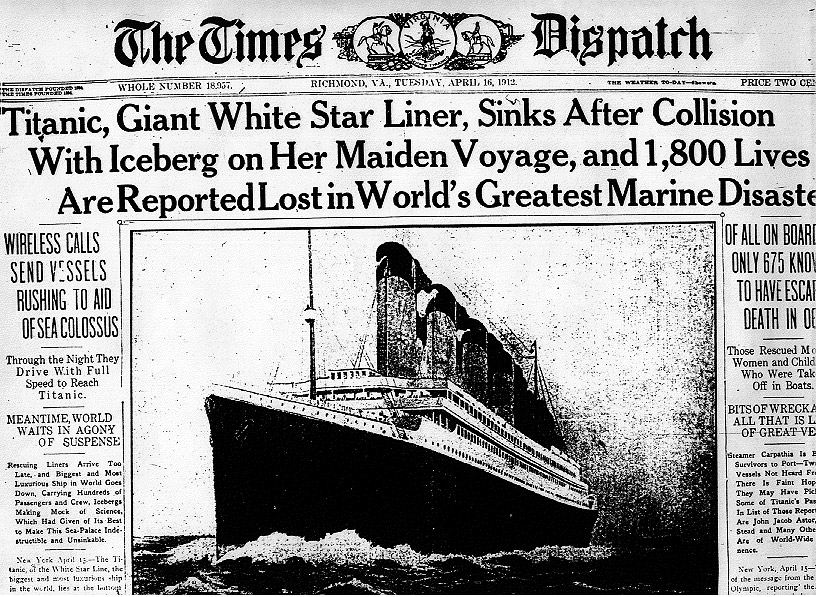
Dredging up the Past: Titanic and the Body of Memory

I just saw Titanic in 3D. I hadn't thought much about going to see it, and had even laughed at this rerelease as an easy money-making endeavor. Yet when some friends asked me to join, I went. I hadn't seen the film since it was in theaters the last time, before it won too many awards and became a parody of itself (i.e. "I'm king of the wooorld!"). I saw it on my first real date, cliche as that may be, and watched it with a mixed response. For the teenaged me, it was sad and awkward and romantic and manipulatively emotional. Then, as now, I loved the costumes. Even then, though I enjoyed the movie, I felt inklings of things I noticed this evening. I could talk, for instance, about the probably well-meaning but not very subtle way in which the film attempts to engage with issues of class or gender. The way that the rollicking party below decks lets us know that people with less money are more authentic, or at least more fun. The way that Rose's mother declares that women's choices are never easy just as she pulls Rose's corset strings tight. Yet something else caught my attention tonight, something I'd missed completely before. Seeing it after all these years, I still remembered the main Rose and Jack plot quite clearly, but the frame narrative hadn't stuck with me as well. Yet tonight I was fascinated by that frame.

The film opens with images of the submerged ship. Mundane objects are strewn about the ocean floor, the only testament to the lived experience of that drowned and broken metal hull. Eyeglasses, a baby-doll, a pair of boots exist in ghostly perpetuity, everyday items made strange by their decontextualization. The ocean, these objects seem to say, is not the natural realm for humans. It swallows us up. Unlike the topography on land, which can be marked by people, the contours of the sea shift continuously, and we can either float to shore or sink to the sandy depths. One must delve deep, quite literally, in order to find any traces of human existence in the ocean. The crew that opens the film, seeking history, fame, and fortune in the wreck, can reconstruct the sinking via computer, but they can't really understand it. They only see material value when they look at the submerged debris. As their inability to interpret the underwater landscape becomes apparent, a drawing of a young woman slowly emerges. They're not sure what to make of that either, except that the woman in the drawing is wearing the costly diamond they want to find.

It is at this point that a sweet elderly woman enters the picture, as if the re-emerged drawing had conjured her from the depths. She joins the crew and tells them all about her memories of the night the Titanic went down. Their fancy equipment can't help them to really understand, but this ancient lady appears just in time to interpret the objects and events for them. All of our images of the original ship and crew and passengers are through this elderly Rose's memory. The primary narrative is therefore invoked by her verbal recollections. For someone who has never spoken of the events before, who never even told her family about Jack, this lady sure can tell her story without a stutter. The men, who've only looked at the wreck for the fortune it could bring them, sit transfixed. They finally see the Titanic.

All of this reminds me of the Middle English poem Saint Erkenwald, which tells the story of an excavation that unearths an ancient tomb. As builders erect a cathedral atop the ruins of a pagan temple, they find a mysterious sarcophagus marked with ancient script. I think it's no accident that this image of palimpsestic architecture unearths such a living relic. While trying to build over history, the workers dig it back up in the form of this strange tomb. All of the most learned men attempt to read the mysterious writing on the tomb and to interpret its meaning. They look at the garments of the body inside the tomb and make conjectures about who he was, perplexed that none of their chronicles mention such a person. None of them can figure it out. As they begin to give into their frustration, they call in Bishop Erkenwald. He prays for guidance, and the long-dead judge buried inside the tomb arises and tells his story from the grave, explaining to them who he was and when he lived. And they finally understand. Erkenwald's understanding and empathy for the dead pagan man get represented physically in the tear he sheds upon learning that the good judge has been in hell all these years, and that tear serves as a kind of baptism that allows the judge's body to dissolve and his soul to rise to heaven. I never understood how the judge can speak English (or some language that the people recognize) when the writing on his tomb is in a language so foreign as to be completely unknown. But that is, I guess, beside the point. The material object from the past is illegible, even the writing from the past is unreadable, so the past needs to be literally revived in order to tell its own story. The resuscitated body of the past can help the people understand in a way that objects and letters never could. Or perhaps the revived body is representative of our attempts to get at that past via the objects and narratives we have. As Christine Chism argues in Alliterative Revivals, "death grants ghosts an interrogative force, imbuing the impossible, unceasing communication between the dead and the living, the past and the present with fearful intimacy" (1). The past is zombie-like in such texts; it rises from the grave and speaks aloud in order that we may hear it.

Though this film is quite different from that Middle English poem, it nonetheless features a past that becomes accessible through a figure emerging and speaking for it. The shot of young Rose's eye morphing into old Rose's eye (again, the film is not trying to be subtle) depicts the direct and physical link between the experience of the sinking ship and the story being narrated today. Though all is mediated via Rose's perspective and memory of long-past events, I suppose we are meant to trust her. If we have any doubts, the fact that she appears at the end with the diamond indicates that she's been conveying the events accurately. She's someone interested in tangible recollections, someone who carries all of her photographs with her when she travels. Yet she admits that she has no photograph of Jack, that there's no record of Jack. He lives on only in her memory. Jack has sunk deep into the sea, not to be brought back to the surface except through Rose's words. For the duration of her tale, the living, breathing, steaming love story can resurface. The captain and Mr Andrews and all the people above and below decks can breathe and speak and live and die as they did so many years ago.

The film could have simply told the story without the frame. It could have begun with Rose and Jack getting on the ship and ended with Jack's death or Rose's survival. It could have even been made from Rose's current perspective, but only in private recollection or more vaguely to us the viewers. Instead, the frame is of people today explicitly seeking something in the wreck and finding it in the person of an old women who once walked the decks of the ship they search. The past emerges bodily and memory is conveyed in color and sound and state-of-the-art special effects. Rose even opens with a description of the smell of fresh paint aboard the ship, a sensory contrast to the rusted and peeling metal we see today. When elderly Rose is finished with her tale, she can finally return to Titanic and to Jack, in dreams or perhaps in death. The narrative has not only brought those around to the ship, but it has returned her to it as well. She rose from the wreckage to tell the story, and then returned to it, along with her heart-shaped necklace.

The past, like the ocean, is never fully accessible to us. We can try to see what lies beneath the waves and we can pull a few things up to the surface, but it is never completely in reach. As a medieval scholar, I understand the frustrations of trying to access the past. And there is no one alive from the 14th century to tell me about it. The image of a body from the past emerging to speak to us is a tantalizing fantasy, as even people's narrations of the past can't actually take us there. Yet it's a fantasy that speaks to our continued longing to plumb those depths, to understand what lies beneath and beyond our own existence as we pass over the same land and through the same waters as people of long ago.

As I sit watching the same film as I did 15 years ago, I see the impossibility of fully understanding or reliving the past, even when that past is my own. On a superficial level, the film is now rendered 3-dimensional, but time has wrought its changes on me as a viewer as well. I notice different things and respond in different ways. My colleagues and I discussed the ways in which films and viewers have changed more broadly. My friend Amanda noted that this movie is situated in its time and place. Post-9-11, its disaster narrative would have meant something very different than it did to us all in 1997. Now we picture the twin towers or think about the socioeconomic realities that allowed some to escape Hurricane Katrina while others could not. I look at pictures of flood and remember the horrifying images from Japan after the recent earthquakes there. The film, already a heavily mediated image of history, is now filtered through all the disasters we've witnessed on the evening news in the past decade and a half. All of these connections make the film and the history it attempts to depict both more and less immediate. And yet it remains as an artifact and we engage with it and with both Roses and with our past selves as we sit in the theater. And we narrate the memories of our previous experiences with the film even as the film gives memory a tangible existence in the person of an elderly lady with a story to tell.