Showing posts with label pilgrimage. Show all posts

Monday, August 4, 2014

Like Sun on a Troll's Back: Tales of Iceland and the New Chaucer Society Congress

View of Reykjavik from Hallgrímskirkja
This summer I had the chance to visit Iceland for the Nineteenth Biennial International Congress of the New Chaucer Society. I am still processing the experiences I had, which loom like fantastical peaks in my memory. I went a week ahead of the conference so that I would have time to explore Reykjavik and spend some time in the surrounding country as well. As the conference grew nearer, I began to run into more and more familiar faces around the city, and it was exciting to feel that sense of connectedness in this beautiful new place. The conference was fantastic. I heard excellent papers and conversed with friends old and new. The energy of the conversations I had is helping to motivate me as I work through the final period of dissertation writing/revising. The congress also included excursions, so I got to see some stunning things both in and out of the city. The landscape in Iceland is startlingly, unbelievably beautiful. I asked my Romanticist friend if the word "sublime" applied, and she said that it did. Driving through the country there feels like driving out of this world and into a world of myth. I fell in love with Iceland. I immersed myself in sagas before and during my trip, and then the landscape of the sagas vivified and challenged  and confirmed everything that I had read or wanted to read.

Black sand beach at Vik
(The sea stacks may be trolls who
were petrified by the sunrise)
An incredible feature of the landscape is that every place I visited was interwoven with stories. These stories bridge the gaps between myth and history with growing grass and trickling water and surging lava. A cliff was a troll who'd been petrified by the rising sun. A pool of water  once splashed with the bodies of women hurled there to drown for adultery or incest or infanticide. The terrain there seems indifferent to humans (though maybe not to elves). Its beauty delights and beckons, but it seems like it isn't really meant for us either. I cannot imagine how the first settlers survived. Yet the stories that surround every topographical feature manage to lend it a narrative texture. Reykjavik, for example, exists where it does because Ingólfur Arnarson threw his high seat pillars into the ocean in 874 when he saw Iceland's coastline materialize on the horizon. The pillars landed in a spot made steamy by hot springs, leading to the name Reykjavik, meaning "smoky bay."

The city, then, functions as the living answer to a question from story: where will these pillars land? And other built environments are connected to stories as well. Visiting the turf houses of Keldur was a thrill, having read about them in Njál's Saga. The host, a stoic lady who grew chatty as we showed her our enthusiasm for the location and its history, told us that the foundation was a thousand years old, but that people had lived in the house we we're standing in until 1946. We could see the layers of construction; we could feel the temporal rift as we moved between two sections of the house that had been built 600 years apart. We looked at the mixed construction -- wood and stone -- that our host explained combined building practices from Viking and Celtic cultures, a sign that the settlers from Norway often stopped off in Ireland and Scotland to pick up slaves. Not only geographical movements, but sociocultural realities of the past leave their mark.


Turf houses at Keldur
Detail from Njáls saga fragment, c. 1300


But architectural wonders are not the primary attractions in Iceland. The people who settled there built no massive castles or cathedrals. And much of what they did build has disappeared under layers of time. The remains of  a longhouse, for example, feature in the Settlement Museum. The ruins were discovered during a construction project, and the museum is carved out around them in an underground space. As incredible as this museum is, most of the impressive buildings I saw are not medieval, but modern: the Harpa concert hall, Hallgrímskirkja church. The most dazzling remains of times past in Iceland are manuscripts and the recorded sagas and laws and history and myths they contain. And those narratives are written onto the landscape as surely as any wood or stone constructions could be. 

Leif Erikisson and Hallgrímskirkja
Inside Harpa


Outside of the city, the landscape seems to swallow up built structures with its shifting and boisterous geological demeanor. In the landscape of Þingvellir, fissures and cracks in the earth proliferate and separating plates reveal a path between the continents. In such a space, who could hope to locate the famed rock where The Law Speaker stood to recite the laws to the people? Grass-covered outlines of booths are the only traces of the lively gatherings that once crowded the space. Yet the story of the law rock and of the yearly general assemblies that took place there from 930 to 1798 still brings us to Þingvellir en masse. The description of the general assembly as a place to adjudicate disputes and visit friends and relatives is vivid in texts like Njál's saga. The land is steeped in the intersected narratives of geological and historical time.

The earth splits at Þingvellir

The multiplicity of temporal narratives written onto the landscape there reminds me of medieval mappa mundi, which feature Biblical and classical and contemporary history arranged spatially over the world. Medieval travel narratives (and Icelandic sagas, for that matter) connect their stories to locations, while the maps connect the locations to stories, but in each case there remains a strong sense that narratives and places are mutually constitutive. Since I was presenting a paper on this very idea, the location of the conference and my adventures there ended up connecting to my presentation in ways that I couldn't have anticipated. In my paper, "'By Sun and by Shadow': Narrative Mapping in The Canterbury Tales," I considered the frame of the The Canterbury Tales as a travel narrative and thought about the function of the tales in relation to travel. I guess it was inevitable that my own experience of traveling would link to my paper.

Walking behind Seljalandsfoss
In one memorable moment, for example, as I scrambled into a cavern behind the waterfall called Seljalandsfoss, I found myself rethinking how time is conceived in The Canterbury Tales. The power of the water was palpable, so palpable that I emerged from the experience drenched. Water rolls off of the mountain inexorably; currents and gravity converge so that the water travels forcefully in one direction, a teleological natural wonder. (Though I was later told that the wind is sometimes so strong that it can send a waterfall upward ...) Anyone who gazes into the heart of a waterfall can see that its movements are beyond human control. Harry Bailey evokes such an image in the prologue to the Man of Law’s Tale, when he laments wasted time:

Lordinges, the tyme wasteth night and day,
And steleth from us, what prively slepinge,
And what thurgh necligence in our wakinge,
As dooth the streem, that turneth never agayn,
Descending fro the montaigne in-to playn. (21-25).

The host’s description of time expresses the movement from one moment to the next in a strikingly geographical way. Time is like a stream, whose current only moves one way. The progression of time is like gravity, flowing down the mountain in a way that we mortals are powerless to fight. We are always in the flow of time; it’s not so visible or tangible as the waterfall, but its movement is just as relentless. The pilgrims’ trip to Canterbury might be meandering and, ultimately, incomplete, but time moves along as they tell their tales and we read them.

This description of time as a geographical feature connects temporal movement, often seen as linear and narrative (at least in many Western cultures), with the more spatial and visual. Since the frame of The Canterbury Tales is a travel narrative, this connection between narrative and landscape makes sense. Medieval travel narratives, all along the spectrum from real to fictional, follow a model of connecting locations to stories of things that have happened there (or may have happened there). And my travel the week before had been the same. The part of the gorge leading to Seljalandsfoss, for example, is named Troll’s Gorge for an old troll woman who tried to cross it. Other places I visited connect to people and events from the sagas, and the sagas in turn are consistently connected to topographical features that we can visit today. A hill or city or waterfall links us with things that happened there a thousand years ago. Travel narratives more generally serve to yoke stories and locations. Medieval mappae mundi take this connection even further, collapsing past and present by presenting all of their details in
Babylon and Tower of Babel from Ranulph Higden’s Polychronicon
(From the British Library's Medieval Manuscripts Blog)
terms of space: here is where Lot’s wife looked back, here is where the Tower of Babel was constructed, here is where Alexander crossed the Hellespont. In Maps of Medieval Thought, Naomi Reed Kline describes the medieval world map as "a visual encyclopedia of images and disparate facts" which she contrasts with the "linear and discursive" nature of language (89). The depiction of historical narratives on these maps is spatial rather that teleological; bits of text only make sense in terms of their location on the map. Pilgrimage both relies upon this sense of narrative location and imposes a linearity to it, as pilgrims create an itinerary to a place because of the story associated with it. You go to Canterbury because that is where Thomas Becket was martyred. (And many of us, in turn, go to Canterbury because of The Canterbury Tales.) Chaucer's pilgrims perpetually travel the road to Canterbury, always moving toward it and never arriving. Yet The Canterbury Tales do not describe the journey itself, do not recreate the landscape or experience of travel in words. Rather, the text employs a kind of narrative mapping to move the characters along via stories. Tales whose subject matter spans the globe serve to paint a line between two distinct locations in England.

I argue that Chaucer's use of narrative mapping in The Canterbury Tales serves to reexamine the ways in which time and space function together in the act of traveling. Chaucer specifically calls attention to the connection between story and travel in the prologues to The Man of Law's Tale and The Parson's Tale. In each prologue, the host notes the position of the sun and the shadows it creates in order to ascertain the time and thus to decide how many tales may yet be told that day. Each tale is told as a result of these calculations, and thus each tale begins with a specific sense of correlation to the journey at hand. Unlike the bits of narrative on mappae mundi, these stories do not directly concern the location of their telling, but instead represent the movement through time and space that constitutes travel itself. To map the progress of these pilgrims, then, is only possible by engaging with acts of storytelling.

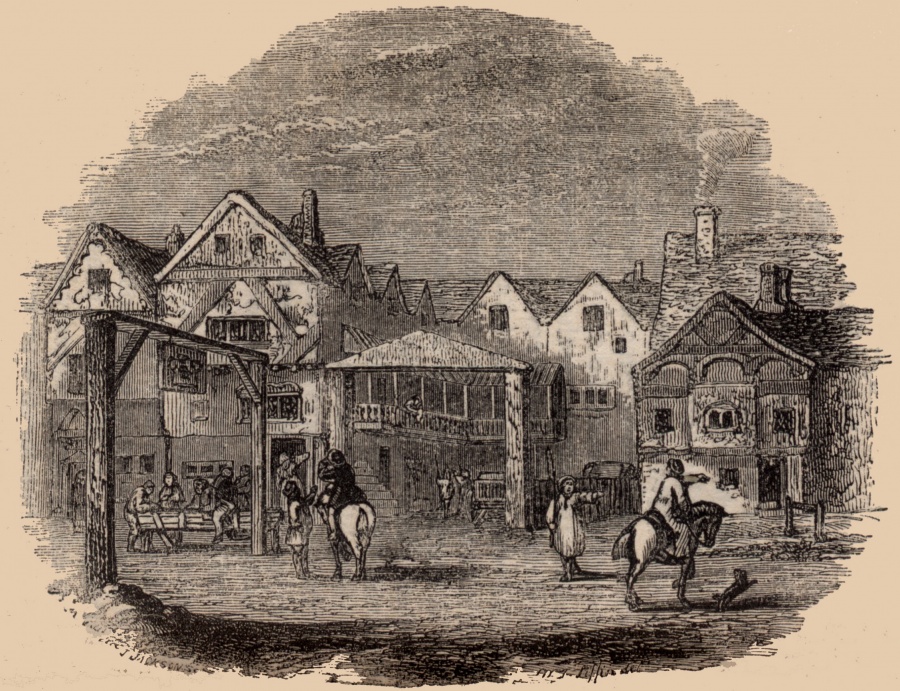
The Tabard, Urry's edition of Chaucer (1720)
(Courtesy of Visualizing Chaucer)
In the prologue to the Canterbury Tales, the narrator takes pains to give us “Th' estaat, th' array, the nombre, and eek the cause/ Why that assembled was this compaignye/ In southwerk at this gentil hostelrye/ That highte the tabard, faste by the belle” (716-19). The people on the trip are clear to us, so much so that my students came in angry with the Wife of Bath one semester. We get details about them that give context to the stories they tell, and many of the stories (such as the Wife’s) are deeply rooted in the character who tells them. The places are far less clear. My colleague Kara McShane has recently created a website called Visualizing Chaucer, and it features a constantly increasing number of images of the pilgrims and their tales. Under the heading “places,” however, only two locations are mentioned: the Tabard Inn and Canterbury Cathedral. Since the pilgrims never seem to actually make it to Canterbury, the Tabard Inn is the only place in the text well-defined enough to illustrate. And even the inn is simply placed “fast by the belle.”  Despite the frame’s implied movement, the stories could be told anywhere (though the pilgrimage gives a reason for the disparate group to be together, and starting in Southwark may increase the possibility of mixing such a cross-section of society). Once the tale-telling begins, the movement from Southwark to Canterbury recedes into near invisibility as we’re treated to tales with locations that are both specific and general but that do not in any way correspond to the landscape through which the pilgrims move.

Because of this lack of topographical detail, the moments when the host does seem to call attention to the surroundings are striking. Before introducing the Man of Law’s Tale, we are told that
           
           Our Hoste sey wel that the brighte sonne
The ark of his artificial day had ronne
The fourthe part, and half an houre, and more;
And though he were not depe expert in lore,

He wiste it was the eightetethe day
Of April, that is messager to May;
And sey wel that the shadwe of every tree
Was as in lengthe the same quantitee
That was the body erect that caused it. (1-9)
Photo from my own pilgrimage to
Canterbury in 2011

The passage continues for some time, as the host notices many things about the shadows and infers many things about the time on account of what he sees. Josie Bloomfield pointed out last year at the Plymouth Medieval and Renaissance Forum (in a talk titled "Walking with an Astrolabe: Measuring Time on Chaucer’s Pilgrimage") that his information is not particularly accurate and is more cumbersome than it needs to be. If the host wants to know the time, listening to church bells would be much easier. And yet Chaucer chooses to write it this way. The details he includes might not describe a specific location on the journey to Canterbury, but they do describe sun and tree and shadow in order to define a specific point on the journey. As Helen Cooper explains in The English Romance in Time, “A phrase such as ‘a day’s journey’ is in fact tautologous, since ‘journey’ derives from journée, how far can be covered in a day. Distance itself was hard to measure, and the conversion of space into time provided a functional and accessible approximation. The ease of the conversion is itself an indication of how one-dimensional travel appeared, like time itself. The conversion worked in the other direction too, to represent time as space. Dante famously claimed to have had his vision of Hell, Purgatory, and Heaven mid-way along the pathway of his life, in the thirty-fifth year of his allotted seventy” (68). To travel is to move through space and time simultaneously, and to pilgrimage is to ultimately to collapse the two. We go to the place where Becket was killed in the past because that location has meaning for us in the present. The host further connects location to time when he uses the waterfall metaphor I mentioned above. The conclusion of his astronomical musings is to ask the Man of Law to waste no more time and tell his tale. There is some irony in how much time the host spends in trying to move things along, but the sustained focus on scenery and time and story-telling functions to remind us of the connection between travel and narrative in the Tales.

The tale the Man of Law tells is itself full of travel, as Custance sails from east to west and back again. Kathy Lavezzo argues in Angels on the Edge of the World that "since Custance's journey begins in Syria, the cartographic territory evoked in the tale . . . suggests a map of the world" (95). Both we as readers and the pilgrims as listeners can follow Custance’s voyages while the Man of Law describes them. Stories, after all, are a kind of travel, as reading about travel to holy places sometimes functioned as virtual pilgrimage for those who
Detail from Gustaf Tenggren illustration
to the Man of Law's Tale (1961)
couldn’t make the actual journey. Yet as John F. Plummer noted the same day as my own talk in a fantastic paper called "Figures of Geo-political Spaces in the Man of Law's Tale," 
Custance’s journey is not as specific geographically as it is in Chaucer’s sources. The Man of Law often cannot name the castle or island on which Custance lands. At one point he explains that her boat goes "Som-tyme West, som-tyme North and South,/ And som-tyme Est, ful many a wery day" (948-949). So, basically, her boat goes in every direction. Nothing could be farther from the image of the forcefully direct waterfall. And time is no less clearly defined. Custance’s ship is carried back and forth across the ocean for "Yeres and dayes," a time that seems specific, with the addition of days, and yet is nonetheless vague (463). How many years? How many days? Later, her ship is at sea for "Fyve yeer and more" -- we do get a number of years this time, but the "and more" undoes that precision (902). The sense of movement over space and through time is almost magnified by this unspecificity, as our heroine’s movements could cover any distance we could imagine. Yet the passage of time is indelibly linked to the oceanic spaces through which she is traveling. Everything about her tale is rooted in her landscape (or rather oceanscape).

The second mention of sun and shadows comes before the Parson’s Tale, which is further removed from physical travel than the Man of Law’s choice of material. In this second instance, the geotemporal reflections in this scene come not from the host, but from the narrator Geoffrey. He begins with reference to the previous tale, which places the observations explicitly between tales:

By that the maunciple hadde his tale al ended,
The sonne fro the south lyne was descended
So lowe, that he nas nat, to my sighte,
Degreës nyne and twenty as in highte.

Foure of the clokke it was tho, as I gesse;
For eleven foot, or litel more or lesse,
My shadwe was at thilke tyme, as there,
Of swich feet as my lengthe parted were
In six feet equal of proportion. (1-9)

 My own interaction with sun and mist and
flowers at the base of Gullfloss
With the shift from host to Geoffrey, we also get a more personal interaction with the landscape, as the calculations are made not in terms of trees, but in terms of his own shadow. As before, the landscape is vague and general, and yet it is nonetheless there, and both time and tale-telling are defined by it. And the implications of sun and shadow must be clearly evident, since the host responds to them even as Geoffrey tells us about them. The narrator explains that it is because of the telling length and angle of the shadows that the host addresses the pilgrims:

                      … 'Lordings everichoon,
Now lakketh us no tales mo than oon.
Fulfild is my sentence and my decree;
I trowe that we han herd of ech degree.
Almost fulfild is al myn ordinaunce.' (15-19)

The tale-telling is meant to accompany the trip to Canterbury, so the idea that all but one pilgrim has told a tale and that the host’s ordinance is almost fulfilled gives us a clear sense of movement. If this many tales has been told while riding along, they must have been getting somewhere. And again this knowledge of movement and this request for another tale comes from observations about the play of the sun on the world, details about their surroundings so clear that the host could speak up even as the narrator muses to us about his own shadow.

The Parson’s Tale that follows is, to put it mildly, different from the Man of Law’s. In response to the host’s invitation to give the company a fable, the parson retorts “Thou getest fable noon ytoold for me” (31). And not only is it not a fable, but it’s not even really a tale at all.  It’s more of a sermon. While the Man of Law, responding to a similar request from the host, sends us around the world with his narrative, the parson wants us to instead look inward and examine our souls for a different sort of pilgrimage. As he explains,

          And jhesu, for his grace, wit me sende
          To shewe yow the wey, in this viage,
          Of thilke parfit glorious pilgrymage
          That highte jerusalem celestial. (48-51)

The parson wants to achieve the perfect pilgrimage of celestial Jerusalem, which isn’t physical but is rather spiritual in nature. Even though tales like the Man of Law’s don’t
John's vision of Christ and heavenly Jerusalem, Revelation 21: 2-8
from Yates Thompson 10 f. 36
(Courtesy of the British Library)
directly relate to the voyage at hand, they’re still part of a shared game of tale-telling that is associated with the time it takes to get from one place in England to another. The Parson, on the other hand, yanks us out of the temporal realm and leads us to a kind of pilgrimage that is related to a Canterbury pilgrimage spiritually (at least ideally speaking – some pilgrims seem to have more spiritual reasons than others), but is distinct in more practical ways. As Helen Cooper notes, “The pathway of life is also the journey of life; life as quest” (68). We’re all moving from birth to death, and many hope that death will be followed by a pleasant afterlife. As the narrator in Pearl just can’t help but try to cross the river in his vision, it’s easy to mistake geographical movement as the way to achieve that ultimate pilgrimage, but the parson insistently reminds us that we must look inward and turn our minds to higher things. It is perhaps telling that a “tale” with so little connection to either narrative or location follows an extended musing on the visual cues of the passage of time.  We might long for the eternal, but in the meantime we’re stuck in the temporal realm.

As we read these moments where time and space rise to the surface of the Canterbury Tales’ frame narrative only to be followed by tales with an increasingly vague sense of physical locatedness, the connection in narrative between time and space becomes both apparent and richly complex. It is impossible to separate the one from the other, and yet neither is fixed. Whether we read a story or travel to Iceland or just sit and wait, things change. Time passes. The earth shifts, and landscapes are built and rebuilt. The simultaneously uncertain and sure movement of those pilgrims as they wend their way and tell there tales both removes us from time and space and reminds us that we can never escape them. Except, perhaps, in the afterlife.


Layers of lava rock look heavenly to me

Thursday, June 6, 2013

Kalamazoo 2013: A Pilgrimage

I wrote most of this from about 36,000 feet above Newfoundland – a fitting starting point, I think, since I was returning to the U.S. from Norway by way of Iceland (after attending a conference on medieval Scandinavian literature, no less).

I had a long a fruitful journey during the month of May, and I’ll try to do some of it justice over the course of a few posts. These posts are a bit delayed because I came back from Norway with a fever and raging laryngitis and have spent the better part of the past week recouping! I’m doing much better now though, and will be loading several posts throughout the next week or so now that I'm capable of lucid thought. This first one will focus on Kalamazoo, which was certainly the busiest Congress I’ve ever attended. I presided twice, organized and participated in a performance session, and presented a paper on Pearl. There were lunches, dinners, and outings aplenty, and it couldn’t have come at a better time.

I’d been feeling severely run down prior to the trip. The lack of full-time work has been stressful, especially since my husband’s start-up had to let him go earlier this year, and there were a series of personal tragedies right around that time that made life painfully confusing and heart-breaking. Whenever tragedy has truck in the past, I’ve looked to my work to feel some sense of purpose or control, but the screeds against graduate school, the humanities, etc., the rise of MOOCS and for-profit institutions (and attitudes), and the at times oppressive amount of uncertainty surrounding my own future really dampened my ability to feel and hold onto a sense of purposefulness. As a result, I came to Kalamazoo feeling more than a little beaten down and adrift. More and more though, I’ve come to see the journey to Congress, and the experience of it, as a sort of pilgrimage. One that comes just at the right time — just as I’m starting to lose my sense of why I do what I do. I am so profoundly glad that I made the journey this time, because it renewed more of my enthusiasm and my sense of purpose than I’d ever hoped to win back in such a short span of time.

For starters, this was a ‘zoo of serendipitous encounters. I’d been so busy (between the end of the semester hustle, visiting family, and prepping for two conferences) that I’d only made contact with just a few of the people I’d hoped to see at this conference. Somehow though, I happened to be at the right places at the right times, because I managed to bump into just about everyone! The conversations may have only lasted a couple of minutes in some cases, but it meant the world to see familiar faces from grad school and past conferences and at least get a brief moment to reconnect.

The serendipity also extended into new meetings as well. Thanks to a chance encounter at one of many dinners out, I received sage advice about approaching publishers about my book project. Inspired, I spent time Saturday and Sunday chatting with publishers and had several encouraging conversations along the way. While there aren’t any guarantees, I’ve got a clear sense now of who to send materials to once I’ve got them completed, and that’s a great place to be (especially after having felt so stagnant for the past couple of months). I also had an absolutely marvelous time at the BABEL meet-up at Bell’s Brewery. I joined the working group in the Fall of last year because I’ve enjoyed following the playful, experimental, but always meaningful work that BABLErs produce. I also joined because I’d been feeling adrift since moving away from my tightknit community at Rochester last year, and joining an energetic cohort like this one seemed like a wise move as I transition into this new and liminal stage of academic life.  My schedule at the Congress had kept me away from the meeting and the sponsored sessions thus far (alas!), and so I felt all the more drawn to the gathering in spite of the late hour (I think I got there around 11:30pm after having gone over my paper which I was presenting the following morning). An array of wonderful exchanges ensued, and a nascent project even emerged by way of a conversation about bears, idiot tourists, and lava. I’ll keep things cryptic for now, but I’ll hopefully be able to post more about said project in the near future. In the meantime, I’m struck with a profound sense of gratitude for all of the people I met and reconnected with at this conference. Their generosity — in their advice, their sharing of ideas, their collaborative spirit — overwhelmed me in the best sense of the word, and I’m deeply grateful for the renewed energy and enthusiasm they helped instill in me in such a short span of time.

The sessions I attended also went a long way towards renewing my enthusiasm. It’s always a delight to be surrounded by people as vibrantly excited as you are about a particular topic, and that enthusiasm really shone in the sessions I was able to attend and in which I had the pleasure of participating. The first one I attended was “Romancing Islam,” and I was deeply impressed with Bonnie Erwin’s masterful connection between the mechanics of othering in Ferumbras and in the aftermath of the Boston Marathon bombing: a connection that hinges on the desire for the familiar Other (in both cases, a Muslim Other by way of convenient branding). I was also very glad to see an Early Modernist on the panel. Dennis Britton spoke on the allegorizing of Islam in the Faerie Queene, and made a compelling case for the influence of contemporary proto-ethnograpic writings on Spenser’s portrayal of the (Islamicized) figures Wrath and Lust. He also convincingly argued that moments of conversion in Book II (where these figures regularly appear) are not only absent but “actively denied.” In this formulation, the Saracens are made to be incompatible in ways strikingly convergent with those seen in medieval romance. His presence on the panel and the inclusion of Spenser alongside medieval texts invited both the speakers and the audience in the Q&A session to get out from under the pressures of periodization and to talk across the (often fictionalized) divide between the Medieval and Early Modern periods. I joked on Twitter earlier in the year about creating an anti-Greenblatt panel for K’zoo called “Interswervist Aesthetics,” but it was lovely to see much of what The Swerve seems to advocate effortlessly elided in the conversations that came out of this session.

The same kind of connectivity seen in this session extended into the one over which I was delighted to preside. The papers knitted together incredibly well, and I was thrilled by how — despite the focus on a the editing of a single manuscript — each paper had something unique to offer to the conversation. Joyce Coleman focused on the images in the manuscript, specifically those attached to Pearl, and persuasively argued that the illustrator sought to draw parallels between the dreamer/narrator of the poem and Narcissus as he appears in illustrations of Roman de la Rose. Kelsey Moskal asked that we try to find a way to avoid “sterilizing the manuscript reading process” by finding ways to acknowledge the subtle but significant markers, details, and ordination found in the manuscript itself as we produce critical editions. Elias Fahssi stressed the power of exploratory reading, and how faithful reproductions of the text assist in that process. Finally Arthur Bahr challenged our uses of punctuation when it comes to a poem like “Patience,” observing that the quatrain marks in the manuscript are important specifically because they are so difficult to interrogate. He argued that the marks, while not being puncti, suggest a certain kind of pause, which seems especially apt in this poem given its stress on the length of time it “takes humans to perform God’s will.” The inclusion of these marks, then, link readers to Jonah, reminding us that “we are bound in time, differing from Jonah only in degree, not in time.” In the end, Bahr offered up the possibility that we needn’t punctuate definitively, especially when it comes to a poem like “Patience” that seems to be playing with the kinds of pauses produced by such marks.

The conversation that sprang from these four papers was wonderfully lively, and we discussed, among other things, the ways in which we might reconcile all of these various needs and emphases when trying to produce accessible critical editions.  More than anything, I think the session really drove home the sacrifices that inevitably get made when trying to prepare these texts for modern readership, and it was gratifying to see so many people engaged in a discussion of how we can serve both the reader and the original text. To that end, I was very happy to hear later on at the conference that Kelsey and Elias will be taking on more active and official roles in the Pearl Poet Society — as contributors to the fantastic Cotton Nero A.x. Project, and in light of their illuminating papers, I can hardly imagine a better team!

I’ll save a discussion of the session in which I presented — “New Perspectives on Pearl” — for my next post (one that will include the actual talk), but all I’ll say for now is that I was tremendously grateful for the experience and for the feedback received both prior to and during the session itself.  I’m starting to experiment with ideas for a later project (once I get this first book off and away. . . god, if it were only so easy!), and I was so glad, as a result, to have this opportunity to present my nascent ideas for that potential work. More on that later though!

The last session I attended was BABEL’S Blunder panel, and what a delight it was! In some respects, the papers couldn’t have been further apart — with topics ranging from blunder in Beowulf, to the cruelty/inanity of blind peer-review evaluations, to the poetics of scribal blunders, to the poetics of our own conference papers/sessions, to the inception of Fumblr — hands down one of the most humanizing academic blogs I’ve yet encountered. I was struck by the beautiful discursiveness of these presentations, by their verve and energy, by their braveness. Those qualities extended into the lively conversation/debate that followed, one that focused for a time on the perils of blind peer-review. Eileen Joy made a particularly innervating statement about the problems with the current review system, problems that were made painfully clear in Maggie Williams and Nancy Thompson's presentation: that reviewers forget all too often that they’re dealing with human beings who have struggled hard to produce the work that they’re tasked with reviewing. If we are in the business of the humanities, she argued, then we need to start treating each other more humanely. This does not, as one person in the crowd worried, mean that we have to pull our punches when we review, or that we – as receivers of criticism – shouldn’t have a thick skin. Rather, as I offered in tandem with others, we owe it to ourselves (if we are really going to pride ourselves in our mastery of language) and to those whose work we review to write both effectively and humanely. Ultimately, I think that double-blind peer review can be essential to fair treatment in the realm of publishing (people are, for instance, presumably less likely to be discriminated against for a variety of unfair reasons), but as so many of the audience members and presenters stressed, it’s often rather easy to tell who is reviewing your work or who authored the piece you are reviewing. As such, the question remains as to how helpful this set-up actually is, especially when it seems to give so many people license to behave rather unhelpfully (not to mention rather poorly) because they can hide behind the mask of anonymity.

No Congress would be complete without a fair share of levity, and so it was all too fitting that I capped everything off by attending the Pseudo-Society with a merry band of friends. The papers were hilarious, and I especially loved the fact that they so freely poked fun at the conventions of the academic conference. It’s always good to be reminded not to take yourself or what you do too seriously, and the pseudo-society’s “talks” did a more than decent job of reminding us of that!

All in all, this was certainly one of the most fruitful and fulfilling conferences I’ve ever had the pleasure to attend, and I’m already looking forward to next year. As I’ve said throughout this post, attending the conference did a tremendous amount to boost my spirits and enthusiasm for what I do. It helped to remind me, in a series of truly profound ways, that I have made good decisions about my career (no matter what the screeds might say), and that while my life might be precarious and under a variety of intense pressures, it’s also full of electric opportunity. And so, in closing, I’d like to say thank you — a thousand times over — to all of the wonderful people at this conference who helped remind me of that.

Monday, November 12, 2012

A Pilgrimage to Williamsburg . . .


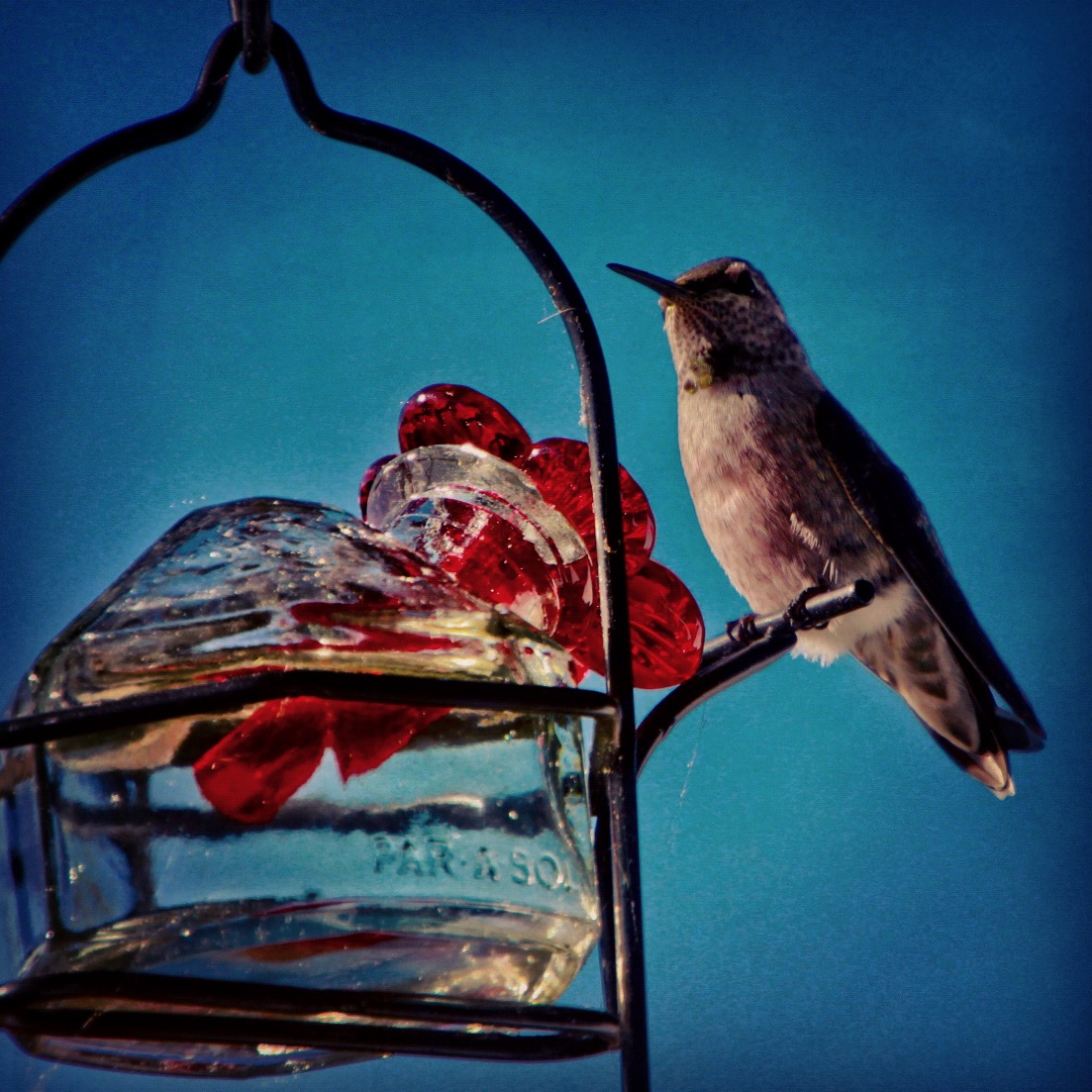
Taken when I was much better at refilling the feeder . . . 
I am currently sitting on my lovely porch, catching meaningful looks from the local hummingbirds. Their feeder desperately needs a refill, and I think they’re doing reconnaissance for an impending revolution. I also just narrowly escaped from a lounge of lizards dangling underneath my porch umbrella (apparently a group of lizards is called a “lounge” . . . the things you learn!). It’s been a few weeks since my trip back to Virginia, and I’m thankful for the quiet time I have now to reflect upon everything I experienced while I was away. Each day of my trip was lit up with reunions, lectures, dancing, weddings, and more, and I find myself overwhelmed, in a good sense, with all I experienced.   These events converged with one another in truly surprising and beautiful ways, and I’ll try to capture at least some of that here.


I travelled back to Williamsburg, VA on October 2nd to attend a variety of events. Monica Potkay, who is in no small part responsible for my love of Chaucer, invited me to lecture for the Medieval and Renaissance Studies department at William and Mary on a topic related to my dissertation, and George Greenia — ever a source of support and encouragement throughout my undergrad and graduate years — invited me to submit a paper to the Annual Symposium for Pilgrimage Studies he was organizing.  For the lecture, I chose one of my favorite topics of late: the representation of Mongols in Middle English Romance. For the conference paper, I decided to revisit my old flame Sir Isumbras, choosing to approach the romance from the angle of redemptive pilgrimage rather than that of crusade. Lecturing at my alma mater was at once comfortable and surreal. I’d presented on this topic once before, and I knew the College very well, but it felt strange to inhabit a new role in this place all the same. I was deeply touched by the number of my professors who attended, and I had at least a few moments where, as I looked out at the students, I realized that I was in exactly their position only a handful of years ago, and that I honestly didn’t feel that differently from how I did back then. Admittedly, I can’t pull the all-nighters I used to (I've tended of late to fall asleep like a cartoon character around 11pm), and I know a lot more stuff than I did back then. I’ve also been through a tremendous amount — experiences both wonderful and tragic — that has certainly impacted how I see and respond to the world and those around me. And yet, as I stood up at the podium waiting to get started on the talk, I realized that what hasn’t changed at all is my enthusiasm for what I do. I had worried at various points throughout my years in graduate school that I was choking what I loved to death (and sometimes I really think I was!), but what hit me in that moment before the talk was that I still felt like a student in a certain sense. I still felt the gravitational pull of all I had left to discover, and that was why I was excited enough to stand up in front of a group of (mostly) strangers and talk about my findings for an hour.  A pleasant feeling, to say the least!

A tremendous amount happened in between this lecture and the conference. My incomparable sister-in-law got hitched to a truly great guy, and we all danced together (many of us in pink dresses and feather boas) late into a gorgeous Fall evening to the dulcet tones of Van Halen, Journey, and The Beatles. My good friend Andrea and I crashed our undergrad advisor’s office hours with Cheese Shop sandwiches (and beer) for a long-overdue reunion, and I also had the great pleasure of reconnecting with a professor who had always encouraged my poetry writing and whose children I’d babysat for a few of my undergrad years. I hadn’t seen them since I graduated, but it felt in many ways as though we were picking up where we left off – barring the fact that the son I babysat as a little one is taller than me now (which, in fairness, isn't that hard to accomplish, hobbit that I am).  I made sure to spend an evening training and having an incredibly meaningful conversation with my Sensei, who has been a constant source of wisdom and support for as long as I've known him. 

I also met up with someone I hadn’t seen since high school but who serendipitously came back in to my life a few months ago; we’re facing a lot of the same challenges at the moment in certain aspects of our lives, and being able to talk with her and find an ally at this particular juncture was such a gift.  Last but certainly not least, the long stay allowed me to spend a lot of quality time with my parents and sister (my brother was still deployed at the time, but I’m happy to report he is now home safe and sound!), and I even made a brief trip down to North Carolina to visit with my grandmother, who I hadn’t been able to see since my grandfather passed away this past summer. 

Each of these wonderful reunions reminded me of how important it is to stay connected with those who matter in my life, and to always take the chance to reconnect with those I’ve accidentally eluded over the years.  The work that brought me back to William and Mary was certainly important, but the combination of work and “play” reminded me of what Eileen Joy asked recently in her post on friendship: "What would it mean to imagine one’s career, one’s writing, as a sort of devotion to another, to a beloved, whether mother, sister, lover, or friend? Or even to a set of friends, those already met and those still unmet, a kind of ceaseless love-as-talking?” In a way, my work on this trip pulled me back to Virginia and allowed all of these wonderful reconnections to occur, and I rather love the idea of imbricated work and friendship. Her challenge — that we don’t necessarily need to separate work and life — really resonated with me on this trip as a result.

The symposium I attended was the first one ever held by the Pilgrimage Institute at the College of William and Mary, and in many ways it aligned with this desire to balance and comingle work with other aspects of ones life.  Attendees and presenters came from a variety of fields and vantage points. Some were academics. Others were dancers. Some were art therapists. Others were documentary directors. Many were pilgrims. This vibrant mixture of passions and careers imbued the symposium with an eclectic energy I’d never quite experienced before at a conference.  The weekend kicked off with a rough-cut screening of “The Camino Documentary” directed and produced by Lydia B. Smith. The documentary focuses on Camino Frances, and follows a diverse array of pilgrims who embark on a pilgrimage for equally varied reasons. Some travel in memory of a loved one who has passed, some for the adventure and the challenge, some to find missing parts of themselves. I was struck, however, by something that a monk said at the outset of the documentary. He talked about how the external journey is important, but that the internal journey one undertakes when on a pilgrimage is of equal if not greater significance. This resonated strongly with what I was preparing to say in my own presentation on virtual pilgrimage, and it was fascinating to see it play out in the lives of the pilgrims on the screen. What truly impressed me, however, was the fact that the documentary didn’t push any particular narrative on the pilgrims.  The ending was cathartic, but it didn’t pretend that every person who journeyed on the Camino was fundamentally altered. The changes, if there were any, were subtle and allowed their privacy, something that I’d imagine can be hard to balance in the making of a documentary film about personal journeys. 

The following day was one largely made up of presentations, and I was especially taken with the student exhibits on display between the major sessions. The undergraduate presenters had attended the Camino abroad trip this past summer and had – as part of the requirements of the program – completed a research project focused on a particular aspect of pilgrimage. Their research interestes were diverse, creative, and deeply insightful, and it was thrilling to see so many intrepid undergraduates working hard on new and exciting projects. I had an especially serendipitous conversation with one of these students, Robin Crigler, who focused his project on aspects of playfulness and ritual on the Camino, which reminded me yet again of the power of conjoined formality and informality (it really seemed to be the running theme of this trip).

My own presentation, which I’m providing at the end of this post, was a standard conference paper, but I decided to be a bit bolder in terms of what I encompassed. I introduced my topic — Sir Isumbras’ use of pilgrimage imagery — by way of Google Earth, Petrarch, and German nuns, and even though I worried initially that the combination made for nothing more than insanity, it somehow all came together. Considering Isumbras from the angle of pilgrimage rather than crusade was hard at first. I kept wanting to talk about its crusading themes because that’s what I knew best. Forcing myself to stick with pilgrimage, however, allowed me to discover a whole array of new possibilities in this text. I had honestly gotten very tired of Sir Isumbras after working on it in both the dissertation and in an article for Chaucer Review. Discovering something new about the romance went a long way towards reigniting my enthusiasm for it, and it helped to reminded me of the value in taking diverse — and seemingly contradictory — approaches when analyzing (dare I say journeying through?) a text.

We drew on "shrinky-dink" paper, and then got to watch our
creations warp and diminish in a toaster-oven. The point was
to experience anxiety over the loss of our creation, only to
realize that it was simply undergoing a transformation. Much
like the experience of pilgrims on a journey . . . 
I decided to attend the session on pilgrimage and art therapy following my own, and was so very glad that I did. It was unlike any session I’d ever participated in before. The presenter, Wanda Sawicki, explained how she uses art therapy and the concept of journeying to work with her patients. She explained that "pilgrims who struggle with integrating transformative experiences from the Way into their daily life can benefit from engaging in creative work through art therapy;" in other words, the virtual can assist and enrich the actual. She invited all of the attendees to participate in an exercise with her to help demonstrate this concept. She asked all of us to meditate on a place we have journeyed to, or even a favorite place where we like to go walking, and think about the colors of that location. She asked us to imagine ourselves in that space and to focus on the colors closest to us and then move further and further out to the horizon, taking in all of the hues we recalled along the way. Afterwards, she invited us to paint our own mandalas with those very colors and images in mind. The point of all of this was to create a virtual journey that recreated the same positive transformations and emotions we experienced in the actual space. Her exercise converged in surprising ways with my own musings on virtual pilgrimage, and it was fascinating to me that centuries — even millennia — after the creation of labyrinths and other modes of virtual travel, we still find value in (and are pulled towards) these kinds of meditative journeys. 

This theme continued into the evening at the dance performance. Each of the dances performed were powerful in their way, but I was especially struck by the concluding act that, like the art therapy workshop, enacted a form of virtual pilgrimage. The dancers journeyed across the stage, acting out their struggles with the landscape and with the limitations of their bodies. They climbed. They stumbled. They pressed on. They carried one another. They eventually made it to Santiago. The choreography captured the arduousness and cathartic nature of such journeys, and also served as a beautiful example of how powerful the visual representation of such journeys can be. It also made me recognize an alternative meaning of the phrase “to feel moved.” It occurred to me that when we say as much, we’re actually suggesting transportation — that meaningful events, moments, performances, etc., actually have the power to inspire powerful virtual journeys of their own.  

The final day involved two diverse and fascinating plenaries — one on the shifting meanings of pilgrim garb and the other on an ‘eco-evangelical’ pilgrimage along the Sao Francisco River — and a concluding round-table meeting about the future of the conference and the Institute. This kind of meeting was new to me as well, and it was an absolute delight to attend. We all volunteered ideas and suggestions for the financial plans of the Institute, and also raised suggestions for future symposiums. By the end of the meeting, it seemed like we had an array of exciting future plans in the works, and I cannot wait to see what the Institute has to offer in the coming months and years. The energy and conviviality of this weekend gathering was infectious, in no small part because of how welcome people were to simultaneously analyze and personalize the experience of pilgrimage. This conference quietly broke down the divides between academic and non-academic modes (for lack of a better set of terms); both became equal and complementary partners in this setting. I think that the topic of this conference — pilgrimage — invited this kind of openness. It is impossible to completely separate the intellectual from the personal when we talk about these kinds of journeys, since the experience of pilgrimage is meant to be deeply subjective. This isn’t to say that all conferences have to be this way, but I certainly hope that this one does, because it allowed for an array of striking convergences to emerge in even the most unlikely of places.

As soon as the meeting wrapped, I dashed over to Mama Steve’s (my family’s favorite place for brunch) for one last get-together before I headed to the airport. While there, I noticed — of all things — a person who looked suspiciously like Santa Claus sitting at the table behind my mother. As I chatted with my parents, I couldn’t help but notice him as he stood up (in a Christmas-themed aloha shirt) and assembled a plate of homemade cookies from the contents of a cooler he’d brought with him. He placed a holiday card for the waitresses next to the platter and then left the restaurant as casually as an aloha-attired Santa possibly could.  The waitresses seemed bemused, and for a few seconds I worried that they were going to turn skeptical and toss the cookies in the trash. To my delight, they did no such thing, but passed the plate around to each other, laughing and enjoying a moment of mirth in an otherwise hectic Sunday. The wonderful absurdity of this scene seemed a fitting way to conclude this trip. A little reminder, perhaps, to take the time to revel in moments of subtle hilarity — to be playful — in the midst of everything else around me. 

I left for California that evening with a truly full heart, and I’ve remained deeply grateful for all of the renewed energy and enthusiasm I’ve been able to bring back with me.  I’ll close for now by offering up my paper, and will look forward to sharing other ideas with you all very soon. Cheers!


Sir Isumbras and the Virtual Pilgrimage

The term virtual is loaded with an array of very modern implications.  Select Google Earth from a smart phone, for instance, and you can find yourself transported to any far corner of the virtual globe, many of which can be viewed in 3-d. Click on Skype, Facetime, or any number of other such programs and you can have virtual face-to-face conversations with friends a half a world away. The desire to bridge vast and uncrossable distances propels us towards the world of the virtual, and I would hazard to guess that each of us can think of at least one occasion (if not dozens) where that ability was deeply comforting. This desire extends quite naturally into the world of pilgrimage, and a wide array of cyberpilgrimages are available to a modern peregrinator. You can find apps that allow pilgrims to virtually participate in pilgrimages to Lourdes, and I even found one that allows you to trace your way through a variety of labyrinths (a virtual pilgrimage twice over). In another example, the United States Conference of Catholic Bishops created a Facebook app in 2011 that allowed young people to virtually travel on pilgrimage to World Youth Day, and nearly a thousand students participated in this way. Given that the entire world can be accessed through mobile devices and computers, the development of virtual pilgrimage in the modern world is hardly surprising. What might be surprising, however, is that the medieval world was also one in which this kind of nonstandard journeying was quite popular. 
            Some of the most striking examples can be found in medieval convents. As Marie-Luise Ehrenschwendtner has explored, the nuns at the convent of St. Katherine’s at Augsburg were, in 1487, “awarded papal privilege by Innocent VIII . . . granting them all the indulgences usually acquired through a pilgrimage to Rome and visits to the seven pilgrim churches . . . To qualify they simply had to recite three Paternosters and three Ave Marias at three different and specified localities within the enclosure;” the nuns of Augsburg would go on, in 1499 to commission Hans Holbein the Elder, Hans Burgkmair the elder, and another unnamed painter to create paintings of the seven pilgrim churches of Rome for their convent (“Virtual Pilgrimages,” 46). Kathryn M. Rudy has also tracked the appeal of virtual pilgrimage in continental (mostly Dutch and German) convents, arguing that since “nuns and religious women had little chance of visiting the Holy Land in the flesh . . . [they] instead invented, developed, and revised existing strategies for virtually visiting Jerusalem and the other holy places” (Virtual Pilgrimage in the Convent, 19). In her work, she examines seventeen texts and an array of images and practices used by enclosed nuns to inspire and actualize their virtual peregrinations. Importantly, Rudy discovered through her work that for many of these women, their pilgrimages were not metaphors but were “practice[s] to exercise as physically as possible and as literally as possible: not just with the imagination, but with the eyes, the hands, and the feet” (19). 
            These nuns frequently made use of actual pilgrimage itineraries and travelogues in their creation of virtual peregrinations, of which Francis Petrarch’s Itinerarium ad Sepulchrum Domini is an example (as an aside, I came across no evidence to suggest that the nuns used Petrarch's Itinerarium specifically, but since it remains one of the more noteworthy examples of virtual pilgrimage, I felt bound to include it here). In 1358, Giovanni Mandelli invited Petrarch on a pilgrimage to Jerusalem. Fears of either dying or becoming ill at sea caused him to decline the offer, and Petrarch instead composed, over the course of three days, an itinerary for his friend to take with him on his journey. This work is often cited as an example of the widespread phenomenon and practice of virtual pilgrimage to Jerusalem during the later Middle Ages.  As Theodore Cachey observes in his marvelous edition of the Itinerarium, this work  “asserts and celebrates the poet’s capacity for overcoming the alienation of the journey and of space through writing” (20). In fact, by emphasizing the lightness and ease of travel through the writing process, Petrarch elevates virtual travel, advocating for its legitimacy alongside more conventional means of pilgrimage.  As Cachey observes, Petrarch does not criticize pilgrimage or delegitimize it, but he does suggest the potential irrelevance of physical location. As he says at one point,  “In fact, that which makes me happy or miserable is not to be found in any place but in the soul, and knowing that we must die in some place, I do not know where is better” (Itinerarium, Pr. 3). Rather than travelling in the conventional sense, Petrarch decides to go virtual: he announces his plans to “complete a very long journey in a concise style” and frequently emphasizes the ease of his journeying through maps and letters in this work.
These examples demonstrate the widespread appeal and popularity (throughout a variety of cultural settings) of virtual pilgrimage. This form of meditative travel, as scholars such as Suzanne Yeager have observed, were considered as valid as actual peregrinations. Yeager, however, extends the exploration of medieval virtual pilgrimage to vernacular literature as well, and, in complement to her work, I’ve come to realize in my studies of medieval literature that this legitimization of nonstandard travel affected the representation of pilgrimage (martial or otherwise) in late Middle English literature. For the sake of time today, I’ll only discuss a single, representative text – Sir Isumbras – but this romance stands as particularly clear example of virtual pilgrimage in Middle English literature. Through this text, and in complement to the examples above, we see how its depiction of redemptive travel simultaneously validates actual and virtual modes of pilgrimage. Virtual replications of such journeys, in the end, emphasize the significance of the various destinations and highlight the palpable desires to reach them, even if the means are seemingly unconventional. These alternative modes of travel, in the end, reveal and important truth about pilgrimage: that the journey and its potential to activate change, revelation, and redemption in the traveller, is what actually matters. To quote from The Camino Documentary we saw last night, virtual pilgrimage hones in on the fact that such journeys are “not about arriving, [but are instead] about living.”
Isumbras was arguably one of the most popular vernacular romances in Late Medieval England. It has no direct source, but appears inspired by the legend of St. Eustace, so much so that scholars have frequently noted the romance’s occupation of a space in between hagiography and romance. The romance’s hybridity, coupled with its widespread circulation (from Chichester to the Scottish lowlands), and the fact that it survives in both secular and devotional manuscripts, suggests that the romance may well have been read both for entertainment value and for devotional purposes, a theory supported by  Sir Isumbras' mimicry of the devotional model of virtual pilgrimage in its plot and narrative structure.
Since the text is a fairly obscure one, I’ll provide a brief summary. The romance begins with a description of the hero as a generous and benevolent knight. One day while hunting, a divine messenger comes to him with a message that God plans to punish him for his pride. The messenger gives Isumbras a choice: to suffer now as a young man or later in his old age. Isumbras chooses the former and immediately loses all worldly possessions: his horse drops dead, his dogs go mad and run off into the forest, his livestock die, his house burns down (all in a mater of seconds it seems). His wife and three sons survive, but the family finds themselves destitute with hardly the cloths on their backs. Isumbras carves a cross into his shoulder with a knife and announces that he and his family will go on pilgrimage to Jerusalem. On the way, two of his sons are abducted (either by beasts or angels depending on the version) and are presumed dead. At the Greek Sea, Isumbras, his wife, and his remaining son are confronted by sea-faring Saracens who are on their way to sack an unnamed kingdom in Christendom. The Sultan abducts Isumbras' wife and makes her his bride, orders Isumbras to be brutally beaten, and leaves him and his remaining son on the shoreline; the wife is sent to Palestine to reside in the Sultan's palace while he and his men continue on their way into Christian territory. Isumbras's remaining son is abducted in turn (again, either by a beast or an angel).
The hero makes his way to a town where he takes up blacksmithing and, after seven years, forges his own armor. He battles as an unknown in support of a Christian kingdom besieged by the aforementioned sultan, and kills scores of Saracens, the Sultan included. The king of the Christian kingdom asks Isumbras for his name, clearly wishing for him to join his retinue. Isumbras refuses to divulge his identity and continues on his pilgrimage. Once he reaches Jerusalem or Bethlehem (manuscript depending), an angel visits him and announces that he has been absolved of his sins. Isumbras soon hears of a beneficent queen (who is, in fact, his wife) and journeys to her castle. They are happily reunited, and Isumbras is swiftly made king, having rightfully inherited the territory through the death of the Sultan and his wife's false marriage to him. Isumbras attempts to convert the inhabitants of his kingdom but they refuse, and a force of roughly thirty thousand Saracens rises up against him. On the day of battle, his wife announces that she will wear armor and die at his side in battle, but, in the nick of time, the three sons arrive on the field (either guided by an angel or riding on the beasts that had abducted them several years prior). The united family lays waste to the entire Saracen army, and Isumbras and his sons go on to conquer other territories.
In my previous work on Isumbras, I looked closely its representation of crusading (which is, at heart, a form of pilgrimage), and argued that the romance provides a streamlined and deliberately idealistic version of successful religious conquest. Significantly, however, the romance emphasizes the journey and the process of Isumbras’ salvation over the establishment of global empire. The romance might end with a vision of military victory, but Isumbras’ ability to win lands and prestige are predicated on his moral redemption — on his pilgrimage. As such, despite the martial flourishes that pull Isumbras into the realm of crusades romances, the text remains one deeply wedded to notions of virtual devotional practice.
While it is true that Isumbras’ journey to the Holy Land gradually takes the form of a crusade, the romance stresses that the martial components of his pilgrimage are born out of necessity. All we are given at the outset of the hero’s journey, for instance, is a clear sense of his need for redemption and his desire to embark on a redemptive journey: 
To his poor children three
Who stood before him naked, he said: 
You shall do as I advise,
To seek God where he lived and died,
Who for us shed his blood.” . . .
With his knife he cut
A cross in his bare shoulder,
In stories as clerkes say.  (Sir Isumbras, 125-29;143-44) 
The carving of the cross into his shoulder evokes (however brutally) the crossing vows of crusader knights, but it remains the only hint of the battles that are to come. And even when they do occur, it is clear that Christians are only being forced to protect themselves. The sultan’s attacks of Christian lands, and the Saracen uprising against Isumbras and his wife, require martial responses. Initially, however, all we are presented with is the hero’s announcement that he and his family must undertake a redemptive journey for the sake of his (and even their) souls. While the battles may remain the more captivating moments of the romance, the bulk of the story details Isumbras’ physical journey from Europe to the Holy Land and his journey from sin to absolution. His ascension to kingship and his martial victories, in other words, are only made possible by his humbling pilgrimage.
The suffering endured by Isumbras and his family on their way to the Holy Land dominates the initial stages of their journey.  Their escalating misfortunes and its eventual dissolution force the hero into complete submission to the will of God. Initially stripped of all worldly possessions, Isumbras eventually finds himself alone after wild beasts (or, in some versions, an angel) abduct his children and a marauding sultan kidnaps his wife. Perceiving all of these moments of abjection as part of God’s will (113-116; 205-6), Isumbras remains faithful to his penitential quest, never despairing or growing angry in the face of his suffering. His losses of status, of material goods, and of his family force him to relinquish any sense of control over his identity. He becomes, as a result, a penitent tabula rasa through which his salvation and his earthy successes as a crusader are assured.
Even when Isumbras charges into his first battle against Saracens, emphasis remains on his need for redemption and for the continuation of his promised journey to Jerusalem. As Elizabeth Fowler has argued, he “reforges his identity” by working as a blacksmith and creating a set of armor, and eventually rides out in support of an unnamed Christian kingdom besieged by the Sultan who had previously abducted his wife ("Lordship and the Saracens," 102). He dominates on the field, killing scores of Saracens and even the Sultan himself. But when presented to the grateful Christian king, he solemnly refuses to give his name. While this refusal to identify himself resonates with the “Fair Unknown” tradition of medieval romance, Isumbras’ insistence on anonymity allows for the foregrounding of his pilgrim journey. Since he will only find redemption through his completed pilgrimage to the Holy Land, and since any form of recognition at this king’s court would imply vainglory and lead to distraction and premature social elevation, the hero has no other choice but to remain nameless and to depart in order to stay faithful to his redemptive journey. He leaves quietly in the guise of a palmer, and, in so doing, reveals an ability to contextualize his successes and failures as results of God’s will rather than his own. He also demonstrates, through the adoption of anonymity, his learned capacity to prefer spiritual devotion and the maintenance of his soul to secular and social ambitions.
As I described earlier, Isumbras’ journey doesn’t end in Jerusalem, but rather in a vague Levantine principality, and also on a note of martial victory and crusade. Nevertheless, it’s important to note that this romance doesn't reveal the beginning or the end point of Isumbras’ journey.  We have no idea where he comes from, and all we can say about where he ends up is that it lies somewhere in the vicinity of the Holy Land. Geographic punctuations like the Greek Sea and Jerusalem do exist, but not even they are stable — as I mentioned earlier, versions of this romance place Isumbras’ redemption in either Jerusalem or Bethlehem. Additionally, Acre (the last Latin kingdom to fall in 1291) is mentioned in the romance, but only in certain versions.  I have previously seen these kinds of slippages as byproducts of the romance’s circulation throughout a lengthy and volatile time period. As Lee Manion has observed, for instance, Acre did not remain as strong a seat of desire as Jerusalem, which may explain why so many later versions of the romance fail to mention it. And while the naming of Jerusalem — at the outset of the romance and as a site of Isumbras’ absolution — certainly participates in the long-standing tradition of its status as Christendom’s ideological nexus, I would offer that Isumbras’ journey, since it does not — cannot — end in the Holy City, points not only to the desires of reclaiming Jerusalem in the late Middle Ages but also to a deprioritization of destination over the journey itself.  The fact that the very geographic locations in Isumbras are negotiable, in other words, align with Petrarch’s observations about location and its limitations.
This romance creates, from start to finish, a streamlined virtual journey from Europe to the Holy Land, from a state of pride and sin to a state of grace and redemption. Audiences of the tale are actively invited, moreover, to insert themselves into the narrative. By refraining from naming the exact location of Isumbras’ home or of his eventual Levantine kingdom, those who encounter the story are given an opportunity to create those locations for themselves. Isumbras and his journey have all the more opportunity to become exemplary for the audience as a result. In a strange way, the romance takes a narrative form that nearly replicates the structure of the meditative labyrinth at Chartres. I’ve wandered along that labyrinth many times, and have always found its replication of faith journeys to be startlingly simple and revelatory: when you enter into it, you immediately come very near to the center. You think that your journey will be an easy one, only to find yourself rapidly swung out to the farthest edge of that center. This process repeats itself over and over again until, at long last, you reach the end of the journey. Unlike a maze, the labyrinth offers up no tricks or false endings.  There is only one, inexorable conclusion to your wandering.  In a similar fashion, while Isumbras’ life — initially so calm and peaceful (even complacent) — is rapidly destabilized, the journey he undertakes inexorably leads him to a state of absolution, a spiritual prosperity mirrored in his ascension to kingship and the reunion of his family. Like a wanderer in the labyrinth, Isumbras is flung to the far edge of his faith, and has to slowly find his way back to his center.  Along the way, he models the process of a penitent pilgrim for audiences of the story, and offers opportunities for reflection on the tensions between the earthly and spiritual priorities.
To return to a point made earlier, the fact that this romance circulated in both secular and devotional manuscripts suggests rather strongly that Isumbras was not only an entertaining story but was one that had actual devotional value. What my brief exploration of Isumbras’ narrative structure hopes to offer, in the end, is a glimpse into how a text long considered a less-than-artful vernacular romance successfully uses the structure of romance and of virtual pilgrimage as a conduit to devotion. By replicating a pilgrim’s journey, and by demonstrating how essential that journey is to a knight’s salvation, the romance invites audiences to virtually trace a similar route and reflect upon the lessons learned therein. Thank you.


Bibliography: 

Cachey, Theodore J. Petrarch’s Guide to the Holy Land: Itinerary to the Sepulcher of Our Lord Jesus Christ. Notre Dame: University of Notre Dame Press, 2002.

Ehrenschwendtner, Marie-Luise. “Virtual Pilgrimages? Encloser and the Practice of Piety at St Katherine’s Convent, Augsburg.” In The Journal of Ecclesiastical History (January 2009): 45-73. 

Fowler, Elizabeth. “The Romance Hypothetical: Lordship and the Saracens in Sir Isumbras.” In The Spirit of Medieval English Popular Romance, edited by Ad Putter and Jane Gilbert, 97-121. Essex: Pearson Education, 2000.

Manion, Lee. “The Loss of the Holy Land and Sir Isumbras: Literary Contributions to Fourteenth-Century Crusade Discourse.” Speculum 85 (2010): 65-90.

Rudy, Katherine M. Virtual Pilgrimage in the Convent: Imagining Jerusalem in the Late Middle Ages. Turnhout: Brepols, 2011.

Yeager, Suzanne. Jerusalem in Medieval Narrative. Cambridge: Cambridge University Press, 2008.