Showing posts with label memory. Show all posts

Wednesday, September 14, 2016

Monuments, memorials, & legacy


During my nine days in London this summer in and around the inestimable NCS Congress, I was strongly reminded that memorials, especially graves, are everywhere.  This realization is not, if you’ll forgive the pun, ground-breaking. Earth is old, and the people who have lived on it have long been concerned about how they will be remembered.  I think I noticed it afresh in part because of the turn my research has been taking: I have been caught up in thinking about memorials and collective memory in Middle English literature over the past year as I reconsider how the dissertation-that-was is slowly morphing into the book-to-be.  

And so: memorials.  I spent part of a day on a pilgrimage of sorts to Southwark Cathedral.  If you haven’t visited, you should – Southwark is a beautiful church, and Karen and I were lucky enough to be there while the organist was practicing.  We explored the church and the gardens and the neighboring market all morning, then returned on Sunday to attend services there.  The point of the trip, though, was to visit an old friend by the name of John Gower, the poet who has been a companion, a comfort, and an occasional aggravation to me since my first semester in graduate school.  (As a sidenote: some of my earliest conference presentations were on Gower’s works, and I spent several months writing a chapter on Gower’s Visio Angliae that never made it into my dissertation.  I find his work beautiful, compelling, powerful, and frustrating, and I return to it often: in fact, this upcoming year, I am working with my first independent study student, who is working on Gower’s Confessio Amantis.)

photo of the author in front of the tomb of John Gower, with three major works serving as pillow for the poet.
Selfie with John Gower: a photo I think many of us working in Middle English literature have taken.

Gower’s tomb is obviously invested in legacy, and it entwines literary and literal afterlives. Gower’s massive pillow, here obscured by my head, is made of his three major works, their names given in Latin.  The inscription again emphasizes Gower’s poetic work: he is described first as a celebrated English poet (“anglorum poeta celeberrimus”) and then as benefactor to the building that houses his tomb.  It seems to me that John Gower gets legacy.  The tomb is trying to do for Gower what the opening lines of the Confessio Amantis seek to do for the work in question, that is, they put Gower’s work into the context of a broader canon: 

 Of hem that writen ous tofore
The bokes duelle, and we therfore
Ben tawht of that was write tho:
Forthi good is that we also
In oure tyme among ous hiere
Do wryte of newe som matiere,
Essampled of these olde wyse,
So that it myhte in such a wyse,
Whan we ben dede and elleswhere,
Beleve to the worldes eere
In tyme comende after this. (Confessio Amantis, Prol.1-11)

The “newe” thing in the reader’s hands thus fits into a perfect lineage: it emerges from old writings, then moves forward to inform “tyme comende.”

Yet what is obscured by this memorial?  Well, to begin with, the rest of Gower’s work: his short Latin and French poetry and the English “In Praise of Peace” go unmemorialized, much as they often go unread.  (Not that there are hordes of medievalists reading the Vox Clamantis or the Speculum Meditantis – unfortunately, I say, but that is perhaps a post for another time.)  The monument to Gower’s work is thus partial, incomplete.  It doesn’t capture the poet’s whole literary corpus – only the works that are themselves monumental.  In fact, it doesn’t contain the poet’s physical corpus, either: the literary present tense means that Gower is always off doing something in the many articles and books written about his literary work.

A monument is a physical construction of history, but it can only be partial.  Monuments require a context, a story: inscriptions are meant to help, but they only take us so far.  Some Middle English literary monuments try to be complete: lengthy inscriptions capture an episode, a prophesy, some nugget of the story.  The past gives the present much-needed context: in Malory’s Morte d’Arthur, the grave of Sir Patryse, who dies an untimely death through a poisoned fruit, reads: “Here lyeth sir Patryse of Irelonde, slayne by Sir Pynell le Saveaige that enpoysynde appelis to have slayne Sir Gawayne, and by myssefortune sir Patryse ete one of the applis, and than suddeynly he braste.” Thus, the inscription memorializes Sir Patrick himself, but it also preserves the circumstances of his death.  Further, it emphasizes Guinevere’s innocence in that death for the future readers, since the tomb also includes a description of the trial by combat that proved she was not complicit in the murder (Malory, Works 621, lines 12-20).  While Patryse’s memorial seems to feature quite a lengthy text, other literary monuments prove inaccessible: the “roynyshe” golden writing in St. Erkenwald troubles those gathered at St. Paul’s Cathedral precisely because it cannot be read, though all the physical signs suggest the person this tomb memorializes is important and should be known.  While Sir Patryse’s grave tells the story of his death (if not many details of his life), the judge’s tomb in Erkenwald’s needs a narrative – the writing needs miraculous, posthumous glossing by the very figure it is meant to memorialize.

These monuments, it seems to me, are entangled with writing itself as a medium.  The paradox and the power of the memorial is the same as that of writing: it can’t capture everything.  As the burned manuscript means the medieval document is lost forever, so the misplaced notebook, the to-do list we accidentally wash, and the hard drive crash remind us that "writing it down" is no guarantee of survival. At the same time, sometimes writing preserves too much: debates about Gower’s recensions of the Confessio Amantis are ongoing, and we cannot know which one(s) Gower wanted in circulation. 

While at NCS, I heard R. F. Yeager’s presentation on Gower’s afterlife in Reformation England.  He opened the talk by comparing Gower’s monument to Chaucer’s, and he pointed out that Gower didn’t fare so well: the tomb is now restored, but evidently poor Gower had his nose broken off at one point, among other damages.  Perhaps not so celebrated, then. (Access, too, is an interesting question: As M. W. Bychowski noted in her Facebook reflections post-conference, you can see Gower for free, but visiting Chaucer is a somewhat more costly enterprise.)  Gower’s work long suffered a similar fate: extracts from the Confessio first appeared in the ninth of the Norton Anthology of British Literature, published in 2012.  And yet, this summer I visited Gower’s restored monument, and next year I hope to return to the UK to join colleagues and friends for the fourth International John Gower Society conference, to be held in conjunction with the Early Book Society conference at Durham University.  

Preservation – of books, of reputations, even of monuments – is always at the mercy of other’s judgments and interests, no matter how well we plan for it.


Thursday, August 2, 2012

On Time and the Garden

I've had a whirlwind summer thus far, and it's gone by too fast (especially since there's still so much more work to do . . .). I've tried to research and write, and taken on many (too many) side projects (as my last post mentioned). I've been planning a brand-new ESOL course, which I'll teach in the fall and spring. I had a beautiful road trip to Asheville, North Carolina to help my friend Ali move, and enjoyed spending time there with close friends and exploring both the city itself and the surrounding Blue Ridge Mountains. I also attended my first New Chaucer Society conference in Portland, Oregon. I found the conference to be, as the best conferences always are, equal parts invigorating and exhausting. All of the panels I attended were excellent and the discussion lively. My own panel went really well. I got great questions, and I felt that all of the papers worked together beautifully to bring out new ideas. I was also lucky enough to be presenting on the same panel with my friend Sharon, who gave her first conference paper, which was excellent. I was reminded once again of how lucky I am to be in a field with such intelligent, warm, lively people.They're people who pose interesting questions and allow for productive dialogue. This conference is set up particularly well for graduate students, with generous financial assistance, a full-day graduate seminar, and a generally welcoming environment in which all are made to feel part of the community. I met some new people and spent time with old friends; I saw many wonderful papers and a really outstanding plenary lecture by Carolyn Dinshaw. Dinshaw spoke eloquently about history and temporality and Mandeville's Travels. I also got to explore Portland a bit and to visit some delightful family members whom I don't see often enough.

Now, after two years away, I am home for a visit to Northern California. The last time I was home, I was here for the birth of my friend Dominique's son. This time I made it to that son's second birthday party. The differences between the newborn baby and two-year-old make concrete for me the temporal distance between my last visit and this one. I am staying with my grandmother in my childhood home, a place filled with memories of the times I had there and the people I've loved who used to live there and who live there still. I still expect to discover my grandfather dozing in a chair when I walk into a new room. I still expect to hear my father's voice calling for me from the next room to come and see something he's discovered in the newspaper or in a book or online. I am aware of the way in which the space I'm in exists relatively unchanged, and only time separates me from previous moments in the same locations. I'm particularly struck by the garden, much grander than it was when I was a child. I spent so many happy hours in that yard, swinging on my swing set or having adventures or pretending to be in a fairy land. My grandpa spent many hours in the yard as well, working in his treasured rose garden and planting new varieties of tomato. Three activities my grandfather loved above all: photography, hiking, and gardening. I would swing and he would garden and we would need no words to express our contentment. I see traces of him everywhere in this garden. Flowers that he planted still bloom each year, their colors bursting forth from the past into the present. My dad loved the garden, too, and had information and opinions on every plant. When we had landscaping done some years back, my father would bake treats and make snacks and bring them out to the gardeners and just talk to them for hours. When I stand in the garden now, I feel comforted in knowing that a space they both loved so much is still thriving.

I was primed by the NCS conference to think about time and the garden. There was so much discussion at the conference of time, history, and space (as with the plenary I mentioned above), of ecologies, of objects. (There was also a whole thread on oceans! I presented on a panel in this thread, and saw some other incredible oceans panels as well.) One of the conference receptions was held in the beautiful Chinese Gardens, a lush location which fostered much happy mingling between scholars young and old (aided by a generous sprinkling of champagne). I had also gone for a walk outside of Portland with my cousins Susan and John, who had explained to me that the topography we saw (verdant trees and brooks) would have covered downtown Portland, a fairly new city, only about a hundred years ago. Trees have been cleared away to make room for streets and buildings, but wild greenery still makes its presence known around the margins of the city. We walked from this landscape past the mowed lawns of suburban Portland, and I noticed the similarities and differences of these landscapes. I also visited the Buffalo Botanical Gardens earlier this summer, a Victorian greenhouse wonderland filled with spaces that seem wild (carnivorous plants lurk in one spot, koi fish swim playfully in another), and yet in which everything is contained and categorized. The rooms are carefully themed and the enclosed nature of the space allows for a great deal of control. With all these experiences this summer, both recreational and professional, I was uniquely prepared to think about urban spaces and greenery as I returned to my childhood home.

Gardens are complex spaces; they're natural and yet cultivated. My grandmother talks brightly to me of one plant that has been carefully chosen and another, right next to the first, which, as she puts it, "the birds brought to us -- a delightful surprise." No matter how deliberately a garden is maintained or controlled (I'm looking at you, topiary), the natural world will make its mark. Animals and weather patterns, for example, cannot be easily regulated. So the garden is both natural and manmade. Gardens are popular spots in medieval literature because of their liminal existence in a variety of categories. They blur the line between public and private, outside and inside. Medieval dream vision poems most often begin in gardens, complicating the distinction between awake and asleep, reality and dreaming. I am reading Bachelard's book on The Poetics of Space right now, and he praises the house for enabling us to dream. In medieval literature, it is often the garden that facilitates dreaming (though Chaucer sometimes writes about falling asleep in bed while reading a good book, a practice all too familiar to me).

There's also a real way in which the garden we have now is the garden of my family's dreams. Much planning and discussion and work and love went into the garden, and everyone felt as if they were witnessing, as the plants grew and blossomed, their floral visions coming to vivid life. And, in some cases, exceeding imagination. Plants grow and change and interact in surprising ways. I walked into the backyard and was astonished at how plants have covered my old swing set. A tiny swing emerges from a tangle of leaves and flowers, barely visible from a distance. When I was young, it was the swing set which defined that backyard space for me. Its crisp lines divided the space and were easily visible from inside the house. Now, from inside, I could almost miss the swing if I didn't know it were there. I moved into this home when I was seven, and the swing set was there waiting for me. It is the same swing set that my dad and aunt and uncle played on before I was born. My grandpa put that swing set up in the yard in 1964 when they moved to this house, but it had been in the family before that, traveling with them from Oxnard to Santa Cruz to Sunnyvale before landing here in Petaluma. My grandparents first set up the swing set around 1950, before my father was born, so he played on it his whole childhood and then I did the same. The swing set always seemed to me a tangible object connecting me to my father's childhood. It connected me to past and future, ground and sky. If I swung high enough, I could see both our own yard and over the fence to the plum trees in the yard next door. There's a freedom for a child in swinging, but a contained freedom, a comfortable kind of freedom. Within the confines of our yard I could have adventures and know that an adult was right around the corner. The swing set always seemed a permanent fixture, rooted in the ground like a metal tree, a part of the yard more reliable than the fleeting petals that visited the garden in spring. The fact that the swing set had in fact been relocated multiple times, that it neither grew from the yard nor originated there, simply didn't fit with my conception of my childhood. Flowers bloomed and wilted, but that swing set was always there, would always be there. Now, as the leaves and flowers cover and enclose the swing, I see that the swing set really has been taken into the garden. The overgrowth has made the set its own, has turned it into a kind of trellis, covered by plants but also holding them up in a kind of symbiosis of metal and paint and flower and leaf. Unlike the inside of the house, the garden really looks nothing like it did when I was little; changes happen and are made to happen. But if I look close enough I can see traces of my childhood, of my dad's childhood and my grandparents' adult life. The swing is still there, hidden amidst the leaves like a secret memory; the baby rosebush my grandpa planted for me in seventh grade (a rough year for me, as for many kids) still blooms amid newer plants. Layers of vegetation and layers of memory intertwine in that space which is both of the house and separate from it. Some of the same plants bloom, but their petals are new each year, highlighting the ways in which temporality and tangibility can be both very fragile and very real.

Saturday, April 14, 2012

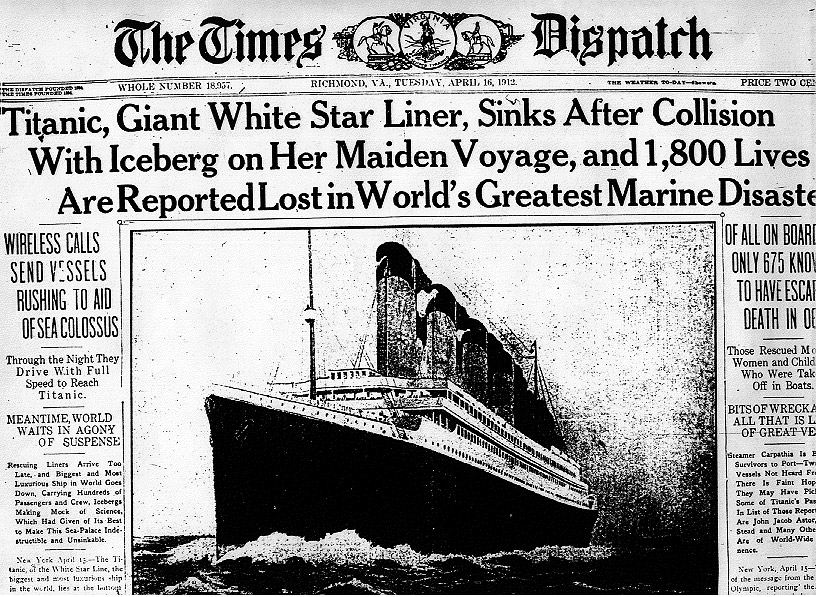
Dredging up the Past: Titanic and the Body of Memory

I just saw Titanic in 3D. I hadn't thought much about going to see it, and had even laughed at this rerelease as an easy money-making endeavor. Yet when some friends asked me to join, I went. I hadn't seen the film since it was in theaters the last time, before it won too many awards and became a parody of itself (i.e. "I'm king of the wooorld!"). I saw it on my first real date, cliche as that may be, and watched it with a mixed response. For the teenaged me, it was sad and awkward and romantic and manipulatively emotional. Then, as now, I loved the costumes. Even then, though I enjoyed the movie, I felt inklings of things I noticed this evening. I could talk, for instance, about the probably well-meaning but not very subtle way in which the film attempts to engage with issues of class or gender. The way that the rollicking party below decks lets us know that people with less money are more authentic, or at least more fun. The way that Rose's mother declares that women's choices are never easy just as she pulls Rose's corset strings tight. Yet something else caught my attention tonight, something I'd missed completely before. Seeing it after all these years, I still remembered the main Rose and Jack plot quite clearly, but the frame narrative hadn't stuck with me as well. Yet tonight I was fascinated by that frame.

The film opens with images of the submerged ship. Mundane objects are strewn about the ocean floor, the only testament to the lived experience of that drowned and broken metal hull. Eyeglasses, a baby-doll, a pair of boots exist in ghostly perpetuity, everyday items made strange by their decontextualization. The ocean, these objects seem to say, is not the natural realm for humans. It swallows us up. Unlike the topography on land, which can be marked by people, the contours of the sea shift continuously, and we can either float to shore or sink to the sandy depths. One must delve deep, quite literally, in order to find any traces of human existence in the ocean. The crew that opens the film, seeking history, fame, and fortune in the wreck, can reconstruct the sinking via computer, but they can't really understand it. They only see material value when they look at the submerged debris. As their inability to interpret the underwater landscape becomes apparent, a drawing of a young woman slowly emerges. They're not sure what to make of that either, except that the woman in the drawing is wearing the costly diamond they want to find.

It is at this point that a sweet elderly woman enters the picture, as if the re-emerged drawing had conjured her from the depths. She joins the crew and tells them all about her memories of the night the Titanic went down. Their fancy equipment can't help them to really understand, but this ancient lady appears just in time to interpret the objects and events for them. All of our images of the original ship and crew and passengers are through this elderly Rose's memory. The primary narrative is therefore invoked by her verbal recollections. For someone who has never spoken of the events before, who never even told her family about Jack, this lady sure can tell her story without a stutter. The men, who've only looked at the wreck for the fortune it could bring them, sit transfixed. They finally see the Titanic.

All of this reminds me of the Middle English poem Saint Erkenwald, which tells the story of an excavation that unearths an ancient tomb. As builders erect a cathedral atop the ruins of a pagan temple, they find a mysterious sarcophagus marked with ancient script. I think it's no accident that this image of palimpsestic architecture unearths such a living relic. While trying to build over history, the workers dig it back up in the form of this strange tomb. All of the most learned men attempt to read the mysterious writing on the tomb and to interpret its meaning. They look at the garments of the body inside the tomb and make conjectures about who he was, perplexed that none of their chronicles mention such a person. None of them can figure it out. As they begin to give into their frustration, they call in Bishop Erkenwald. He prays for guidance, and the long-dead judge buried inside the tomb arises and tells his story from the grave, explaining to them who he was and when he lived. And they finally understand. Erkenwald's understanding and empathy for the dead pagan man get represented physically in the tear he sheds upon learning that the good judge has been in hell all these years, and that tear serves as a kind of baptism that allows the judge's body to dissolve and his soul to rise to heaven. I never understood how the judge can speak English (or some language that the people recognize) when the writing on his tomb is in a language so foreign as to be completely unknown. But that is, I guess, beside the point. The material object from the past is illegible, even the writing from the past is unreadable, so the past needs to be literally revived in order to tell its own story. The resuscitated body of the past can help the people understand in a way that objects and letters never could. Or perhaps the revived body is representative of our attempts to get at that past via the objects and narratives we have. As Christine Chism argues in Alliterative Revivals, "death grants ghosts an interrogative force, imbuing the impossible, unceasing communication between the dead and the living, the past and the present with fearful intimacy" (1). The past is zombie-like in such texts; it rises from the grave and speaks aloud in order that we may hear it.

Though this film is quite different from that Middle English poem, it nonetheless features a past that becomes accessible through a figure emerging and speaking for it. The shot of young Rose's eye morphing into old Rose's eye (again, the film is not trying to be subtle) depicts the direct and physical link between the experience of the sinking ship and the story being narrated today. Though all is mediated via Rose's perspective and memory of long-past events, I suppose we are meant to trust her. If we have any doubts, the fact that she appears at the end with the diamond indicates that she's been conveying the events accurately. She's someone interested in tangible recollections, someone who carries all of her photographs with her when she travels. Yet she admits that she has no photograph of Jack, that there's no record of Jack. He lives on only in her memory. Jack has sunk deep into the sea, not to be brought back to the surface except through Rose's words. For the duration of her tale, the living, breathing, steaming love story can resurface. The captain and Mr Andrews and all the people above and below decks can breathe and speak and live and die as they did so many years ago.

The film could have simply told the story without the frame. It could have begun with Rose and Jack getting on the ship and ended with Jack's death or Rose's survival. It could have even been made from Rose's current perspective, but only in private recollection or more vaguely to us the viewers. Instead, the frame is of people today explicitly seeking something in the wreck and finding it in the person of an old women who once walked the decks of the ship they search. The past emerges bodily and memory is conveyed in color and sound and state-of-the-art special effects. Rose even opens with a description of the smell of fresh paint aboard the ship, a sensory contrast to the rusted and peeling metal we see today. When elderly Rose is finished with her tale, she can finally return to Titanic and to Jack, in dreams or perhaps in death. The narrative has not only brought those around to the ship, but it has returned her to it as well. She rose from the wreckage to tell the story, and then returned to it, along with her heart-shaped necklace.

The past, like the ocean, is never fully accessible to us. We can try to see what lies beneath the waves and we can pull a few things up to the surface, but it is never completely in reach. As a medieval scholar, I understand the frustrations of trying to access the past. And there is no one alive from the 14th century to tell me about it. The image of a body from the past emerging to speak to us is a tantalizing fantasy, as even people's narrations of the past can't actually take us there. Yet it's a fantasy that speaks to our continued longing to plumb those depths, to understand what lies beneath and beyond our own existence as we pass over the same land and through the same waters as people of long ago.

As I sit watching the same film as I did 15 years ago, I see the impossibility of fully understanding or reliving the past, even when that past is my own. On a superficial level, the film is now rendered 3-dimensional, but time has wrought its changes on me as a viewer as well. I notice different things and respond in different ways. My colleagues and I discussed the ways in which films and viewers have changed more broadly. My friend Amanda noted that this movie is situated in its time and place. Post-9-11, its disaster narrative would have meant something very different than it did to us all in 1997. Now we picture the twin towers or think about the socioeconomic realities that allowed some to escape Hurricane Katrina while others could not. I look at pictures of flood and remember the horrifying images from Japan after the recent earthquakes there. The film, already a heavily mediated image of history, is now filtered through all the disasters we've witnessed on the evening news in the past decade and a half. All of these connections make the film and the history it attempts to depict both more and less immediate. And yet it remains as an artifact and we engage with it and with both Roses and with our past selves as we sit in the theater. And we narrate the memories of our previous experiences with the film even as the film gives memory a tangible existence in the person of an elderly lady with a story to tell.