Showing posts with label Erkenwald. Show all posts

Wednesday, September 14, 2016

Monuments, memorials, & legacy


During my nine days in London this summer in and around the inestimable NCS Congress, I was strongly reminded that memorials, especially graves, are everywhere.  This realization is not, if you’ll forgive the pun, ground-breaking. Earth is old, and the people who have lived on it have long been concerned about how they will be remembered.  I think I noticed it afresh in part because of the turn my research has been taking: I have been caught up in thinking about memorials and collective memory in Middle English literature over the past year as I reconsider how the dissertation-that-was is slowly morphing into the book-to-be.  

And so: memorials.  I spent part of a day on a pilgrimage of sorts to Southwark Cathedral.  If you haven’t visited, you should – Southwark is a beautiful church, and Karen and I were lucky enough to be there while the organist was practicing.  We explored the church and the gardens and the neighboring market all morning, then returned on Sunday to attend services there.  The point of the trip, though, was to visit an old friend by the name of John Gower, the poet who has been a companion, a comfort, and an occasional aggravation to me since my first semester in graduate school.  (As a sidenote: some of my earliest conference presentations were on Gower’s works, and I spent several months writing a chapter on Gower’s Visio Angliae that never made it into my dissertation.  I find his work beautiful, compelling, powerful, and frustrating, and I return to it often: in fact, this upcoming year, I am working with my first independent study student, who is working on Gower’s Confessio Amantis.)

photo of the author in front of the tomb of John Gower, with three major works serving as pillow for the poet.
Selfie with John Gower: a photo I think many of us working in Middle English literature have taken.

Gower’s tomb is obviously invested in legacy, and it entwines literary and literal afterlives. Gower’s massive pillow, here obscured by my head, is made of his three major works, their names given in Latin.  The inscription again emphasizes Gower’s poetic work: he is described first as a celebrated English poet (“anglorum poeta celeberrimus”) and then as benefactor to the building that houses his tomb.  It seems to me that John Gower gets legacy.  The tomb is trying to do for Gower what the opening lines of the Confessio Amantis seek to do for the work in question, that is, they put Gower’s work into the context of a broader canon: 

 Of hem that writen ous tofore
The bokes duelle, and we therfore
Ben tawht of that was write tho:
Forthi good is that we also
In oure tyme among ous hiere
Do wryte of newe som matiere,
Essampled of these olde wyse,
So that it myhte in such a wyse,
Whan we ben dede and elleswhere,
Beleve to the worldes eere
In tyme comende after this. (Confessio Amantis, Prol.1-11)

The “newe” thing in the reader’s hands thus fits into a perfect lineage: it emerges from old writings, then moves forward to inform “tyme comende.”

Yet what is obscured by this memorial?  Well, to begin with, the rest of Gower’s work: his short Latin and French poetry and the English “In Praise of Peace” go unmemorialized, much as they often go unread.  (Not that there are hordes of medievalists reading the Vox Clamantis or the Speculum Meditantis – unfortunately, I say, but that is perhaps a post for another time.)  The monument to Gower’s work is thus partial, incomplete.  It doesn’t capture the poet’s whole literary corpus – only the works that are themselves monumental.  In fact, it doesn’t contain the poet’s physical corpus, either: the literary present tense means that Gower is always off doing something in the many articles and books written about his literary work.

A monument is a physical construction of history, but it can only be partial.  Monuments require a context, a story: inscriptions are meant to help, but they only take us so far.  Some Middle English literary monuments try to be complete: lengthy inscriptions capture an episode, a prophesy, some nugget of the story.  The past gives the present much-needed context: in Malory’s Morte d’Arthur, the grave of Sir Patryse, who dies an untimely death through a poisoned fruit, reads: “Here lyeth sir Patryse of Irelonde, slayne by Sir Pynell le Saveaige that enpoysynde appelis to have slayne Sir Gawayne, and by myssefortune sir Patryse ete one of the applis, and than suddeynly he braste.” Thus, the inscription memorializes Sir Patrick himself, but it also preserves the circumstances of his death.  Further, it emphasizes Guinevere’s innocence in that death for the future readers, since the tomb also includes a description of the trial by combat that proved she was not complicit in the murder (Malory, Works 621, lines 12-20).  While Patryse’s memorial seems to feature quite a lengthy text, other literary monuments prove inaccessible: the “roynyshe” golden writing in St. Erkenwald troubles those gathered at St. Paul’s Cathedral precisely because it cannot be read, though all the physical signs suggest the person this tomb memorializes is important and should be known.  While Sir Patryse’s grave tells the story of his death (if not many details of his life), the judge’s tomb in Erkenwald’s needs a narrative – the writing needs miraculous, posthumous glossing by the very figure it is meant to memorialize.

These monuments, it seems to me, are entangled with writing itself as a medium.  The paradox and the power of the memorial is the same as that of writing: it can’t capture everything.  As the burned manuscript means the medieval document is lost forever, so the misplaced notebook, the to-do list we accidentally wash, and the hard drive crash remind us that "writing it down" is no guarantee of survival. At the same time, sometimes writing preserves too much: debates about Gower’s recensions of the Confessio Amantis are ongoing, and we cannot know which one(s) Gower wanted in circulation. 

While at NCS, I heard R. F. Yeager’s presentation on Gower’s afterlife in Reformation England.  He opened the talk by comparing Gower’s monument to Chaucer’s, and he pointed out that Gower didn’t fare so well: the tomb is now restored, but evidently poor Gower had his nose broken off at one point, among other damages.  Perhaps not so celebrated, then. (Access, too, is an interesting question: As M. W. Bychowski noted in her Facebook reflections post-conference, you can see Gower for free, but visiting Chaucer is a somewhat more costly enterprise.)  Gower’s work long suffered a similar fate: extracts from the Confessio first appeared in the ninth of the Norton Anthology of British Literature, published in 2012.  And yet, this summer I visited Gower’s restored monument, and next year I hope to return to the UK to join colleagues and friends for the fourth International John Gower Society conference, to be held in conjunction with the Early Book Society conference at Durham University.  

Preservation – of books, of reputations, even of monuments – is always at the mercy of other’s judgments and interests, no matter how well we plan for it.


Saturday, May 11, 2013

When Giants Walked the Earth: Jurassic Park, The Legend of Albina, and Inherited Topography

Having recently been to see Jurassic Park in 3D, I have felt a renewed enthusiasm for dinosaurs. Kate's delightful post on "Deadline Anxiety and Dinosaurs" further reminded me of the wonders of the classic film. At the same time, I was working on a paper about the legend of Albina for Plymouth's 34th Annual Medieval and Renaissance Forum, which led me to connect the two in my mind. Let me start with a recap of each story:

Jurassic Park is a tale about scientists who figure out how to bring dinosaurs back through the magic of DNA. Chaos ensues.

The legend of Albina (or, sometimes in Middle English, Albin) gives an origin story for the name Albion. Albina is a princess from Greece (or perhaps Syria) who plots with her many sisters to murder their husbands and is thus exiled on a rudderless ship. Fate intervenes, and the women land safely on an unnamed, uninhabited island at the edge of the world. Albina calls the mysterious land Albion after herself and goes about setting up a home there. Mating with incubi, Albina and her sisters produce giant offspring and populate the island with their monstrous progeny. The giants rule the island for 800 years, and then Brutus shows up from the wreckage of Troy. He kills the giants and renames the island Britain for himself. He tames the wilderness and cultivates the land. From the wood and stones of the island, he fashions a New Troy that we call London.

On the surface, I will admit that these two stories have little in common. A modern warning story about the dangers of unexamined scientific exploration and a medieval mytho-historic explanation for the name Albion might seem, quite literally, worlds apart. And yet fortune has thrown them together in my mind, and I'd like to humor myself by thinking about possible connections.


The edge of the world seems like a good place to stop
Like dinosaurs, the giants of the Albina story walk the same land that we inhabit. The only thing that separates us from these frightening and yet fascinating forebears is time. Though we're not descended from them -- both dinosaurs and giants have been extinct since prehistory -- we have inherited their realm. As Jurassic Park opens, paleontologists in Montana are digging up fossils. The ease with which they dig up these fossils has been making paleontologists chuckle and children look optimistically at their toy shovels ever since the film opened. The image of these fossils, hidden away by the sands of time and yet still just below the surface of our landscape, connects these ancient bird-lizards to our own countryside. Time may separate us from the dinosaurs, the movie seems to indicate, but only by a couple feet of dust. Their bones lie under our feet, and our land was theirs first.

Similarly, the Albin story imagines British history beginning with monstrous creatures: a murderous woman, a mother of monsters. The image of a man called Brutus pulling himself from the carnage of his fallen city and making his way to an island on the edge of the world was widely recited in medieval England. The story usually begins with Brutus landing on the island, finding it populated with barely-human giants, and conquering the land by dispatching of these unpleasant natives. Surely this is a colonial fantasy, in which the colonizer need not feel guilt for taking over a new land because the inhabitants can be discounted as less than human. The versions of this story that insert the Albina legend in the beginning, however, shift the reader's perspective. In these texts, we follow not Brutus but Albina to the island; we sit with the giants on the shore as Brutus sails up to claim the land and rename it for himself. Brutus may kill these giants, Brutus may remake the landscape into his own version of civilization, but the story still begins with Albina and her larger-than-life children. They stomp around, and their movements undoubtedly shift and mold the topography, carving out lakes and valleys and mountains with their rumbling steps. The wilderness that Brutus discovers when he arrives on the island still lurks beneath and beyond the streets and buildings he commissions. The people who live in the London of the 14th century (or today) may not be able to trace their ancestry back to Albin or her outsized offspring, but the chronological and topographical link is nonetheless inherent in the narrative. In The Short English Metrical Chronicle, readers are told that Albina landed "here" and on "this land" (307, 306). There is never any doubt in the text that her location, even before it has a name, is the reader's location as well. We can kill off the monsters, the legend seems to tell us, but we can't escape their influence. The island may be Britain, but it is Albion as well. As with the dinosaurs of Jurassic Park, only time stands between us and the monsters from whom we inherited our earth.


What is this strange, four-wheeled creature?
Jurassic Park increases this uneasy sense of chronology with a particularly 1990s fable in which technology can bridge the gap between past and present. Dinosaur DNA, with a little frog DNA thrown in for good measure, initiates a shocking confrontation with the past. As with the story of Saint Erkenwald speaking to a long-dead judge (see my Titanic post for more on that), our paleontologists can see the bones they've studied come to vibrant life. I was speaking with some fellow medievalists recently about how Jurassic Park is a fantasy for anyone who studies the past. We can collect our evidence, we can imagine how it must have been, but we know that there's always a little bit of guesswork, a little bit of our own time and place getting in our way. The centuries are, despite our best efforts, an unpassable obstacle to full engagement with past people and places and events. When Doctors Alan Grant and Ellie Sattler (played by Sam Neill and Laura Dern, respectively) gaze in wonder at the living versions of the fossils they have studied for so many years, it's hard not to feel a sympathetic twinge. When Alan Grant murmurs gleefully "They do move in herds," I can't help but think that I would make similar comments if I got to view a performance of the medieval York Cycle or a production of Shakespeare at the original Globe. And when the doctors pet and hug a living triceratops, the tactile interaction means that they are literally touching a creature of the past. The new 3D version enhances these interactions and confrontations by making the dinosaurs appear to pop out of the screen toward us as we watch. The years have been kind to these dinosaurs, and they appear more real than ever. Yet these dinosaurs, made from prehistoric DNA, are still born here and now. They're still in a contemporary landscape, no matter the efforts put into recreating a proper habitat (maybe this is why that triceratops is so ill). The bit of modern frog DNA making up each one means that, even on a genetic level, they are modern creatures even as they are ancient ones. The closest we can come is still imperfect. Still, ultimately, dangerous in its imperfections.

Even as time in Jurassic Park is both then and now, place is both real and imagined. We may recognize the Montana badlands, but Snakewater is a fictional Montana city. The backstory of this fossil paradise is that it was originally an island. In other words, a fictional place was once a fictional island, subsumed into the middle of the modern-day United States. The park itself is built upon a fictional island as well, Isla Nublar (meaning something like "clouded island" or even "obscure island"), just off the coast of Costa Rica. As with Snakewater, Isla Nublar is given a specific location in relation to real geography (and, of course, was filmed in a real place that we may visit if we wish), and yet it is imaginary. Off the coast of the known lies the land of the film, connected to the world we know and yet always separate from it.

Albina is given a much more specific location in that she lands where the reader now stands. Her time at sea may exist in a geotemporal shadow realm, but before and after she travels we can point to her on a map. As I mentioned above, she lands "here." And when Brutus comes to the island, the city he builds is the city we now call London. Her island is not ours -- it is a mythic wilderness ruled by overly-ambition women and their overly-corporeal descendants. They are vanished into the past. Their imaginary bones are dust, and we cannot simply dig them up in our backyards. Yet if their bones are dust, even the dust of legend, then that dust makes up the story of the modern island. Albion both is and isn't Britain.


Not as cuddly as you might think
The monsters of our past (the monstrosity of the past?) is both frightening and fascinating. (For a detailed examination of this paradox, see Monster Theory, especially Jeffrey Jerome Cohen's sixth thesis: "Fear of the Monster is Really a Kind of Desire" (16).) Albina may create giants from her lust, forging progeny with an incubus to populate the island, but her desire isn't totally disconnected from our own readerly desire. Albin and her giants and her alien-familiar wilderness are tantalizing fictions of British chronology. Similarly, dinosaurs maintain the capacity to terrify and attract us. When I was four or five, I received a blow-up Tyrannosaurus Rex for Christmas. Obsessed with T-Rex, I was delighted with this gift. I couldn't wait for my father to blow up the toy so I could exist in an imaginary dinosaur world with my T-Rex friend. Yet when night came, I was suddenly panicked because I knew that a T-Rex prowled in my house. I begged my father to deflate it for the safety of everyone involved. For the next several days, we repeated this pattern. By day, I loved my T-Rex; by night, I wanted him annihilated. Finally, my dad, exhausted from blowing up a four-foot-tall dinosaur day after day, said I could choose special days to play with my T-Rex, but that it couldn't be everyday. The terror induced by the T-Rex and velociraptors in the film is not the only reason it has been so popular. Yes, we love to be afraid of dinosaurs, but we also just love dinosaurs. The tender moments of the film in which characters lovingly pet peacefully plant-eating dinosaurs are there for a reason. Whether we would hide from T-Rex in a bathroom or wave a flare at her to distract her from the children, we know that she is deadly. The way that Dr. Grant revels in frightening an obnoxious child with a description of the velociraptor's hunting style at the beginning of the film gets echoed in the famous last words of Robert Muldoon (played by Bob Peck) as a velociraptor leaps toward him: "Clever Girl!" He admires her for outsmarting him even in his last breath.

An aspect of the monsters of the past that makes us love and fear them is that they can't really be controlled. Albina's father sends her away on a rudderless ship, a punishment which is surely a death sentence. A punishment which robs her of narrative control as she floats powerlessly around the world. Yet she manages to claim a land for herself, to attach her name to that land and to become a part of a nation's history. Even as she and her sisters consider their position as an island full of women, they find a way to reproduce, monstrous and unnatural as that way is, producing as it does children who are both more and less than humans. Brutus may tame the land by killing Albina's monster-children, but they haunt British chronicles nonetheless.

In Jurassic Park, modern science and technology may seem to contain and control the past even as they resurrect it, but the monsters of the past defy such efforts. The opening scene, in which a velociraptor manages to kill a worker even in the most carefully planned situation, indicates for us from the first moments of the film that modern knowledge has met its match. When we are told later that the velociraptors methodically test each section of their fence for weakness, it's clear that they do not take well to their high-tech cage. Dr. Ian Malcolm (played by Jeff Goldblum) sums up the dangers of such attempts at containment when he states that "the kind of control you're attempting simply is... it's not possible. If there is one thing the history of evolution has taught us it's that life will not be contained. Life breaks free, it expands to new territories and crashes through barriers, painfully, maybe even dangerously, but, uh... well, there it is." In this speech, monstrous vitality is life itself, that which breaks free of control and simply finds a way. Everything on Isla Nublar is an attempt at control, down to the jeeps which can't be steered (am I going too far to compare these to medieval rudderless ships, outside of their riders' control and yet firmly on the track of fate?). The designers of the park may have automated the vehicles, but it never occurred to them that riders could (or would) simply open the jeep doors and step outside. Given all of these hints, we're not terribly surprised when we see a dinosaur egg in the wild. Despite the careful breeding of only female dinosaurs, we learn that these dinosaurs, made partly with frog DNA, can switch sexes in order to reproduce. Like Albin and her sisters, the dinosaurs manage to procreate even when denied the normal means of doing so. They can neither be kept in cages nor kept from expanding their population.


At least Skull Island had King Kong
We might say that the real monster of the film is human greed, but this very greed is predicated on human desire to encounter dinosaurs. The monsters can only menace us because we bring them back in order to do so. John Hammond (played by Richard Attenborough) speaks with wonder of creating a park in which people can see and touch real dinosaurs, and he says plainly that "this park was not built to cater only for the super-rich. Everyone in the world has the right to enjoy these animals." But his wonder at scientific possibility, in the real world, translates into the chaos that characterizes the film from the opening scene. We never believe that things are going to go well, even as we also to want to see and touch the dinosaurs.

I am not saying that Jurassic Park is a modern-day Albina myth, nor that either Michael Chrichton or Steven Spielberg had considered or even read the obscure medieval tale when they created first book and then movie of this modern story. Rather, I suggest that attempts to engage with the past, or to imagine how that engagement might take place, may partake of the larger-than-life. The past is monstrous in that it is both wholly other and wholly familiar, in that it is distant and yet part of us, in that the here and now will inevitably become the past. The past, whether we understand it or not, will always swallow the present. The giant lurks just beneath the surface of our modern world, unattainable and yet tempting us with possible proximity. Albina, giants, dinosaurs, titans -- all are creatures of the past both consumed and consuming. And, yes, I would probably visit Jurassic Park, even knowing what I know. Who could resist?

Saturday, April 14, 2012

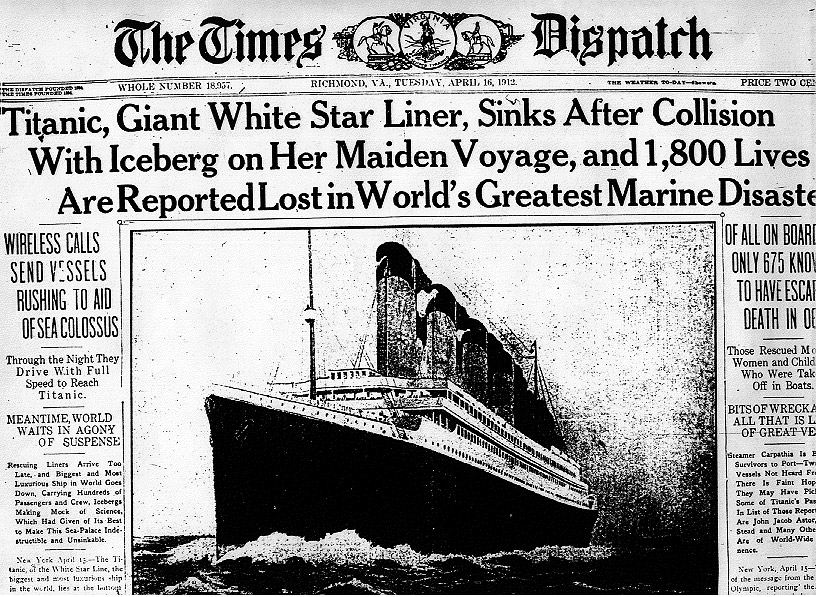
Dredging up the Past: Titanic and the Body of Memory

I just saw Titanic in 3D. I hadn't thought much about going to see it, and had even laughed at this rerelease as an easy money-making endeavor. Yet when some friends asked me to join, I went. I hadn't seen the film since it was in theaters the last time, before it won too many awards and became a parody of itself (i.e. "I'm king of the wooorld!"). I saw it on my first real date, cliche as that may be, and watched it with a mixed response. For the teenaged me, it was sad and awkward and romantic and manipulatively emotional. Then, as now, I loved the costumes. Even then, though I enjoyed the movie, I felt inklings of things I noticed this evening. I could talk, for instance, about the probably well-meaning but not very subtle way in which the film attempts to engage with issues of class or gender. The way that the rollicking party below decks lets us know that people with less money are more authentic, or at least more fun. The way that Rose's mother declares that women's choices are never easy just as she pulls Rose's corset strings tight. Yet something else caught my attention tonight, something I'd missed completely before. Seeing it after all these years, I still remembered the main Rose and Jack plot quite clearly, but the frame narrative hadn't stuck with me as well. Yet tonight I was fascinated by that frame.

The film opens with images of the submerged ship. Mundane objects are strewn about the ocean floor, the only testament to the lived experience of that drowned and broken metal hull. Eyeglasses, a baby-doll, a pair of boots exist in ghostly perpetuity, everyday items made strange by their decontextualization. The ocean, these objects seem to say, is not the natural realm for humans. It swallows us up. Unlike the topography on land, which can be marked by people, the contours of the sea shift continuously, and we can either float to shore or sink to the sandy depths. One must delve deep, quite literally, in order to find any traces of human existence in the ocean. The crew that opens the film, seeking history, fame, and fortune in the wreck, can reconstruct the sinking via computer, but they can't really understand it. They only see material value when they look at the submerged debris. As their inability to interpret the underwater landscape becomes apparent, a drawing of a young woman slowly emerges. They're not sure what to make of that either, except that the woman in the drawing is wearing the costly diamond they want to find.

It is at this point that a sweet elderly woman enters the picture, as if the re-emerged drawing had conjured her from the depths. She joins the crew and tells them all about her memories of the night the Titanic went down. Their fancy equipment can't help them to really understand, but this ancient lady appears just in time to interpret the objects and events for them. All of our images of the original ship and crew and passengers are through this elderly Rose's memory. The primary narrative is therefore invoked by her verbal recollections. For someone who has never spoken of the events before, who never even told her family about Jack, this lady sure can tell her story without a stutter. The men, who've only looked at the wreck for the fortune it could bring them, sit transfixed. They finally see the Titanic.

All of this reminds me of the Middle English poem Saint Erkenwald, which tells the story of an excavation that unearths an ancient tomb. As builders erect a cathedral atop the ruins of a pagan temple, they find a mysterious sarcophagus marked with ancient script. I think it's no accident that this image of palimpsestic architecture unearths such a living relic. While trying to build over history, the workers dig it back up in the form of this strange tomb. All of the most learned men attempt to read the mysterious writing on the tomb and to interpret its meaning. They look at the garments of the body inside the tomb and make conjectures about who he was, perplexed that none of their chronicles mention such a person. None of them can figure it out. As they begin to give into their frustration, they call in Bishop Erkenwald. He prays for guidance, and the long-dead judge buried inside the tomb arises and tells his story from the grave, explaining to them who he was and when he lived. And they finally understand. Erkenwald's understanding and empathy for the dead pagan man get represented physically in the tear he sheds upon learning that the good judge has been in hell all these years, and that tear serves as a kind of baptism that allows the judge's body to dissolve and his soul to rise to heaven. I never understood how the judge can speak English (or some language that the people recognize) when the writing on his tomb is in a language so foreign as to be completely unknown. But that is, I guess, beside the point. The material object from the past is illegible, even the writing from the past is unreadable, so the past needs to be literally revived in order to tell its own story. The resuscitated body of the past can help the people understand in a way that objects and letters never could. Or perhaps the revived body is representative of our attempts to get at that past via the objects and narratives we have. As Christine Chism argues in Alliterative Revivals, "death grants ghosts an interrogative force, imbuing the impossible, unceasing communication between the dead and the living, the past and the present with fearful intimacy" (1). The past is zombie-like in such texts; it rises from the grave and speaks aloud in order that we may hear it.

Though this film is quite different from that Middle English poem, it nonetheless features a past that becomes accessible through a figure emerging and speaking for it. The shot of young Rose's eye morphing into old Rose's eye (again, the film is not trying to be subtle) depicts the direct and physical link between the experience of the sinking ship and the story being narrated today. Though all is mediated via Rose's perspective and memory of long-past events, I suppose we are meant to trust her. If we have any doubts, the fact that she appears at the end with the diamond indicates that she's been conveying the events accurately. She's someone interested in tangible recollections, someone who carries all of her photographs with her when she travels. Yet she admits that she has no photograph of Jack, that there's no record of Jack. He lives on only in her memory. Jack has sunk deep into the sea, not to be brought back to the surface except through Rose's words. For the duration of her tale, the living, breathing, steaming love story can resurface. The captain and Mr Andrews and all the people above and below decks can breathe and speak and live and die as they did so many years ago.

The film could have simply told the story without the frame. It could have begun with Rose and Jack getting on the ship and ended with Jack's death or Rose's survival. It could have even been made from Rose's current perspective, but only in private recollection or more vaguely to us the viewers. Instead, the frame is of people today explicitly seeking something in the wreck and finding it in the person of an old women who once walked the decks of the ship they search. The past emerges bodily and memory is conveyed in color and sound and state-of-the-art special effects. Rose even opens with a description of the smell of fresh paint aboard the ship, a sensory contrast to the rusted and peeling metal we see today. When elderly Rose is finished with her tale, she can finally return to Titanic and to Jack, in dreams or perhaps in death. The narrative has not only brought those around to the ship, but it has returned her to it as well. She rose from the wreckage to tell the story, and then returned to it, along with her heart-shaped necklace.

The past, like the ocean, is never fully accessible to us. We can try to see what lies beneath the waves and we can pull a few things up to the surface, but it is never completely in reach. As a medieval scholar, I understand the frustrations of trying to access the past. And there is no one alive from the 14th century to tell me about it. The image of a body from the past emerging to speak to us is a tantalizing fantasy, as even people's narrations of the past can't actually take us there. Yet it's a fantasy that speaks to our continued longing to plumb those depths, to understand what lies beneath and beyond our own existence as we pass over the same land and through the same waters as people of long ago.

As I sit watching the same film as I did 15 years ago, I see the impossibility of fully understanding or reliving the past, even when that past is my own. On a superficial level, the film is now rendered 3-dimensional, but time has wrought its changes on me as a viewer as well. I notice different things and respond in different ways. My colleagues and I discussed the ways in which films and viewers have changed more broadly. My friend Amanda noted that this movie is situated in its time and place. Post-9-11, its disaster narrative would have meant something very different than it did to us all in 1997. Now we picture the twin towers or think about the socioeconomic realities that allowed some to escape Hurricane Katrina while others could not. I look at pictures of flood and remember the horrifying images from Japan after the recent earthquakes there. The film, already a heavily mediated image of history, is now filtered through all the disasters we've witnessed on the evening news in the past decade and a half. All of these connections make the film and the history it attempts to depict both more and less immediate. And yet it remains as an artifact and we engage with it and with both Roses and with our past selves as we sit in the theater. And we narrate the memories of our previous experiences with the film even as the film gives memory a tangible existence in the person of an elderly lady with a story to tell.