Showing posts with label body. Show all posts

Wednesday, July 30, 2014

Is that a riddle in your pocket? Apollonius of Tyre and The Third International Congress of the John Gower Society

We had our own watery voyage.
(A boat ride on the Genesee River.)
This summer has combined conferences both far away and very near. I got to travel to Iceland for the New Chaucer Society Conference (about which I'll blog later), and I got to present at home in Rochester at The Third International Congress of the John Gower Society: "John Gower: Language, Cognition, and Performance." Traveling to Iceland was magical, but it was also a joy to welcome scholars from around the world to my own institution. The Gower conference was all that I hoped, combining scholarship, camaraderie, and creativity.

I presented a paper entitled "'Bot in writinge it mai be spoke': Intratextual Desire in Gower's Tale of Apollonius of Tyre." The paper was new topic for me. Just as I'm finishing up my dissertation, this paper helps bring a second project into focus (which also connects to work I've been doing on Elaine of Astolat, the Camelot Project page on whom I published recently). As is inevitable at the beginning of a project, I feel like I need to think through it much more fully, but I'm excited about where it will take me. Despite my nerves, the paper went well. The whole panel fit together beautifully, our ideas mingling in surprising and delightful ways, and the discussion afterward continued throughout the conference. As with the best presentation experiences, I feel like the enthusiasm and questions and discussions I encountered will help me continue to develop my ideas.

For those who aren't familiar with the Tale of Apollonius of Tyre, I recommend reading the tale (just scroll down to line 271 of Confessio Amantis book 8). If you've seen/read Shakespeare's Pericles, then you have a basic sense of the plot. The story begins with a king, Antiochus, who has lost his wife and tries to replace her with his daughter. It's a disturbing beginning, and Gower doesn't shy away from the trauma of the princess as her own father violates her. As suitors begin to vie for the princess's hand, Antiochus devises an impossible riddle for them to answer.  Many suitors try, and many suitors fail. Finally, Apollonius arrives to try his hand at the riddle. He correctly guesses that the answer is the
Gower's main hobby is shooting the world.
He's basically the opposite of Atlas.
incest between Antiochus and his daughter, but this correct guess sends him running for his life. After many adventures, he lands on Pentapolis, where he gets a position as tutor to the king's daughter. Many suitors are vying for this princess's hand as well, but this father tries to facilitate his daughter's marriage. He asks the suitors to write bills, which the princess will read and compare. The princess, however, has fallen in love with Apollonius and is ill with lovesickness. The king is worried about his daughter, and she writes him a letter explaining her condition. The king brings the letter first to his wife and then to Apollonius, carefully arranging the marriage his daughter wants. Apollonius and the princess are married and the princess soon becomes pregnant, a sure sign that things are going well. When they hear that Antiochus and his daughter have been destroyed in a storm and it is safe for Apollonius to return home to Tyre, it almost seems like we've reached a happy ending. But there are a lot of lines, and a lot of troubles, left in the tale. While sailing to Tyre, the princess gives birth to a baby girl but dies in chil
dbirth. Apollonius, heartbroken over the loss of his wife, puts her in a coffin with jewels and a letter begging for her proper burial and then sends the coffin to sea. The coffin, miraculously, reaches land, and, even more miraculously, the clerk who reads the letter discovers that the princess is only mostly dead. Reviving her and hearing her story, he sets her up for the chaste life she requests. A lot more happens in the story, and we get wonderful adventures of the daughter as she grows up as well, but this brief summary will get us through the parts of the tale I had time to discuss in my paper.

I began outside the tale (and a few hundred years earlier), with riddle 44 from the Exeter Book: 
Swings by his thigh a thing most magical!
Below the belt, beneath the folds

of his clothes it hangs, a hole in its front end, 
stiff-set & stout, but swivels about.

Levelling the head of this hanging instrument,
its wielder hoists his hem above the knee:
it is his will to fill a well-known hole
that it fits fully when at full length.   


He has often filled it before. Now he fills it again.1
The answer, of course, is a key. What, were you thinking something else? The moment where the room shares a stifled laugh and represses the obvious dirty answer in favor of thinking through less obvious and more innocuous possibilities is the heart of such riddles. The pleasure lies in the simultaneity of the answer we don’t say and the one that we do.

The riddle at the beginning of Apollonius of Tyre, on the other hand, distorts this tradition by denying the pleasures of the genre. Antiochus gives suitors a riddle in which the sexual answer is correct. Centuries of riddles would suggest that there must be a clever trick here, but there isn’t. And yet speaking the real answer is a dangerous option as well. To declare publically that the king and his daughter share an incestuous relationship seems a good way to separate your head from your shoulders. No wonder so many suitors get it wrong. This twisted form of a twisted genre is well-suited to such a taboo desire as the king’s for his daughter.

The riddle in Apollonius of Tyre is the first of many expressions of as many varieties of desire. Characters in the text articulate their desires by crystallizing them in language. I argue that the genre that each linguistic expression takes directly represents the type of desire being expressed. From the opening incestuous riddle to the body wrapped lovingly in a letter, characters solidify their desires in language that can then be examined and distributed. At each instance of linguistic desire, language takes on a more corporeal quality, until letter and body are interconnected. Throughout the tale, then, language does not merely convey emotion, but embodies it, rendering it both tangible and communicable. Like the key from our opening riddle, language is both the thing to be unlocked and the means to unlock it; it is a passageway between the private and the public, one’s one thoughts and desires and the rest of the world. The fact that the genres of the linguistic expressions I discuss match the desires they communicate gives language an increasing material reality that renders it increasingly productive.

The tale begins with an inappropriate and traumatic desire, that of a father for his own daughter. The private world that Antiochus creates for himself, in which he may do as he pleases, is a world where desires cannot be clearly articulated. As María Bullón-Fernández explains, “incest is equated not just with ignorance but also with secrecy; can keep being performed as long as it is kept private” (49).2 Antiochus’s daughter weeps, but doesn’t know how to express herself so that he will hear her. Afterward, “sche lay stille, and of this thing,/ Withinne hirself such sorghe made” (314-15). The daughter’s emotions and desires become trapped in her motionless, soundless body. Not only is she silent, but R.F. Yeager points out “that Antiochus's daughter has no name, in a tale in which even the least servants and functionaries … are made known. … Thus the namelessness of Antiochus's daughter … bears a message we should ponder: that … sexual gluttony has no acceptable side” (228).3 Although the second princess, whom I will discuss later, also has no name, namelessness here seems to deny the princess any possibility of a subject position. She has no language; she cannot articulate her position. 


As offspring becomes consumed by progenitor, desire feeding upon that which it engendered, it’s fitting that the verbal form for these forbidden feelings is a riddle, a tricky trap of language to represent something to taboo to express. If, as Yeager suggests, “sexual gluttony has no acceptable side,” then it makes sense that its linguistic representation is a genre that both reveals and conceals. Antiochus recites, 

'With felonie I am upbore,
I ete and have it noght forbore
Mi modres fleissh, whos housebonde
Mi fader for to seche I fonde,
Which is the sone ek of my wif.
Hierof I am inquisitif;
And who that can mi tale save,
Al quyt he schal my doghter have;
Of his ansuere and if he faile,
He schal be ded withoute faile.' (405-14) 
The riddle puts the desire itself into first person. If the “I” is Antiochus himself, then by sexually consuming his daughter he renders himself his own father-in-law and thus his daughter becomes his mother-in-law. His daughter is his wife is his mother. Family titles multiply to the point of chaos. As Gary Lim explains, "While the riddle evokes familiar subject positions of the family … these terms are thrown into an incomprehensible jumble, except when incest is offered as an interpretive key. Yet if incest indeed governs these relations, it would render the conventionally accepted significance of these subject positions meaningless” (334).4 According to Larry Scanlon, the pleasure of riddles “lies in drawing a single, unambiguous solution out of what initially appears to be an irresolvable confusion. Thus, though they are founded on the possibility of instability, they depend just as much on the capacity of language to stabilize meaning as they do on the capacity to destabilize. In this riddle, by contrast, instability is all” (124).5

Although the riddle is difficult to parse, as family titles multiply and feed back on themselves, there is something inherently incestuous about it. Unlike riddles like the key from the Exeter book, this one is uncomfortably suggestive precisely so that no one would guess the answer. Even Apollonius never mentions the word incest, only stating that 

‘The question which thou hast spoke,
If thou wolt that it be unloke,
It toucheth al the priveté
Betwen thin oghne child and thee.’ (423-6) 
The answer to the riddle is that the answer is a secret. The riddle represents something that can be unlocked, but that perhaps shouldn’t be, a private space of taboo that can only be put into language when that language resists naming it. Bullón-Fernández points out that “the moment of incest might seem to have assumed a nature/culture opposition, or an opposition between the pre-linguistic and the linguistic, … Such an assumption postulates the existence of an original ‘natural’ state that culture acts upon,” but she argues that  “It is impossible … to go back to that origin, because … the moment we try to conceptualize an original moment, a moment before language, we must use language” and thus Antiochus’s “actions are thus not pre-legal or prelinguistic; rather, they change the existing law and they produce a new type of discourse, the riddle” (59; 60).6 This inextricability of language, prohibition, and transgression suits the riddle well, since its very messiness marks it as a link between the desire, the inexpressibility of the desire, and the desire’s expression. If desires are not prediscursive, then it makes sense that linguistic expressions in this tale fundamentally embody the desires of the characters who voice them.

After Apollonius, right about the riddle and yet running for his life, makes his way to Pentapolis, we get is very different scene of wooing. The bills created by suitors for the hand of the princess of Pentapolis are diametrically opposed to the riddle. The king recommends that “ech of hem do make a bille/ He bad, and wryte his oghne wille,/ His name, his fader and his good” (875-877). The bills are formal documents; they are straightforward, listing name, father's name, and possessions. The desire they represent is proper, but more practical than emotional. The twisted form of the riddle mirrored the twisted physical interactions between Antiochus and his daughter, her flesh proceeding from his and then being pulled backward, whereas the lineage related by the bills is appropriately linear, an overly determined teleology. Further, the bills only represent the suitors themselves, no physical or even linguistic interactions having taken place between them and the object of their attentions. The too-private desire of Antiochus is replaced by the too-public desire of these suitors. Rather than meeting her suitors, the princess will compare their petitions. They are interested in making a good match to a princess they neither know nor who knows them. But her love for the mysterious Apollonius, whom she knows in person but about whom she knows nothing, exceeds these other princes, who have given her clear information but with whom she has no personal connection. 


The letter the princess writes in response to these bills is neither direct information, like the bills, nor is it a riddle. Russell Peck explains that “[i]n Gower's source the daughter, when approached by the suitors, replies with a riddle, saying that she will marry the one who was shipwrecked ... The riddle in the source is a felicitous touch in that it makes more emphatic the parallel with Apollonius' first courtship when he encountered Antiochus' riddle. … Gower's reason for the change is probably to set off the motif of movement from will to reason, a motif we have already seen in a negative way with Antiochus, and now put positively in the growth of both Apollonius and his bride-to-be” (170-71).7 Not only does this second scene, as Peck suggests, give us a more positive version of the movement from will to reason, but it also gives us a linguistic expression more suited to this positive desire. 


The response the princess gives is romantic desire crystallized into language, a letter voicing her love for Apollonius that convinces her parents and her beloved to forge a marriage according to her wishes. As Peter Nicholson explains, “Apollonius' kin … are more virtuous … not because they don't fall in love but precisely because they do, and it is worth pointing out how fully the effects of romantic love are celebrated this late in the poem” (371-72).8 Whereas Antiochus’s desire was destructive and traumatic, the princess’s romantic desire is mutual and fruitful. And unlike the private desire of the riddle or the public desire of the bills, the princess’s letter is a point of access between the private and the public; it renders private emotions publically intelligible. We learn that she loves Apollonius “malgré wher sche wole or noght,” and this lack of control might connect us uncomfortably back to the unwieldy desire that opened the tale (829). Yet even those physical conditions that seem out of her control—being fevered or chilled, for example—proceed from “Riht after the condicion/ Of hire ymaginacion” (849-50). Her imagination, then, becomes physically manifest in her body, and these feelings take shape in the words of her letter. 


A carefully-reared young woman who is unfamiliar with such feelings and who “wolde hire goode name kepe/ For feere of wommanysshe schame,” the letter is a suitable method of articulating her desires in tangible, controllable form (854-5). Her letter opens with reference to maidenly shame as a bar to verbal communication: 

'The schame which is in a maide
With speche dar noght ben unloke,
Bot in writinge it mai be spoke;
So wryte I to you, fader, thus:
Bot if I have Appolinus,
Of al this world, what so betyde,
I wol non other man abide.
And certes if I of him faile,
I wot riht wel withoute faile
Ye schull for me be dowhterles.' (894-903)
Her words are not addressed to the object of her affection, but rather to her father, which fits within her sense of maidenly shame. Shame makes verbal communication impossible, and the rhyme between the words “spoke” and “unlock” indicates that there’s something hidden away that she must reveal through the letter. Apollonius used the same rhyme earlier, but in that case it was his job to unlock the riddle that had been spoken, whereas here the princess will unlock her own desires by writing the letter. The riddle obscured desire, while the letter clarifies it. Bullón-Fernández notes that words like “schame,” “unloke” and “privete” link this courtship scenario to the one in Antioch, but argues that “Unlike Antiochus, even though she falls madly in love, Artestrathes's daughter is aware of the public … the scenes and vocabulary are parallel to the story of Antiochus, but in these instances … privacy and secrecy are ultimately handled wisely and for public purposes” (51-2).9 The princess’s act of writing brings about a royal marriage, and the princess is clear about what she wants. Though much of the letter is conditional, using words like “but” and “if,” there is an ultimatum in her final statement. Either she’ll have Apollonius, or her father won’t have a daughter any longer. The role of daughter in her world is clear – it’s the only relationship possible between her father and herself, and it can only be maintained if she has her way. 

By voicing her emotion via letter, the princess is able to choose how and to whom she will grant her body and heart. The letter becomes a tangible, distributable form of her emotion, and it functions to facilitate her marriage in spite of the fact that the suitors have followed the proper procedure. Even as Apollonius was denied his initial suit after he correctly guessed the riddle, the princes here are denied their suit even after they write the bills. In the first case, Antiochus’s desire outweighs the suitor’s wishes, and in this case the princess communicates her desire to outweigh the bills. As Georgiana Donavin points out, “In contrast to Antiochus who controls his daughter’s sexuality, Arestrathes allows his daughter to choose her own mate; indeed, in her letter she demands the right to choose herself” (79).10 Scanlon agrees that “[a]t Antioch the desires of the daughter were obliterated; at Pentapolis they are determinative” (116).11 I would argue that this shifted emphasis onto the desires of the daughter is directly related to the ability of this daughter to express herself linguistically and the ability of this father to heed her words. Scanlon notes a contradictory element in the second father-daughter relationship:  “Antiochus’s riddle revealed the ‘privete’ he intended to hide. The king of Pentapolis, by contrast, wholeheartedly offers to Apollonius, 'The lettre and al the privete, / The which his dowhter to him sent' (VIII.918-19). What is striking about this gesture is its radically antithetical double meaning. On the one hand, it is an assertion of patriarchal privilege of the most [brutal] and naked sort. He displays his daughter’s ‘privete’ as if she were livestock at auction. One the other hand, this gesture also constitutes a radical abdication. The king reduces his role to that of obedient go-between. He becomes the transparent signifier of his daughter’s desire. Neither of these meanings can be subsumed by the other; they are irreducible components of the same act” (121).12 Whether the father here is displaying his daughter like livestock via the letter or whether he is “a transparent signifier” of her desire, her letter manages to directly stand in for her body and desires. 


Although this letter allows her to distribute her body as she chooses, the next letter comes when she has no voice left to speak her wishes. Believing her dead while they are at sea, Apollonius wraps her body in a letter and places her in a casket to float to land. The letter pleads for her burial, but leads instead to her resuscitation. 

'I, king of Tyr Appollinus,
Do alle maner men to wite,
That hiere and se this lettre write,
That helpeles withoute red
Hier lith a kinges doghter ded:
And who that happeth hir to finde,
For charité tak in his mynde,
And do so that sche be begrave
With this tresor, which he schal have.' (1110-1130) 
The fact that the subject of the letter is the body that lies “here” renders the message only meaningful if read in conjunction with the body, making text and body mutually constitutive. It’s as if the body is a text in its own right and the letter is a gloss to explain its meaning. 

The coffin also becomes a form of communication, since the men who find it “Which that thei finde faste stoke,/ Bot thei with craft it have unloke” (1175-6). As the princess used her letter to unlock and reveal her desire, the men here unlock the casket to reveal the letter and body. And, luckily for the princess, those who find the casket are able to read both the letter and the body. The letter is visible immediately upon opening the casket, and the letter leads the men to unsew the body from its shroud, another layer of unlocking that reveals crucial information. A learned clerk examines the princess’s seemingly lifeless body, “And with the craftes whiche he couthe/ He soghte and fond a signe of lif.” (1188-9). In order to find this sign of life, the clerk not only needs to be able to read both letter and body, but also must be open to a disjunction between the meaning of the two. Though the letter states that the princess is dead, the physician discovers that he can revive her. Written communication, it seems, can only unlock within the limitations of the writer’s perspective. The princess’s letter stated that she would die without Apollonius, and we believed her because she was describing her own body, but Apollonius’s letter about her can only state what he can see of her. 


Thanks to the physician, the princess regains both consciousness and linguistic expression. And her simultaneous reintroduction into both life and language allows her to situate herself and her needs properly once again. That her husband's written words can give way to her spoken ones extends the possibilities of the letter, even as this final letter is inextricably bound to her body. Her desire to be chaste while she believes her husband dead, like her earlier desire to choose her husband, is granted. Though coming from a place of limited narrative control, because of her death-state, her enclosed position, and her powerlessness to steer on her impromptu ocean voyage, the princess again succeeds in dictating her own terms for her life and body. Her husband's love for her, voiced in the letter he places with her body, allows her to continue her life as she chooses until their surprise reunion. Her facility with language thus creates for her the life of her choosing; it allows her to shape the world according to her desires. 


The tale begins not only with incest, but with rape. Gower presents us with the trauma of the rape victim, the woman who could neither articulate nor enact her own desires but rather had desires enacted upon her. The riddle is her father’s, the “I” of the riddle is him; she is silenced and fated to feel the pain of lightning strike along with her rapist. The rest of the tale, however, shows us how desire can be communicated and love can be expressed. The second princess uses writing to choose her own husband, and her own daughter, of whom I don’t have time to speak, is able to use both tears and words to maintain her chastity even when kidnapped by pirates and brought to a bordello. Language, both as a thing to be interpreted and an interpretive key in its own right, is inextricable from material realities it represents in the tale. The concordance between the language and what it represents allows for efficacious communication and thus greater autonomy and reciprocity for characters who can both speak and listen.


1 The Earliest English Poems. Translated and introduced by Michael Alexander. Harmondsworth, England: Penguin Books, 1991.

María Bullón-Fernández. Fathers and Daughters in Gower’s Confessio Amantis: Authority, Family, State, and Writing. Cambridge: D. S. Brewer, 2000.


3 R.F. Yeager. John Gower's poetic: The Search for a New Arion. Woodbridge, Suffolk; Rochester, NY, USA: D.S. Brewer, 1990. 


4 Gary Lim. "Constructing the Virtual Family: Socializing Grief in John Gower's 'Tale of Apollonius of Tyre.'" Exemplaria, Vol. 22 No. 4, Winter, 2010, 326–48. 


5  Larry Scanlon. “The Riddle of Incest: John Gower and the Problem of Medieval Sexuality.” Re-Visioning Gower. Ed. R. F. Yeager. Asheville, NC: Pegasus Press, 1998. 93–127. 


6 María Bullón-Fernández. Fathers and Daughters.


7 Russell A. Peck. Kingship & Common Profit in Gower's Confessio Amantis. Carbondale: Southern Illinois University Press, 1978


8 Peter Nicholson. Love & Ethics in Gower's Confessio Amantis. Ann Arbor: University of Michigan Press, 2005. 


María Bullón-Fernández. Fathers and Daughters.


10 Georgiana Donavin. Incest Narratives and the Structure of Gower’s Confessio Amantis. Victoria, B.C.: English Literary Studies, 1993.


11 Larry Scanlon. “The Riddle of Incest."


12 Ibid.

Tuesday, October 9, 2012

The Proof is in the Plotting: Stratford, Cymbeline, and Much Ado About Nothing

I recently spent a weekend in Stratford, Ontario for the Shakespeare Festival. Each Fall the University of Rochester English department makes a theater pilgrimage to Stratford led by the indomitable Russell Peck and his equally incredible wife Ruth. The trip is, for me, wrapped up in the changing season, the new school year. As leaves turn and new courses begin, the trip cements old bonds and creates new ones. Returning each year to the same small town to see very different plays helps create for me a sense of both the cyclical and the ever-new. The trip also encapsulates what I love about my program. Not only do I adore a chance to see such wonderful theater, but I treasure the kind of community fostered by the trip. The last night always ends in the Pecks taking everyone out to dessert, and professors, grads, undergrads, family, friends, significant others all crowd around pub tables to discuss the plays and gorge on chocolate and meringue. The connections made across horizontal and vertical lines through the shared experience of theater remind me of what a vibrant community the university can be.

My co-blogger Kate flew back from California to make the trip, and it was good to spend quality time with her in pursuit of our favorite hobby -- trying to cram as many plays as possible into one weekend (we saw five plays in three days). I'll focus in this post on the first day, when we saw both Cymbeline and Much Ado About Nothing, because seeing those two together really called my attention to interesting aspects of each play. Though I have seen Much Ado many times and know the play well, I had never before seen Cymbeline, nor have I studied it much or taught it before. I'll admit that, aside from reading it in a youthful effort to read all of Shakespeare, I hadn't given Cymbeline much thought. But this particular production was so engaging that it made me want to take another look at the play. Both of these plays feature a man's misplaced jealousy against an innocent lady, so that connection was immediately clear, but I started to notice other connections as well. Each play has an intriguing focus on misunderstood evidence, on bodies themselves misrepresented and misread. A striking scene from Cymbeline features Imogen weeping over the headless body of her enemy, who had dressed in the clothes of Imogen's husband Posthumus before getting himself killed. We the audience realize that the body doesn't belong to her husband, but she reads the body based upon its clothing, and her grief is terrible to behold. The most startling part of this scene to me was when Imogen dissected the body with her words, saying that she recognized the calves, arms, chest of the corpse as those of her own husband, when in fact all that she recognized was the textile exterior of shirt and breeches. This corporeal misrecognition comes after we have already seen a corporeal misrepresentation of Imogen herself. The scheming Iachimo, unable to seduce the virtuous lady, sneaks into her bedroom and takes note of the features of her chamber and, more disturbingly, of her sleeping body. This production maximized the tension in the scene, having Iachimo literally crawl over the inert body of the unconscious lady like the ghoul from Fuseli's The Nightmare. The violation involved in his actions were readily apparent, and I had a visceral reaction which I thought was exactly the right feeling for such a scene. In many parts, the production played up the comedic potential of the play, and this scene could have been funny or even ridiculous, but I felt they made the right choice by making it instead terribly uncomfortable. So details of Imogen's body related to her husband cause him to think her unchaste, while details of her husband's clothing cause her to think him dead. The evidence in each case seems strong, physical, tangible, and yet in each case it proves false. Compounding such bodily misreadings, when Imogen arrives dressed as a boy, her husband doesn't recognize her. In fact, no one but her servant realizes that it is she in boy's clothing. As his clothing made her believe a strange body to be his, strange clothing made him believe her body was not her own.

The production made even more of this focus on clothing in that it combined various historical eras of costume. Some characters seemed from the 12th century, while others seemed from the 16th or even 17th. When the Roman soldiers arrived, they were dressed as centurions. The Roman costumes complicated matters, since the Italian characters from the play are also from Rome, and therefore Romans, and yet their dress was from a much later period. During the battle scenes at the end, these Italian characters joined the Roman forces and slowly merged into the visual homogeny of the Roman troops. Kate and I wondered if the varying costumes were connected to the fact that the many-stranded plot is itself pieced together from a variety of sources. Part Geoffrey of Monmouth, part Holinhshead, part Boccaccio, Cymbeline partakes of stories from other times and places and combines them all, as Shakespeare tends to do, with Elizabethan England. The costumes may therefore represent the different narrative threads, and the changing and merging costumes at the end might show how all of these threads come together to give the play its satisfying, if someone ridiculous, conclusion. It's to the production's credit that the entire audience was so moved by the ending, which could easily have lapsed into the absurd. I heard delighted sounds and chuckles and sighs all around me at the end, and we all jumped to our feet as soon as the lights dimmed.

The Much Ado that we saw was enjoyable, though not my favorite version of the play. The overall concept of the production didn't always come together for me. There were insertions of singing and dancing which could have been charming, but seemed a little disjointed. But the witty lines and a strong Benedick made it still a fun performance. The physical comedy in the scenes where Benedick and Beatrice overhear their friends discussing them was, I thought, quite effective. I was most interested, however, given my musings on Cymbeline from that afternoon, in the fact that the play didn't feel the need to show us Margaret and Borachio at the window. So many versions of the play include the mis-viewing at the window, and I feel that it actually does make a huge difference whether we as the audience have seen the "evidence" or not. Since the play didn't include that scene, we not only know that the evidence is false, that it's not really Hero at the window, but we are only told of any of it secondhand. The misunderstanding of physical evidence, the misrecognition of Hero's body and voice, exists at an extra remove from us. And yet the misrecognition of the faithful woman occurs firsthand for Claudio, who believes Margaret to be Hero, whereas Posthumus only hears about his wife (and receives her bracelet), but never sees any misconduct with his own eyes.

So much of Much Ado is about the way in which narratives can be used constructively (to bring Benedick and Beatrice together) or destructively (to tear Claudio and Hero apart). I've had wonderful conversations before with Russell Peck and Russ McDonald about the fact that “nothing” may have been pronounced “noting,” a fact which opens up my interpretation of reading and misreading and fiction and truth. The play is so much about listening, overhearing, and reading people and situations. The characters, like the audience, bare the burden of interpretation, and much of the plot hinges on how they choose to interpret. There are many lines in the play about reading evidence or noting something, and Benedict even says that he doesn’t want Beatrice to see his bad rhymes. Even the comic relief with lower class malapropisms make more sense to me in this context of noting, since malapropisms call attention to the importance of effective communication. And let us not forget that it is the malaprop-wielding Dogberry, in all his ridiculous comic presence, that stumbles upon the truth of Don John's deception -- the learned and witty characters can't untangle that knot on their own. It is the character with the least command of language who is able to apprehend the truth in the form of Borachio and Conrade.

The protagonists of Much Ado spend their days creating deceptions, whether simply for fun (the masque, which leads to several cases of mistaken identity), or for redefining the community (the verbal games to bring Benedick and Beatrice together, the near-deadly game to convince Claudio of Hero's betrayal/unchastity). The image of the second wedding, in which Claudio believes the veiled woman he's marrying to be Hero's cousin, brings together the elements of disguise and misunderstanding in the play. Whereas before Claudio assumed a woman was Hero without seeing her face, he now assumes that a woman is not Hero when he can't see her face. In either case, he believes what he is told about the female body before him without actually looking at the evidence for himself. This production gave us a Claudio who seemed perfectly fine with marrying another woman in place of Hero, as if Hero herself really were interchangeable (as the fact that he twice mistakes her for someone else suggests). The multiple ways that evidence is uncovered at the end, both in the confessions from the villains and in the literal unveiling of Hero's face, allow for ultimate clarification even as the play makes us uncomfortably aware of the limitations of evidence to reveal truth.

I would like to teach a class one day with Cymbeline, Much Ado About Nothing, and Othello. (Now that I think of it, I could include some great medieval stuff as well -- rewritten letters and mistaken identities as false evidence in "The Man of Law's Tale" and The Roman de Silence, for example.) In each of these plays, evidence, even strong evidence, proves insufficient. Characters read evidence through the lenses provided for them by other characters with various motives. I think it could be instructive to think about the ways in which we rarely can see evidence objectively. It could be interesting to even talk about objectivity itself and if/when objectivity is desirable. We necessarily bring our own interests and experiences to texts, and I have argued elsewhere that this is not a bad thing. (And, hey, Benedick and Beatrice find happiness because the false rumors of love for one another they overhear match with their own actual desires to be together.) Perhaps the important thing is to be aware of our own subjectivity. To try to examine our influences as well as we can. Characters in these plays hear with their own ears and see with their own eyes (or see with the eyes of others who have some token or proof to back up their stories -- a bracelet, a handkerchief), and yet they are wrong again and again, sometimes with disastrous results. Their fault is in believing themselves to be objective receivers of fact rather than active interpreters. Teaching a class about the reception of evidence itself could call attention to the very processes of close-reading and writing that take place in such a class, could call attention to the fact that I want the students to think for themselves even as I, the instructor, lead discussion and provide context. I may choose the texts, but the students have a responsibility for their own ideas and writing, and I think a discussion of such texts could lead to some fascinating dialogue about the act of interpretation itself.

Saturday, April 14, 2012

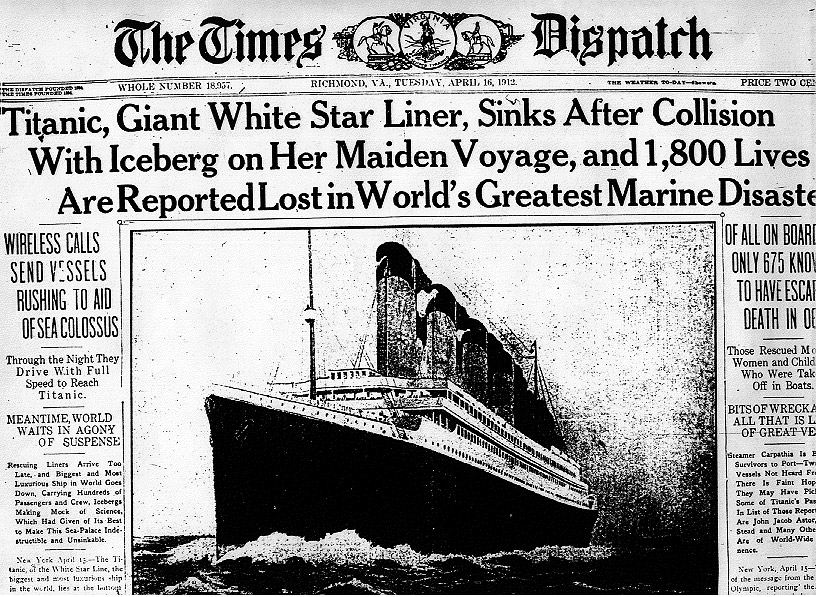
Dredging up the Past: Titanic and the Body of Memory

I just saw Titanic in 3D. I hadn't thought much about going to see it, and had even laughed at this rerelease as an easy money-making endeavor. Yet when some friends asked me to join, I went. I hadn't seen the film since it was in theaters the last time, before it won too many awards and became a parody of itself (i.e. "I'm king of the wooorld!"). I saw it on my first real date, cliche as that may be, and watched it with a mixed response. For the teenaged me, it was sad and awkward and romantic and manipulatively emotional. Then, as now, I loved the costumes. Even then, though I enjoyed the movie, I felt inklings of things I noticed this evening. I could talk, for instance, about the probably well-meaning but not very subtle way in which the film attempts to engage with issues of class or gender. The way that the rollicking party below decks lets us know that people with less money are more authentic, or at least more fun. The way that Rose's mother declares that women's choices are never easy just as she pulls Rose's corset strings tight. Yet something else caught my attention tonight, something I'd missed completely before. Seeing it after all these years, I still remembered the main Rose and Jack plot quite clearly, but the frame narrative hadn't stuck with me as well. Yet tonight I was fascinated by that frame.

The film opens with images of the submerged ship. Mundane objects are strewn about the ocean floor, the only testament to the lived experience of that drowned and broken metal hull. Eyeglasses, a baby-doll, a pair of boots exist in ghostly perpetuity, everyday items made strange by their decontextualization. The ocean, these objects seem to say, is not the natural realm for humans. It swallows us up. Unlike the topography on land, which can be marked by people, the contours of the sea shift continuously, and we can either float to shore or sink to the sandy depths. One must delve deep, quite literally, in order to find any traces of human existence in the ocean. The crew that opens the film, seeking history, fame, and fortune in the wreck, can reconstruct the sinking via computer, but they can't really understand it. They only see material value when they look at the submerged debris. As their inability to interpret the underwater landscape becomes apparent, a drawing of a young woman slowly emerges. They're not sure what to make of that either, except that the woman in the drawing is wearing the costly diamond they want to find.

It is at this point that a sweet elderly woman enters the picture, as if the re-emerged drawing had conjured her from the depths. She joins the crew and tells them all about her memories of the night the Titanic went down. Their fancy equipment can't help them to really understand, but this ancient lady appears just in time to interpret the objects and events for them. All of our images of the original ship and crew and passengers are through this elderly Rose's memory. The primary narrative is therefore invoked by her verbal recollections. For someone who has never spoken of the events before, who never even told her family about Jack, this lady sure can tell her story without a stutter. The men, who've only looked at the wreck for the fortune it could bring them, sit transfixed. They finally see the Titanic.

All of this reminds me of the Middle English poem Saint Erkenwald, which tells the story of an excavation that unearths an ancient tomb. As builders erect a cathedral atop the ruins of a pagan temple, they find a mysterious sarcophagus marked with ancient script. I think it's no accident that this image of palimpsestic architecture unearths such a living relic. While trying to build over history, the workers dig it back up in the form of this strange tomb. All of the most learned men attempt to read the mysterious writing on the tomb and to interpret its meaning. They look at the garments of the body inside the tomb and make conjectures about who he was, perplexed that none of their chronicles mention such a person. None of them can figure it out. As they begin to give into their frustration, they call in Bishop Erkenwald. He prays for guidance, and the long-dead judge buried inside the tomb arises and tells his story from the grave, explaining to them who he was and when he lived. And they finally understand. Erkenwald's understanding and empathy for the dead pagan man get represented physically in the tear he sheds upon learning that the good judge has been in hell all these years, and that tear serves as a kind of baptism that allows the judge's body to dissolve and his soul to rise to heaven. I never understood how the judge can speak English (or some language that the people recognize) when the writing on his tomb is in a language so foreign as to be completely unknown. But that is, I guess, beside the point. The material object from the past is illegible, even the writing from the past is unreadable, so the past needs to be literally revived in order to tell its own story. The resuscitated body of the past can help the people understand in a way that objects and letters never could. Or perhaps the revived body is representative of our attempts to get at that past via the objects and narratives we have. As Christine Chism argues in Alliterative Revivals, "death grants ghosts an interrogative force, imbuing the impossible, unceasing communication between the dead and the living, the past and the present with fearful intimacy" (1). The past is zombie-like in such texts; it rises from the grave and speaks aloud in order that we may hear it.

Though this film is quite different from that Middle English poem, it nonetheless features a past that becomes accessible through a figure emerging and speaking for it. The shot of young Rose's eye morphing into old Rose's eye (again, the film is not trying to be subtle) depicts the direct and physical link between the experience of the sinking ship and the story being narrated today. Though all is mediated via Rose's perspective and memory of long-past events, I suppose we are meant to trust her. If we have any doubts, the fact that she appears at the end with the diamond indicates that she's been conveying the events accurately. She's someone interested in tangible recollections, someone who carries all of her photographs with her when she travels. Yet she admits that she has no photograph of Jack, that there's no record of Jack. He lives on only in her memory. Jack has sunk deep into the sea, not to be brought back to the surface except through Rose's words. For the duration of her tale, the living, breathing, steaming love story can resurface. The captain and Mr Andrews and all the people above and below decks can breathe and speak and live and die as they did so many years ago.

The film could have simply told the story without the frame. It could have begun with Rose and Jack getting on the ship and ended with Jack's death or Rose's survival. It could have even been made from Rose's current perspective, but only in private recollection or more vaguely to us the viewers. Instead, the frame is of people today explicitly seeking something in the wreck and finding it in the person of an old women who once walked the decks of the ship they search. The past emerges bodily and memory is conveyed in color and sound and state-of-the-art special effects. Rose even opens with a description of the smell of fresh paint aboard the ship, a sensory contrast to the rusted and peeling metal we see today. When elderly Rose is finished with her tale, she can finally return to Titanic and to Jack, in dreams or perhaps in death. The narrative has not only brought those around to the ship, but it has returned her to it as well. She rose from the wreckage to tell the story, and then returned to it, along with her heart-shaped necklace.

The past, like the ocean, is never fully accessible to us. We can try to see what lies beneath the waves and we can pull a few things up to the surface, but it is never completely in reach. As a medieval scholar, I understand the frustrations of trying to access the past. And there is no one alive from the 14th century to tell me about it. The image of a body from the past emerging to speak to us is a tantalizing fantasy, as even people's narrations of the past can't actually take us there. Yet it's a fantasy that speaks to our continued longing to plumb those depths, to understand what lies beneath and beyond our own existence as we pass over the same land and through the same waters as people of long ago.

As I sit watching the same film as I did 15 years ago, I see the impossibility of fully understanding or reliving the past, even when that past is my own. On a superficial level, the film is now rendered 3-dimensional, but time has wrought its changes on me as a viewer as well. I notice different things and respond in different ways. My colleagues and I discussed the ways in which films and viewers have changed more broadly. My friend Amanda noted that this movie is situated in its time and place. Post-9-11, its disaster narrative would have meant something very different than it did to us all in 1997. Now we picture the twin towers or think about the socioeconomic realities that allowed some to escape Hurricane Katrina while others could not. I look at pictures of flood and remember the horrifying images from Japan after the recent earthquakes there. The film, already a heavily mediated image of history, is now filtered through all the disasters we've witnessed on the evening news in the past decade and a half. All of these connections make the film and the history it attempts to depict both more and less immediate. And yet it remains as an artifact and we engage with it and with both Roses and with our past selves as we sit in the theater. And we narrate the memories of our previous experiences with the film even as the film gives memory a tangible existence in the person of an elderly lady with a story to tell.