Showing posts with label conference. Show all posts

Friday, May 22, 2015

Kalamazoo 2015 Round-up!

I know I’ve said it before, but I’ve really come to see my (usually) annual journey The International Congress on Medieval Studies as a kind of pilgrimage, and this particular journey to K’zoo was no exception. Traveling here had its salient differences though. I left my baby (called Pixie here and elsewhere online as a form of protection and, well, because she looks like a little woodland sprite!) at home for the first time since she was born, and I also departed while in the midst of a teaching quarter (as opposed to being at the end of a semester). Both were deeply disconcerting, to say the least!

The leaving part was hard, harder than I’d anticipated (though, I’ll admit, watching Interstellar on the flight to Detroit was an apt exercise in perspective), and there were moments on the trip that were even harder. To that end, here is a hard-won tip for fellow new(ish) parents: if you have to travel away from your little, and he/she is under 13 months, approach Skype/FaceTime with deep wells of caution. My husband set up his phone so she and I could see each other that first night, and as soon as she heard my voice she looked around at the front door expecting me to be there (cue the shattering heart). She then turned her head around, saw mom in the tiny box, stuck out a trembling lower lip, and started to wail. Fortunately, I happened to be at Bells with dear friends and a beer flight waiting for me back at the table. Robbie, sweet spouse that he is, also sent me a video of a smiling and giggling Pixie (taken moments after we signed off and she calmed down), that helped me even more. He sent me pictures just about every day along with updates, and – truth be told – I found myself so happily surrounded by friends and colleagues, and so busy and energized by all the things I needed and wanted to do, that my time away was easier to manage than I had thought it would be. Oh, and I’d be remiss if I didn’t thank the Society for Medieval Feminist Scholarship, the Medieval Institute, and the conference organizers for how skillfully they set up and advertised the nursing/lactation rooms. As a nursing mother traveling without my babe, these were crucial to my being able to participate in the conference as fully as possible (without them I would have had to head back to the hotel several times and miss out on much of the conference in the process). I found myself very comforted by their presence and by how easy they were to access throughout the day.

I attended a number of truly innervating sessions, but there were a few that especially stuck with me. The first was the panel honoring the twenty-fifth anniversary of Carolyn Dinshaw’s Chaucer’s Sexual Poetics. Having come up in Academia long after the book’s publication, I was grateful for the reminders of the book’s seminal importance and how much of a productive disruptor it was when it first came out. Steve Kruger reminded us of how the book “challenged dominate masculinist readings” and how it challenged us “to ask different questions about medieval and modern reading practices.” Emma Solberg echoed this sentiment as well by pointing out that the book proffers “liberating, energizing, and empowering readings” that weren’t considered possible/feasible/acceptable at the time, and how Dinshaw, in the book, “seized permission and authority” to do so.  To her (and I agree with her wholly), the book acts like a kind of Griselda in the ways it exposes patriarchal chauvinism. Lynn Shutters, in turn, talked both about the book’s importance and Dinshaw’s ability to find the utility in “necessary discomfort” and “a lack of resolution.” By way of example, she explained how the final chapter of Dinshaw's dissertation, which she wasn’t entirely satisfied with at the time, contained the raw material that would later become Chaucer’s Sexual Poetics. In turn, the ideas in the final chapter of that very book — “Eunuch Hermenutics” — would be explored and teased out even further in Getting Medieval. On hearing Shutters talk about the evolution of Dinshaw's work, I took solace in the reminder that discomfort with your work can, if you let it, be a productive and motivating force.  It’s a reminder I very much needed since I've found myself more than a bit overwhelmed of late with my own book project. 

These responses to Dinshaw’s work were truly compelling, and I found myself equally compelled by her response, where she revealed that – while this book did eventually get her tenure -- she was initially turned down for tenure (a decision that was ultimately overturned by the deans) because of the book and the way in which it threatened the endemic chauvinism of the academy. I’ve always admired her work for its boldness and its ingenuity, and I was reminded – especially as she told her story -- of how indebted I am to her and to others like her for creating room for younger scholars like me to breathe and thrive. It is no exaggeration to say that I would not be able to do the kind of work that I do had it not been for her willingness –- and the willingness of others –- to publish bold and brave works that argued passionately (either implicitly and explicitly) for the power and importance of reflexive analysis. I came away from the session very grateful for her work and for the reminders of its importance provided by each of the speakers.

And I left another session, on being a Public Medievalist, equally innervated. Having been invited to write a brief write-up on my experience as a type of public medievalist (soon to appear on postmedieval’s Forum), I attended the session quite eagerly, and I found myself particularly compelled by the conversations and ideas that emerged throughout the talks and Q&A, especially those surrounding the talk that David Perry gave. He offered insights into the complications of being both a journalist/public writer and an academic, especially when one’s worlds converge (i.e. when, as a crusade’s scholar, you write an 800 word op-ed on a crusades-related topic to a popular audience, knowing you’ll provoke the ire of both scholars and non-specialists). He also spoke compellingly about the risks and perils of going public, and now we – as a community – need to be more humane, more aware of the potential effects our written words can have on social media. He reminded us that a single tweet about a young scholar’s “boring” presentation can and, in this day and age, likely will have an negative impact on his/her career, and he ended his talk with the following recommendation: “If you can’t tweet something nice, don’t tweet it at all.”

I really appreciated his talk, since it helped me to tease out some of the issues and frustrations I’ve had with how I’ve been approaching my own blogging. I know for a fact that I spend more time than I should on each blog post I submit here at In Romaunce. I want to write more frequently and to be bolder, but I also feel immense pressure to watch what I say out here in the blogosphere and in social media. I feel palpably in these spaces how very precarious I am at this point in my career, and this results in my feeling more than a little hesitant about what I say and how I say it. This is why, for instance, it took me well over a week to muster up the courage to post my thoughts on Obama’s prayer breakfast. I’m ultimately glad I wrote what I did, but I’ve wished for sometime now that I could find a way to be braver more frequently (and more swiftly). Attending the session and chatting with him and fellow attendees afterwards, however, reminded me that my cautiousness might not be a bad thing at all. I might not produce as much as I’d like, but at this point in my career, a little extra caution probably can’t hurt. 

This year's K'zoo also marked the last time I served as the organizer and presider over Malory Aloud/Performing Malory. I inherited these roles somewhat by accident, but I couldn't be more grateful for having had the opportunity to lead this group for the past eight years. In addition to each performance session being a rollicking good time, the process of rereading significant portions of Malory's Morte each year has been deeply enriching, especially when I needed to track certain themes or characters. Last year, for instance, we hosted a performance entitled "Malory Interruptus: Sex and Love in the Morte." In addition to (re)discovering that Perceval nearly boinks Satan while on the Grail Quest (!!!!!!!!), I noticed how consistently fraught sexual encounters are in the Morte, and how the problematics of sex are often tangled up with the non-procreative nature of these same encounters. I wouldn't have arrived at that idea, or others, were it not for my work on these sessions, and I remain truly grateful for having been able to take the helm for so long as a result. Also, and just as importantly, I had the privilege to get to know an array of truly lovely and inspirational scholars along the way, and I remain so excited to see what the merry troupe will continue to do in the years to come!

I’ll save my own session for a separate post, but for now, I want to end with a few parting thoughts on conviviality, community, and affect. Though I was (sadly) unable to attend Richard Utz’s plenary, I heard much about it from friends who did, and I was deeply appreciative not only of his discussion of affect (and how we need to dismantle notions that work and pleasure need necessarily be mutually exclusive). I was also glad that BABEL was acknowledged, because I’ve grown very deeply fond of the organization since graduating from Rochester. I am currently very fortunate in my postdoctoral position, but the job search last year showed me how difficult and uncertain my road ahead will be. I know that I might not have a professional future in academia once all is said and done. But I do know that I will always be a medievalist one way or another. I know this because I love the material deeply. But I also know this because of BABEL’s willingness – even insistence – on including non-traditional scholars in its mix. Knowing that I will always genuinely be welcome at their gatherings, that I won’t be looked at askance, is truly comforting to me. It gives me courage, especially as I steel myself for the upcoming job search this Fall. 


In the end, I left this conference with a full head and heart. I wished I’d had more time to connect with even more people than I did, but was so grateful for the deep and fruitful conversations I was fortunate enough to have with so many of you. As many have said on social media already (and as, for example, Elaine Treharne’s recent #GenderImbalance tweets reveal) we have quite a ways to go in how we treat one another, but I was encouraged all the same to see so many of us working towards positive changes at this gathering. Onwards!

Wednesday, February 11, 2015

Join us at NCS 2016 in London

Good news!

Kristi and I recently had a roundtable session approved for the upcoming New Chaucer Society Congress (London, 2016). If you work on representations of waterways in medieval literature and/or are intrigued by the ways in which waterways serve as conduits of narratives, please consider submitting a paper proposal to the two of us. The deadline for submissions is April 15th, and -- as is the way with deadlines -- it'll be here before you know it!


Here's our official description, which you can also find on the NCS website:

Session Title: Narrative Conduits
From the watery borders of the Celtic Otherworld, to the vibrant matrices of transmission in the Mediterranean, to the Thames as meeting point of king and poet in John Gower’s Confessio Amantis, rivers and other bodies of water commonly serve as thresholds, starting points, narrative conduits. The wide-ranging sources we find in Chaucer’s work show us that narratives and texts (and even poets) made their way back and forth across the English Channel. This session welcomes papers that explore how navigable bodies of water like the Thames are represented in medieval literature and how they function as transmitters of narratives themselves. 

We're looking to have five speakers, each of whom will talk for 5-7 minutes. Rousing conversation will hopefully ensue! If you have any questions, please feel free to either post them here or email Kristi (kristi dot castleberry at gmail dot com) or myself (lknorako at stanford dot edu).

Hope to see you in London!


Monday, August 4, 2014

Like Sun on a Troll's Back: Tales of Iceland and the New Chaucer Society Congress

View of Reykjavik from Hallgrímskirkja
This summer I had the chance to visit Iceland for the Nineteenth Biennial International Congress of the New Chaucer Society. I am still processing the experiences I had, which loom like fantastical peaks in my memory. I went a week ahead of the conference so that I would have time to explore Reykjavik and spend some time in the surrounding country as well. As the conference grew nearer, I began to run into more and more familiar faces around the city, and it was exciting to feel that sense of connectedness in this beautiful new place. The conference was fantastic. I heard excellent papers and conversed with friends old and new. The energy of the conversations I had is helping to motivate me as I work through the final period of dissertation writing/revising. The congress also included excursions, so I got to see some stunning things both in and out of the city. The landscape in Iceland is startlingly, unbelievably beautiful. I asked my Romanticist friend if the word "sublime" applied, and she said that it did. Driving through the country there feels like driving out of this world and into a world of myth. I fell in love with Iceland. I immersed myself in sagas before and during my trip, and then the landscape of the sagas vivified and challenged  and confirmed everything that I had read or wanted to read.

Black sand beach at Vik
(The sea stacks may be trolls who
were petrified by the sunrise)
An incredible feature of the landscape is that every place I visited was interwoven with stories. These stories bridge the gaps between myth and history with growing grass and trickling water and surging lava. A cliff was a troll who'd been petrified by the rising sun. A pool of water  once splashed with the bodies of women hurled there to drown for adultery or incest or infanticide. The terrain there seems indifferent to humans (though maybe not to elves). Its beauty delights and beckons, but it seems like it isn't really meant for us either. I cannot imagine how the first settlers survived. Yet the stories that surround every topographical feature manage to lend it a narrative texture. Reykjavik, for example, exists where it does because Ingólfur Arnarson threw his high seat pillars into the ocean in 874 when he saw Iceland's coastline materialize on the horizon. The pillars landed in a spot made steamy by hot springs, leading to the name Reykjavik, meaning "smoky bay."

The city, then, functions as the living answer to a question from story: where will these pillars land? And other built environments are connected to stories as well. Visiting the turf houses of Keldur was a thrill, having read about them in Njál's Saga. The host, a stoic lady who grew chatty as we showed her our enthusiasm for the location and its history, told us that the foundation was a thousand years old, but that people had lived in the house we we're standing in until 1946. We could see the layers of construction; we could feel the temporal rift as we moved between two sections of the house that had been built 600 years apart. We looked at the mixed construction -- wood and stone -- that our host explained combined building practices from Viking and Celtic cultures, a sign that the settlers from Norway often stopped off in Ireland and Scotland to pick up slaves. Not only geographical movements, but sociocultural realities of the past leave their mark.


Turf houses at Keldur
Detail from Njáls saga fragment, c. 1300


But architectural wonders are not the primary attractions in Iceland. The people who settled there built no massive castles or cathedrals. And much of what they did build has disappeared under layers of time. The remains of  a longhouse, for example, feature in the Settlement Museum. The ruins were discovered during a construction project, and the museum is carved out around them in an underground space. As incredible as this museum is, most of the impressive buildings I saw are not medieval, but modern: the Harpa concert hall, Hallgrímskirkja church. The most dazzling remains of times past in Iceland are manuscripts and the recorded sagas and laws and history and myths they contain. And those narratives are written onto the landscape as surely as any wood or stone constructions could be. 

Leif Erikisson and Hallgrímskirkja
Inside Harpa


Outside of the city, the landscape seems to swallow up built structures with its shifting and boisterous geological demeanor. In the landscape of Þingvellir, fissures and cracks in the earth proliferate and separating plates reveal a path between the continents. In such a space, who could hope to locate the famed rock where The Law Speaker stood to recite the laws to the people? Grass-covered outlines of booths are the only traces of the lively gatherings that once crowded the space. Yet the story of the law rock and of the yearly general assemblies that took place there from 930 to 1798 still brings us to Þingvellir en masse. The description of the general assembly as a place to adjudicate disputes and visit friends and relatives is vivid in texts like Njál's saga. The land is steeped in the intersected narratives of geological and historical time.

The earth splits at Þingvellir

The multiplicity of temporal narratives written onto the landscape there reminds me of medieval mappa mundi, which feature Biblical and classical and contemporary history arranged spatially over the world. Medieval travel narratives (and Icelandic sagas, for that matter) connect their stories to locations, while the maps connect the locations to stories, but in each case there remains a strong sense that narratives and places are mutually constitutive. Since I was presenting a paper on this very idea, the location of the conference and my adventures there ended up connecting to my presentation in ways that I couldn't have anticipated. In my paper, "'By Sun and by Shadow': Narrative Mapping in The Canterbury Tales," I considered the frame of the The Canterbury Tales as a travel narrative and thought about the function of the tales in relation to travel. I guess it was inevitable that my own experience of traveling would link to my paper.

Walking behind Seljalandsfoss
In one memorable moment, for example, as I scrambled into a cavern behind the waterfall called Seljalandsfoss, I found myself rethinking how time is conceived in The Canterbury Tales. The power of the water was palpable, so palpable that I emerged from the experience drenched. Water rolls off of the mountain inexorably; currents and gravity converge so that the water travels forcefully in one direction, a teleological natural wonder. (Though I was later told that the wind is sometimes so strong that it can send a waterfall upward ...) Anyone who gazes into the heart of a waterfall can see that its movements are beyond human control. Harry Bailey evokes such an image in the prologue to the Man of Law’s Tale, when he laments wasted time:

Lordinges, the tyme wasteth night and day,
And steleth from us, what prively slepinge,
And what thurgh necligence in our wakinge,
As dooth the streem, that turneth never agayn,
Descending fro the montaigne in-to playn. (21-25).

The host’s description of time expresses the movement from one moment to the next in a strikingly geographical way. Time is like a stream, whose current only moves one way. The progression of time is like gravity, flowing down the mountain in a way that we mortals are powerless to fight. We are always in the flow of time; it’s not so visible or tangible as the waterfall, but its movement is just as relentless. The pilgrims’ trip to Canterbury might be meandering and, ultimately, incomplete, but time moves along as they tell their tales and we read them.

This description of time as a geographical feature connects temporal movement, often seen as linear and narrative (at least in many Western cultures), with the more spatial and visual. Since the frame of The Canterbury Tales is a travel narrative, this connection between narrative and landscape makes sense. Medieval travel narratives, all along the spectrum from real to fictional, follow a model of connecting locations to stories of things that have happened there (or may have happened there). And my travel the week before had been the same. The part of the gorge leading to Seljalandsfoss, for example, is named Troll’s Gorge for an old troll woman who tried to cross it. Other places I visited connect to people and events from the sagas, and the sagas in turn are consistently connected to topographical features that we can visit today. A hill or city or waterfall links us with things that happened there a thousand years ago. Travel narratives more generally serve to yoke stories and locations. Medieval mappae mundi take this connection even further, collapsing past and present by presenting all of their details in
Babylon and Tower of Babel from Ranulph Higden’s Polychronicon
(From the British Library's Medieval Manuscripts Blog)
terms of space: here is where Lot’s wife looked back, here is where the Tower of Babel was constructed, here is where Alexander crossed the Hellespont. In Maps of Medieval Thought, Naomi Reed Kline describes the medieval world map as "a visual encyclopedia of images and disparate facts" which she contrasts with the "linear and discursive" nature of language (89). The depiction of historical narratives on these maps is spatial rather that teleological; bits of text only make sense in terms of their location on the map. Pilgrimage both relies upon this sense of narrative location and imposes a linearity to it, as pilgrims create an itinerary to a place because of the story associated with it. You go to Canterbury because that is where Thomas Becket was martyred. (And many of us, in turn, go to Canterbury because of The Canterbury Tales.) Chaucer's pilgrims perpetually travel the road to Canterbury, always moving toward it and never arriving. Yet The Canterbury Tales do not describe the journey itself, do not recreate the landscape or experience of travel in words. Rather, the text employs a kind of narrative mapping to move the characters along via stories. Tales whose subject matter spans the globe serve to paint a line between two distinct locations in England.

I argue that Chaucer's use of narrative mapping in The Canterbury Tales serves to reexamine the ways in which time and space function together in the act of traveling. Chaucer specifically calls attention to the connection between story and travel in the prologues to The Man of Law's Tale and The Parson's Tale. In each prologue, the host notes the position of the sun and the shadows it creates in order to ascertain the time and thus to decide how many tales may yet be told that day. Each tale is told as a result of these calculations, and thus each tale begins with a specific sense of correlation to the journey at hand. Unlike the bits of narrative on mappae mundi, these stories do not directly concern the location of their telling, but instead represent the movement through time and space that constitutes travel itself. To map the progress of these pilgrims, then, is only possible by engaging with acts of storytelling.

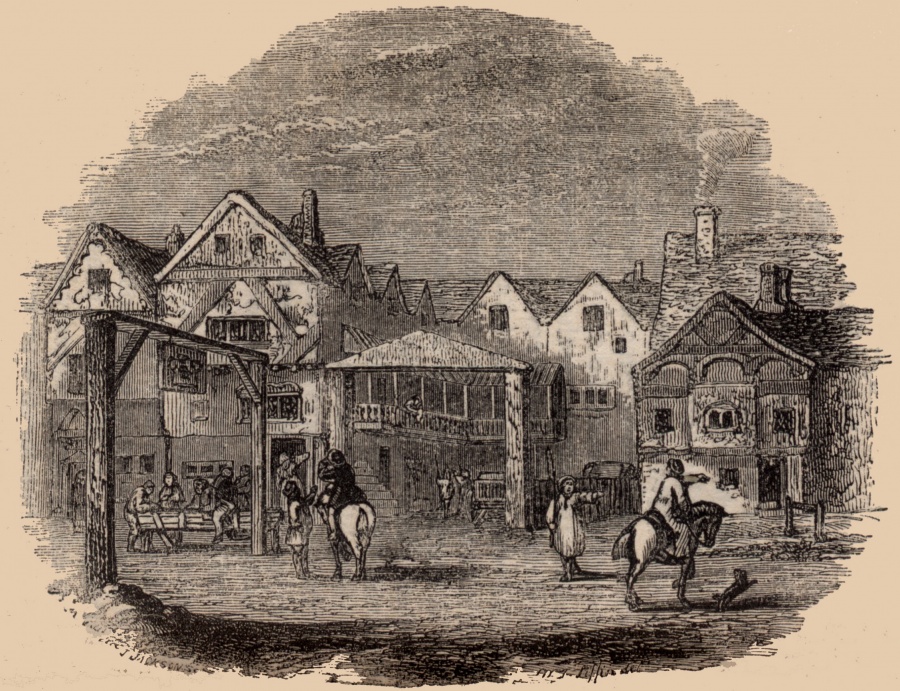
The Tabard, Urry's edition of Chaucer (1720)
(Courtesy of Visualizing Chaucer)
In the prologue to the Canterbury Tales, the narrator takes pains to give us “Th' estaat, th' array, the nombre, and eek the cause/ Why that assembled was this compaignye/ In southwerk at this gentil hostelrye/ That highte the tabard, faste by the belle” (716-19). The people on the trip are clear to us, so much so that my students came in angry with the Wife of Bath one semester. We get details about them that give context to the stories they tell, and many of the stories (such as the Wife’s) are deeply rooted in the character who tells them. The places are far less clear. My colleague Kara McShane has recently created a website called Visualizing Chaucer, and it features a constantly increasing number of images of the pilgrims and their tales. Under the heading “places,” however, only two locations are mentioned: the Tabard Inn and Canterbury Cathedral. Since the pilgrims never seem to actually make it to Canterbury, the Tabard Inn is the only place in the text well-defined enough to illustrate. And even the inn is simply placed “fast by the belle.”  Despite the frame’s implied movement, the stories could be told anywhere (though the pilgrimage gives a reason for the disparate group to be together, and starting in Southwark may increase the possibility of mixing such a cross-section of society). Once the tale-telling begins, the movement from Southwark to Canterbury recedes into near invisibility as we’re treated to tales with locations that are both specific and general but that do not in any way correspond to the landscape through which the pilgrims move.

Because of this lack of topographical detail, the moments when the host does seem to call attention to the surroundings are striking. Before introducing the Man of Law’s Tale, we are told that
           
           Our Hoste sey wel that the brighte sonne
The ark of his artificial day had ronne
The fourthe part, and half an houre, and more;
And though he were not depe expert in lore,

He wiste it was the eightetethe day
Of April, that is messager to May;
And sey wel that the shadwe of every tree
Was as in lengthe the same quantitee
That was the body erect that caused it. (1-9)
Photo from my own pilgrimage to
Canterbury in 2011

The passage continues for some time, as the host notices many things about the shadows and infers many things about the time on account of what he sees. Josie Bloomfield pointed out last year at the Plymouth Medieval and Renaissance Forum (in a talk titled "Walking with an Astrolabe: Measuring Time on Chaucer’s Pilgrimage") that his information is not particularly accurate and is more cumbersome than it needs to be. If the host wants to know the time, listening to church bells would be much easier. And yet Chaucer chooses to write it this way. The details he includes might not describe a specific location on the journey to Canterbury, but they do describe sun and tree and shadow in order to define a specific point on the journey. As Helen Cooper explains in The English Romance in Time, “A phrase such as ‘a day’s journey’ is in fact tautologous, since ‘journey’ derives from journée, how far can be covered in a day. Distance itself was hard to measure, and the conversion of space into time provided a functional and accessible approximation. The ease of the conversion is itself an indication of how one-dimensional travel appeared, like time itself. The conversion worked in the other direction too, to represent time as space. Dante famously claimed to have had his vision of Hell, Purgatory, and Heaven mid-way along the pathway of his life, in the thirty-fifth year of his allotted seventy” (68). To travel is to move through space and time simultaneously, and to pilgrimage is to ultimately to collapse the two. We go to the place where Becket was killed in the past because that location has meaning for us in the present. The host further connects location to time when he uses the waterfall metaphor I mentioned above. The conclusion of his astronomical musings is to ask the Man of Law to waste no more time and tell his tale. There is some irony in how much time the host spends in trying to move things along, but the sustained focus on scenery and time and story-telling functions to remind us of the connection between travel and narrative in the Tales.

The tale the Man of Law tells is itself full of travel, as Custance sails from east to west and back again. Kathy Lavezzo argues in Angels on the Edge of the World that "since Custance's journey begins in Syria, the cartographic territory evoked in the tale . . . suggests a map of the world" (95). Both we as readers and the pilgrims as listeners can follow Custance’s voyages while the Man of Law describes them. Stories, after all, are a kind of travel, as reading about travel to holy places sometimes functioned as virtual pilgrimage for those who
Detail from Gustaf Tenggren illustration
to the Man of Law's Tale (1961)
couldn’t make the actual journey. Yet as John F. Plummer noted the same day as my own talk in a fantastic paper called "Figures of Geo-political Spaces in the Man of Law's Tale," 
Custance’s journey is not as specific geographically as it is in Chaucer’s sources. The Man of Law often cannot name the castle or island on which Custance lands. At one point he explains that her boat goes "Som-tyme West, som-tyme North and South,/ And som-tyme Est, ful many a wery day" (948-949). So, basically, her boat goes in every direction. Nothing could be farther from the image of the forcefully direct waterfall. And time is no less clearly defined. Custance’s ship is carried back and forth across the ocean for "Yeres and dayes," a time that seems specific, with the addition of days, and yet is nonetheless vague (463). How many years? How many days? Later, her ship is at sea for "Fyve yeer and more" -- we do get a number of years this time, but the "and more" undoes that precision (902). The sense of movement over space and through time is almost magnified by this unspecificity, as our heroine’s movements could cover any distance we could imagine. Yet the passage of time is indelibly linked to the oceanic spaces through which she is traveling. Everything about her tale is rooted in her landscape (or rather oceanscape).

The second mention of sun and shadows comes before the Parson’s Tale, which is further removed from physical travel than the Man of Law’s choice of material. In this second instance, the geotemporal reflections in this scene come not from the host, but from the narrator Geoffrey. He begins with reference to the previous tale, which places the observations explicitly between tales:

By that the maunciple hadde his tale al ended,
The sonne fro the south lyne was descended
So lowe, that he nas nat, to my sighte,
Degreës nyne and twenty as in highte.

Foure of the clokke it was tho, as I gesse;
For eleven foot, or litel more or lesse,
My shadwe was at thilke tyme, as there,
Of swich feet as my lengthe parted were
In six feet equal of proportion. (1-9)

 My own interaction with sun and mist and
flowers at the base of Gullfloss
With the shift from host to Geoffrey, we also get a more personal interaction with the landscape, as the calculations are made not in terms of trees, but in terms of his own shadow. As before, the landscape is vague and general, and yet it is nonetheless there, and both time and tale-telling are defined by it. And the implications of sun and shadow must be clearly evident, since the host responds to them even as Geoffrey tells us about them. The narrator explains that it is because of the telling length and angle of the shadows that the host addresses the pilgrims:

                      … 'Lordings everichoon,
Now lakketh us no tales mo than oon.
Fulfild is my sentence and my decree;
I trowe that we han herd of ech degree.
Almost fulfild is al myn ordinaunce.' (15-19)

The tale-telling is meant to accompany the trip to Canterbury, so the idea that all but one pilgrim has told a tale and that the host’s ordinance is almost fulfilled gives us a clear sense of movement. If this many tales has been told while riding along, they must have been getting somewhere. And again this knowledge of movement and this request for another tale comes from observations about the play of the sun on the world, details about their surroundings so clear that the host could speak up even as the narrator muses to us about his own shadow.

The Parson’s Tale that follows is, to put it mildly, different from the Man of Law’s. In response to the host’s invitation to give the company a fable, the parson retorts “Thou getest fable noon ytoold for me” (31). And not only is it not a fable, but it’s not even really a tale at all.  It’s more of a sermon. While the Man of Law, responding to a similar request from the host, sends us around the world with his narrative, the parson wants us to instead look inward and examine our souls for a different sort of pilgrimage. As he explains,

          And jhesu, for his grace, wit me sende
          To shewe yow the wey, in this viage,
          Of thilke parfit glorious pilgrymage
          That highte jerusalem celestial. (48-51)

The parson wants to achieve the perfect pilgrimage of celestial Jerusalem, which isn’t physical but is rather spiritual in nature. Even though tales like the Man of Law’s don’t
John's vision of Christ and heavenly Jerusalem, Revelation 21: 2-8
from Yates Thompson 10 f. 36
(Courtesy of the British Library)
directly relate to the voyage at hand, they’re still part of a shared game of tale-telling that is associated with the time it takes to get from one place in England to another. The Parson, on the other hand, yanks us out of the temporal realm and leads us to a kind of pilgrimage that is related to a Canterbury pilgrimage spiritually (at least ideally speaking – some pilgrims seem to have more spiritual reasons than others), but is distinct in more practical ways. As Helen Cooper notes, “The pathway of life is also the journey of life; life as quest” (68). We’re all moving from birth to death, and many hope that death will be followed by a pleasant afterlife. As the narrator in Pearl just can’t help but try to cross the river in his vision, it’s easy to mistake geographical movement as the way to achieve that ultimate pilgrimage, but the parson insistently reminds us that we must look inward and turn our minds to higher things. It is perhaps telling that a “tale” with so little connection to either narrative or location follows an extended musing on the visual cues of the passage of time.  We might long for the eternal, but in the meantime we’re stuck in the temporal realm.

As we read these moments where time and space rise to the surface of the Canterbury Tales’ frame narrative only to be followed by tales with an increasingly vague sense of physical locatedness, the connection in narrative between time and space becomes both apparent and richly complex. It is impossible to separate the one from the other, and yet neither is fixed. Whether we read a story or travel to Iceland or just sit and wait, things change. Time passes. The earth shifts, and landscapes are built and rebuilt. The simultaneously uncertain and sure movement of those pilgrims as they wend their way and tell there tales both removes us from time and space and reminds us that we can never escape them. Except, perhaps, in the afterlife.


Layers of lava rock look heavenly to me

Wednesday, July 30, 2014

Is that a riddle in your pocket? Apollonius of Tyre and The Third International Congress of the John Gower Society

We had our own watery voyage.
(A boat ride on the Genesee River.)
This summer has combined conferences both far away and very near. I got to travel to Iceland for the New Chaucer Society Conference (about which I'll blog later), and I got to present at home in Rochester at The Third International Congress of the John Gower Society: "John Gower: Language, Cognition, and Performance." Traveling to Iceland was magical, but it was also a joy to welcome scholars from around the world to my own institution. The Gower conference was all that I hoped, combining scholarship, camaraderie, and creativity.

I presented a paper entitled "'Bot in writinge it mai be spoke': Intratextual Desire in Gower's Tale of Apollonius of Tyre." The paper was new topic for me. Just as I'm finishing up my dissertation, this paper helps bring a second project into focus (which also connects to work I've been doing on Elaine of Astolat, the Camelot Project page on whom I published recently). As is inevitable at the beginning of a project, I feel like I need to think through it much more fully, but I'm excited about where it will take me. Despite my nerves, the paper went well. The whole panel fit together beautifully, our ideas mingling in surprising and delightful ways, and the discussion afterward continued throughout the conference. As with the best presentation experiences, I feel like the enthusiasm and questions and discussions I encountered will help me continue to develop my ideas.

For those who aren't familiar with the Tale of Apollonius of Tyre, I recommend reading the tale (just scroll down to line 271 of Confessio Amantis book 8). If you've seen/read Shakespeare's Pericles, then you have a basic sense of the plot. The story begins with a king, Antiochus, who has lost his wife and tries to replace her with his daughter. It's a disturbing beginning, and Gower doesn't shy away from the trauma of the princess as her own father violates her. As suitors begin to vie for the princess's hand, Antiochus devises an impossible riddle for them to answer.  Many suitors try, and many suitors fail. Finally, Apollonius arrives to try his hand at the riddle. He correctly guesses that the answer is the
Gower's main hobby is shooting the world.
He's basically the opposite of Atlas.
incest between Antiochus and his daughter, but this correct guess sends him running for his life. After many adventures, he lands on Pentapolis, where he gets a position as tutor to the king's daughter. Many suitors are vying for this princess's hand as well, but this father tries to facilitate his daughter's marriage. He asks the suitors to write bills, which the princess will read and compare. The princess, however, has fallen in love with Apollonius and is ill with lovesickness. The king is worried about his daughter, and she writes him a letter explaining her condition. The king brings the letter first to his wife and then to Apollonius, carefully arranging the marriage his daughter wants. Apollonius and the princess are married and the princess soon becomes pregnant, a sure sign that things are going well. When they hear that Antiochus and his daughter have been destroyed in a storm and it is safe for Apollonius to return home to Tyre, it almost seems like we've reached a happy ending. But there are a lot of lines, and a lot of troubles, left in the tale. While sailing to Tyre, the princess gives birth to a baby girl but dies in chil
dbirth. Apollonius, heartbroken over the loss of his wife, puts her in a coffin with jewels and a letter begging for her proper burial and then sends the coffin to sea. The coffin, miraculously, reaches land, and, even more miraculously, the clerk who reads the letter discovers that the princess is only mostly dead. Reviving her and hearing her story, he sets her up for the chaste life she requests. A lot more happens in the story, and we get wonderful adventures of the daughter as she grows up as well, but this brief summary will get us through the parts of the tale I had time to discuss in my paper.

I began outside the tale (and a few hundred years earlier), with riddle 44 from the Exeter Book: 
Swings by his thigh a thing most magical!
Below the belt, beneath the folds

of his clothes it hangs, a hole in its front end, 
stiff-set & stout, but swivels about.

Levelling the head of this hanging instrument,
its wielder hoists his hem above the knee:
it is his will to fill a well-known hole
that it fits fully when at full length.   


He has often filled it before. Now he fills it again.1
The answer, of course, is a key. What, were you thinking something else? The moment where the room shares a stifled laugh and represses the obvious dirty answer in favor of thinking through less obvious and more innocuous possibilities is the heart of such riddles. The pleasure lies in the simultaneity of the answer we don’t say and the one that we do.

The riddle at the beginning of Apollonius of Tyre, on the other hand, distorts this tradition by denying the pleasures of the genre. Antiochus gives suitors a riddle in which the sexual answer is correct. Centuries of riddles would suggest that there must be a clever trick here, but there isn’t. And yet speaking the real answer is a dangerous option as well. To declare publically that the king and his daughter share an incestuous relationship seems a good way to separate your head from your shoulders. No wonder so many suitors get it wrong. This twisted form of a twisted genre is well-suited to such a taboo desire as the king’s for his daughter.

The riddle in Apollonius of Tyre is the first of many expressions of as many varieties of desire. Characters in the text articulate their desires by crystallizing them in language. I argue that the genre that each linguistic expression takes directly represents the type of desire being expressed. From the opening incestuous riddle to the body wrapped lovingly in a letter, characters solidify their desires in language that can then be examined and distributed. At each instance of linguistic desire, language takes on a more corporeal quality, until letter and body are interconnected. Throughout the tale, then, language does not merely convey emotion, but embodies it, rendering it both tangible and communicable. Like the key from our opening riddle, language is both the thing to be unlocked and the means to unlock it; it is a passageway between the private and the public, one’s one thoughts and desires and the rest of the world. The fact that the genres of the linguistic expressions I discuss match the desires they communicate gives language an increasing material reality that renders it increasingly productive.

The tale begins with an inappropriate and traumatic desire, that of a father for his own daughter. The private world that Antiochus creates for himself, in which he may do as he pleases, is a world where desires cannot be clearly articulated. As María Bullón-Fernández explains, “incest is equated not just with ignorance but also with secrecy; can keep being performed as long as it is kept private” (49).2 Antiochus’s daughter weeps, but doesn’t know how to express herself so that he will hear her. Afterward, “sche lay stille, and of this thing,/ Withinne hirself such sorghe made” (314-15). The daughter’s emotions and desires become trapped in her motionless, soundless body. Not only is she silent, but R.F. Yeager points out “that Antiochus's daughter has no name, in a tale in which even the least servants and functionaries … are made known. … Thus the namelessness of Antiochus's daughter … bears a message we should ponder: that … sexual gluttony has no acceptable side” (228).3 Although the second princess, whom I will discuss later, also has no name, namelessness here seems to deny the princess any possibility of a subject position. She has no language; she cannot articulate her position. 


As offspring becomes consumed by progenitor, desire feeding upon that which it engendered, it’s fitting that the verbal form for these forbidden feelings is a riddle, a tricky trap of language to represent something to taboo to express. If, as Yeager suggests, “sexual gluttony has no acceptable side,” then it makes sense that its linguistic representation is a genre that both reveals and conceals. Antiochus recites, 

'With felonie I am upbore,
I ete and have it noght forbore
Mi modres fleissh, whos housebonde
Mi fader for to seche I fonde,
Which is the sone ek of my wif.
Hierof I am inquisitif;
And who that can mi tale save,
Al quyt he schal my doghter have;
Of his ansuere and if he faile,
He schal be ded withoute faile.' (405-14) 
The riddle puts the desire itself into first person. If the “I” is Antiochus himself, then by sexually consuming his daughter he renders himself his own father-in-law and thus his daughter becomes his mother-in-law. His daughter is his wife is his mother. Family titles multiply to the point of chaos. As Gary Lim explains, "While the riddle evokes familiar subject positions of the family … these terms are thrown into an incomprehensible jumble, except when incest is offered as an interpretive key. Yet if incest indeed governs these relations, it would render the conventionally accepted significance of these subject positions meaningless” (334).4 According to Larry Scanlon, the pleasure of riddles “lies in drawing a single, unambiguous solution out of what initially appears to be an irresolvable confusion. Thus, though they are founded on the possibility of instability, they depend just as much on the capacity of language to stabilize meaning as they do on the capacity to destabilize. In this riddle, by contrast, instability is all” (124).5

Although the riddle is difficult to parse, as family titles multiply and feed back on themselves, there is something inherently incestuous about it. Unlike riddles like the key from the Exeter book, this one is uncomfortably suggestive precisely so that no one would guess the answer. Even Apollonius never mentions the word incest, only stating that 

‘The question which thou hast spoke,
If thou wolt that it be unloke,
It toucheth al the priveté
Betwen thin oghne child and thee.’ (423-6) 
The answer to the riddle is that the answer is a secret. The riddle represents something that can be unlocked, but that perhaps shouldn’t be, a private space of taboo that can only be put into language when that language resists naming it. Bullón-Fernández points out that “the moment of incest might seem to have assumed a nature/culture opposition, or an opposition between the pre-linguistic and the linguistic, … Such an assumption postulates the existence of an original ‘natural’ state that culture acts upon,” but she argues that  “It is impossible … to go back to that origin, because … the moment we try to conceptualize an original moment, a moment before language, we must use language” and thus Antiochus’s “actions are thus not pre-legal or prelinguistic; rather, they change the existing law and they produce a new type of discourse, the riddle” (59; 60).6 This inextricability of language, prohibition, and transgression suits the riddle well, since its very messiness marks it as a link between the desire, the inexpressibility of the desire, and the desire’s expression. If desires are not prediscursive, then it makes sense that linguistic expressions in this tale fundamentally embody the desires of the characters who voice them.

After Apollonius, right about the riddle and yet running for his life, makes his way to Pentapolis, we get is very different scene of wooing. The bills created by suitors for the hand of the princess of Pentapolis are diametrically opposed to the riddle. The king recommends that “ech of hem do make a bille/ He bad, and wryte his oghne wille,/ His name, his fader and his good” (875-877). The bills are formal documents; they are straightforward, listing name, father's name, and possessions. The desire they represent is proper, but more practical than emotional. The twisted form of the riddle mirrored the twisted physical interactions between Antiochus and his daughter, her flesh proceeding from his and then being pulled backward, whereas the lineage related by the bills is appropriately linear, an overly determined teleology. Further, the bills only represent the suitors themselves, no physical or even linguistic interactions having taken place between them and the object of their attentions. The too-private desire of Antiochus is replaced by the too-public desire of these suitors. Rather than meeting her suitors, the princess will compare their petitions. They are interested in making a good match to a princess they neither know nor who knows them. But her love for the mysterious Apollonius, whom she knows in person but about whom she knows nothing, exceeds these other princes, who have given her clear information but with whom she has no personal connection. 


The letter the princess writes in response to these bills is neither direct information, like the bills, nor is it a riddle. Russell Peck explains that “[i]n Gower's source the daughter, when approached by the suitors, replies with a riddle, saying that she will marry the one who was shipwrecked ... The riddle in the source is a felicitous touch in that it makes more emphatic the parallel with Apollonius' first courtship when he encountered Antiochus' riddle. … Gower's reason for the change is probably to set off the motif of movement from will to reason, a motif we have already seen in a negative way with Antiochus, and now put positively in the growth of both Apollonius and his bride-to-be” (170-71).7 Not only does this second scene, as Peck suggests, give us a more positive version of the movement from will to reason, but it also gives us a linguistic expression more suited to this positive desire. 


The response the princess gives is romantic desire crystallized into language, a letter voicing her love for Apollonius that convinces her parents and her beloved to forge a marriage according to her wishes. As Peter Nicholson explains, “Apollonius' kin … are more virtuous … not because they don't fall in love but precisely because they do, and it is worth pointing out how fully the effects of romantic love are celebrated this late in the poem” (371-72).8 Whereas Antiochus’s desire was destructive and traumatic, the princess’s romantic desire is mutual and fruitful. And unlike the private desire of the riddle or the public desire of the bills, the princess’s letter is a point of access between the private and the public; it renders private emotions publically intelligible. We learn that she loves Apollonius “malgré wher sche wole or noght,” and this lack of control might connect us uncomfortably back to the unwieldy desire that opened the tale (829). Yet even those physical conditions that seem out of her control—being fevered or chilled, for example—proceed from “Riht after the condicion/ Of hire ymaginacion” (849-50). Her imagination, then, becomes physically manifest in her body, and these feelings take shape in the words of her letter. 


A carefully-reared young woman who is unfamiliar with such feelings and who “wolde hire goode name kepe/ For feere of wommanysshe schame,” the letter is a suitable method of articulating her desires in tangible, controllable form (854-5). Her letter opens with reference to maidenly shame as a bar to verbal communication: 

'The schame which is in a maide
With speche dar noght ben unloke,
Bot in writinge it mai be spoke;
So wryte I to you, fader, thus:
Bot if I have Appolinus,
Of al this world, what so betyde,
I wol non other man abide.
And certes if I of him faile,
I wot riht wel withoute faile
Ye schull for me be dowhterles.' (894-903)
Her words are not addressed to the object of her affection, but rather to her father, which fits within her sense of maidenly shame. Shame makes verbal communication impossible, and the rhyme between the words “spoke” and “unlock” indicates that there’s something hidden away that she must reveal through the letter. Apollonius used the same rhyme earlier, but in that case it was his job to unlock the riddle that had been spoken, whereas here the princess will unlock her own desires by writing the letter. The riddle obscured desire, while the letter clarifies it. Bullón-Fernández notes that words like “schame,” “unloke” and “privete” link this courtship scenario to the one in Antioch, but argues that “Unlike Antiochus, even though she falls madly in love, Artestrathes's daughter is aware of the public … the scenes and vocabulary are parallel to the story of Antiochus, but in these instances … privacy and secrecy are ultimately handled wisely and for public purposes” (51-2).9 The princess’s act of writing brings about a royal marriage, and the princess is clear about what she wants. Though much of the letter is conditional, using words like “but” and “if,” there is an ultimatum in her final statement. Either she’ll have Apollonius, or her father won’t have a daughter any longer. The role of daughter in her world is clear – it’s the only relationship possible between her father and herself, and it can only be maintained if she has her way. 

By voicing her emotion via letter, the princess is able to choose how and to whom she will grant her body and heart. The letter becomes a tangible, distributable form of her emotion, and it functions to facilitate her marriage in spite of the fact that the suitors have followed the proper procedure. Even as Apollonius was denied his initial suit after he correctly guessed the riddle, the princes here are denied their suit even after they write the bills. In the first case, Antiochus’s desire outweighs the suitor’s wishes, and in this case the princess communicates her desire to outweigh the bills. As Georgiana Donavin points out, “In contrast to Antiochus who controls his daughter’s sexuality, Arestrathes allows his daughter to choose her own mate; indeed, in her letter she demands the right to choose herself” (79).10 Scanlon agrees that “[a]t Antioch the desires of the daughter were obliterated; at Pentapolis they are determinative” (116).11 I would argue that this shifted emphasis onto the desires of the daughter is directly related to the ability of this daughter to express herself linguistically and the ability of this father to heed her words. Scanlon notes a contradictory element in the second father-daughter relationship:  “Antiochus’s riddle revealed the ‘privete’ he intended to hide. The king of Pentapolis, by contrast, wholeheartedly offers to Apollonius, 'The lettre and al the privete, / The which his dowhter to him sent' (VIII.918-19). What is striking about this gesture is its radically antithetical double meaning. On the one hand, it is an assertion of patriarchal privilege of the most [brutal] and naked sort. He displays his daughter’s ‘privete’ as if she were livestock at auction. One the other hand, this gesture also constitutes a radical abdication. The king reduces his role to that of obedient go-between. He becomes the transparent signifier of his daughter’s desire. Neither of these meanings can be subsumed by the other; they are irreducible components of the same act” (121).12 Whether the father here is displaying his daughter like livestock via the letter or whether he is “a transparent signifier” of her desire, her letter manages to directly stand in for her body and desires. 


Although this letter allows her to distribute her body as she chooses, the next letter comes when she has no voice left to speak her wishes. Believing her dead while they are at sea, Apollonius wraps her body in a letter and places her in a casket to float to land. The letter pleads for her burial, but leads instead to her resuscitation. 

'I, king of Tyr Appollinus,
Do alle maner men to wite,
That hiere and se this lettre write,
That helpeles withoute red
Hier lith a kinges doghter ded:
And who that happeth hir to finde,
For charité tak in his mynde,
And do so that sche be begrave
With this tresor, which he schal have.' (1110-1130) 
The fact that the subject of the letter is the body that lies “here” renders the message only meaningful if read in conjunction with the body, making text and body mutually constitutive. It’s as if the body is a text in its own right and the letter is a gloss to explain its meaning. 

The coffin also becomes a form of communication, since the men who find it “Which that thei finde faste stoke,/ Bot thei with craft it have unloke” (1175-6). As the princess used her letter to unlock and reveal her desire, the men here unlock the casket to reveal the letter and body. And, luckily for the princess, those who find the casket are able to read both the letter and the body. The letter is visible immediately upon opening the casket, and the letter leads the men to unsew the body from its shroud, another layer of unlocking that reveals crucial information. A learned clerk examines the princess’s seemingly lifeless body, “And with the craftes whiche he couthe/ He soghte and fond a signe of lif.” (1188-9). In order to find this sign of life, the clerk not only needs to be able to read both letter and body, but also must be open to a disjunction between the meaning of the two. Though the letter states that the princess is dead, the physician discovers that he can revive her. Written communication, it seems, can only unlock within the limitations of the writer’s perspective. The princess’s letter stated that she would die without Apollonius, and we believed her because she was describing her own body, but Apollonius’s letter about her can only state what he can see of her. 


Thanks to the physician, the princess regains both consciousness and linguistic expression. And her simultaneous reintroduction into both life and language allows her to situate herself and her needs properly once again. That her husband's written words can give way to her spoken ones extends the possibilities of the letter, even as this final letter is inextricably bound to her body. Her desire to be chaste while she believes her husband dead, like her earlier desire to choose her husband, is granted. Though coming from a place of limited narrative control, because of her death-state, her enclosed position, and her powerlessness to steer on her impromptu ocean voyage, the princess again succeeds in dictating her own terms for her life and body. Her husband's love for her, voiced in the letter he places with her body, allows her to continue her life as she chooses until their surprise reunion. Her facility with language thus creates for her the life of her choosing; it allows her to shape the world according to her desires. 


The tale begins not only with incest, but with rape. Gower presents us with the trauma of the rape victim, the woman who could neither articulate nor enact her own desires but rather had desires enacted upon her. The riddle is her father’s, the “I” of the riddle is him; she is silenced and fated to feel the pain of lightning strike along with her rapist. The rest of the tale, however, shows us how desire can be communicated and love can be expressed. The second princess uses writing to choose her own husband, and her own daughter, of whom I don’t have time to speak, is able to use both tears and words to maintain her chastity even when kidnapped by pirates and brought to a bordello. Language, both as a thing to be interpreted and an interpretive key in its own right, is inextricable from material realities it represents in the tale. The concordance between the language and what it represents allows for efficacious communication and thus greater autonomy and reciprocity for characters who can both speak and listen.


1 The Earliest English Poems. Translated and introduced by Michael Alexander. Harmondsworth, England: Penguin Books, 1991.

María Bullón-Fernández. Fathers and Daughters in Gower’s Confessio Amantis: Authority, Family, State, and Writing. Cambridge: D. S. Brewer, 2000.


3 R.F. Yeager. John Gower's poetic: The Search for a New Arion. Woodbridge, Suffolk; Rochester, NY, USA: D.S. Brewer, 1990. 


4 Gary Lim. "Constructing the Virtual Family: Socializing Grief in John Gower's 'Tale of Apollonius of Tyre.'" Exemplaria, Vol. 22 No. 4, Winter, 2010, 326–48. 


5  Larry Scanlon. “The Riddle of Incest: John Gower and the Problem of Medieval Sexuality.” Re-Visioning Gower. Ed. R. F. Yeager. Asheville, NC: Pegasus Press, 1998. 93–127. 


6 María Bullón-Fernández. Fathers and Daughters.


7 Russell A. Peck. Kingship & Common Profit in Gower's Confessio Amantis. Carbondale: Southern Illinois University Press, 1978


8 Peter Nicholson. Love & Ethics in Gower's Confessio Amantis. Ann Arbor: University of Michigan Press, 2005. 


María Bullón-Fernández. Fathers and Daughters.


10 Georgiana Donavin. Incest Narratives and the Structure of Gower’s Confessio Amantis. Victoria, B.C.: English Literary Studies, 1993.


11 Larry Scanlon. “The Riddle of Incest."


12 Ibid.