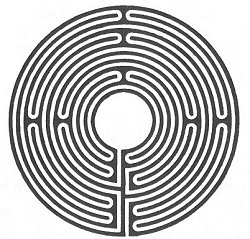
Hi everyone! I'm excited to join In Romaunce as We Rede, and I thought I would start with some musings I had thanks to teaching. As so often happens, the collective process of discovery in class has led me to see a text I've read many times in a fresh way. I've been teaching A Midsummer Night's Dream, and my students have been especially interested in the mythological background of Theseus (probably because they were excited to connect Ariadne to Inception). While we were talking about the minotaur, labyrinth, etc, it occurred to me that I could look at Bottom's transformation as a kind of perversion of the minotaur image. Instead of a frightening bull-man, Bottom becomes a silly mechanical with an ass's head. He's been attempting to play every role in one Ovid story, and has somehow found himself in a different Ovid story altogether. Translation here means transformation, certainly, but I also think that Bottom's transformation becomes synecdochic for the multiple kinds of translation that are going on here (linguistic, cultural, generic, chronological, imagistic, etc.). His hybrid body, part man and part ass (and I do think it's important that the animal aspect is his head, traditionally the seat of reason) is both man and beast, as the stories he performs mingle tragedy and comedy, literal and metaphorical, etc. In each case, the story Bottom represents becomes ridiculous with him as the protagonist, and he is the butt of our jokes throughout.
Yet if Bottom is a sort of ridiculous stand-in for the minotaur, that seems to increase both his centrality to the play and his alterity. He has certainly fascinated audiences, and most of the artistic representation of the play I've seen have been of Bottom and Titania in her bower. Such an image, indeed, often adorns the cover of editions of the play. Bottom therefore becomes an image for the play itself. He's a defining figure, at the center of the labyrinthesque dreamscape of the play. His freakish aspects and eagerness to take on every role make him an object of fun and pity. And it may be with some anxiety that we realize that he is, for Titania, a representative of mortality, of those creatures who connect with the earth itself, unlike her ethereal and supernatural immortality. A creature, therefore, very much like us. My students found the play-within-the-play, often performed to such hilarious effect, troublesome. They pointed out the class problems with the play; they lamented the fact that the mechanicals, who had worked so hard and been so excited when their play was chosen, were mercilessly and unanimously ridiculed. Perhaps they, as new college students whose work is being judged constantly, who work hard without always understanding what the end result should be, who are eager to please and to learn a variety of subjects, perhaps they saw something of themselves in Bottom and the mechanicals. Bottom attempts to be a learned man, a man of authority, and yet is unaware that everyone can see his ass's head. As a graduate student, this may encapsulate my own fears as well.
Many critics, from what I have seen thus far, find Bottom's transformation to be a literalization of what he already is -- a visual pun on the fact that he's an ass (and the play's use of dramatic irony when he claims that the others are trying to make an ass of him backs up such a reading). With some supernatural intervention, his physical form does grow to match his behavior. And in a play the ass's head must be performed literally -- an animal head is actually placed on the actor's body. It is such a literal rendering, however, that I find both fascinating and troubling. It may be a joke about Bottom playing an ass's role, but it also indicates that he is not quite human, not quite worthy of the noble class's empathy. We are meant to laugh along with the Duke and Duchess as Bottom plays the fool (and I have often done exactly that when I've seen the play performed). Like the minotaur, he's not as human as we are; he's both at the center of the puzzle and permanently marginalized. And the fact that my students stepped back and worried about what he was thinking and feeling made me proud as an instructor. Far from being only concerned with their own experiences, they were able to empathize even when to do so was to read against the text of the play.
I'd like to know what others think about this play, about Bottom's hybridity, about moments in teaching or reading that bring hope or empathy like this one did for me. So, what do you think?
