Saturday, February 25, 2012

Reducing the Medieval (with an anecdote about dissertating!)


Waimea 
Apologies for the hiatus, folks. I am in the last two weeks of dissertation editing before I file (o.O).  I feel, at the moment, much as I felt when I (stupidly) decided to swim at Waimea Bay a week before surf season started despite the black flagged beach and the warnings of a dangerous shore break (n.b. DO NOT EVER DO THIS). Despite these warnings, swimming at this beach seemed like a great life decision, and so I did.  My solution to dealing with the large waves crashing ominously close to shore was to time my entry in between the dangerous waves, swim out a nice distance, and tread water far enough away from shore so that the waves wouldn’t toss me around and damage my person.  I did this for as long as I could until I began to get tired and pruny – about an hour or so.   My hope is that my exit from the dissertation editing will leave me with at least a shred more dignity than what remained after I tried to exit the ocean on this particular day.  To say that I “exited,” in fact, assumes far more dignity than what I actually maintained.  “Projectile vomited by Mother Nature” is probably a more accurate description.  It certainly comes closer to capturing what I looked like as I emerged, like a geriatric Swamp Thing, from the chop.

So, here’s hoping I look a lot better on the 13th of March than I did at Waimea a few Novembers ago! I would post comparative pictures, but a) there were, quite mercifully, no photographs taken on that fateful day at Waimea and b) there WILL be no cameras anywhere near me on the 13th of March.

*****

In the meantime, I wanted to share a few thoughts that came to me as I commented on student questions a couple weeks ago in my medieval literature course.  My students are fantastic, by the way, and have managed to make the past few weeks a truly innervating teaching and learning experience – even though we are only three in number!  One of my students brought up Eve in a recent comment, referring to her as many tend to do — as arguably the most negative exemplar for women in medieval iconography, the binary opposite of the Virgin Mary.  In truth, however, Eve’s treatment in medieval literature, as John Flood has recently observed, is far more nuanced and – in several cases – more deeply sympathetic than we’d necessarily assume.  My student was hardly at fault for not realizing this, since the negative portrayal of Eve in the Middle Ages tends to take the foreground more often than not.

The process of clarifying my student’s understanding of Eve’s representation in medieval literature, however, got me thinking about reduction and its imbricated relationship with proximity.  It is so much easier to strip away nuance —from a person, a religion, a culture, etc. — when the object in question is distanced from the viewer.  I’d even go so far as to say that the farther away you get from an object, the easier this process becomes.  Many pre-postcolonial theorists who examine medieval literature have noted as much about the treatment of cultural others in medieval European literature (the work of Sylvia Tomasch comes immediately to mind), and my dissertation argues, in part, that the stark binaries that appear in so many Middle English crusades romances are maintained specifically because of this relationship between proximity and reduction.

The conversation with my student, however, reminded me that this ability to be reductive by way of distance can also apply to 21st century perceptions of the Middle Ages. As John Ganim has observed, the Middle Ages as a time period is both consistently and conspicuously Othered, and scholars who invest themselves in the study of it will always be at odds with the reductive approaches that have been endorsed and perpetuated for centuries.  Because of this treatment, however, studying the Middle Ages can allow students to become more aware of how we are conditioned— and how we condition ourselves — to consider and quantify “things in the past.”  Perhaps one of our broader purposes of teaching these dusty tomes, then, is to invite students to challenge their own tendencies to strip nuance away simply because the object in question is – and always will be – profoundly alien.

Monday, February 20, 2012

"Do you feel different than you did yesterday?": Identity and Growing up

This past week I've turned 30, and I've been thinking a lot about age. In my culture, I've reached a new landmark. I'm now in a different category. Perhaps I'm even an adult (though it's hard to be sure). Yet I remember clearly being a child, being a teenager, turning 18 and 21. Those selves were different, and yet they were also me. I am different, and yet I am still them as well. When I look at the images of me in my prom pictures, first drivers license, or kindergarten school photo I know what thoughts lie behind the eyes of the girl in those pictures because I was the one thinking them. Since I teach and write so much about identity, I think it's perhaps useful to think a bit about how age and identity interact in ways similar to and different from other identity categories.

Aging is inevitable; as long as we're alive we continue to age. (Whether we mature or not is another story . . .) And yet I find it important to remember earlier ages, to remember what it was like to be in different positions because of age. Children are disenfranchised and vulnerable, at the mercy of those to whom fate has delivered them. I was lucky enough to have wonderful parents to care for me, but not all children are fortunate in this way. And being a child is scary even in the best of circumstances. Everything is new, and children have little power over their lives, little understanding of the world around them, and little ability to communicate their ideas.

I remember learning to write my name with my grandma. I must have been about three. I felt terribly unjust providing the "i" with dots and leaving the other letters dotless, so I took a bold and unprecedented step and dotted every letter. My grandmother, a wonderful teacher and very patient person, erased the extra dots and explained to me once again how to spell my name. I tried to explain to her that I did understand how to write my name, that I hadn't made a mistake but instead had made a difficult choice in the name of justice. As you might imagine, I simply didn't have the words. Though this is a silly example, I still understand that struggle to express my opinions and beliefs to others. In fact, much of grad school has been about learning to put into words those things that I've always cared about. Dissertation-writing is so painful at times because it's an attempt to think things that haven't yet been expressed and find a way to express them.

I also remember my first day of pre-school. I was thrilled to be entering a world of learning, but I was also painfully timid. I sat at playtime doing nothing. I wanted to go across the room and get the play-doh, but I wasn't sure whether or not I was allowed to play with the play-doh. That distance between my chair and the toy cabinet was too perilous to cross, so I sat alone while other children laughed and played. Yet that day I came home and announced to my parents that I would be a teacher one day. In the safety of my own bedroom, I grew bold in my newly attained school-wisdom. I lined up my dolls and stuffed animals and taught them everything I'd learned. Over the years, I have worked hard to bring out the assertive teacher-self in me. Most of the time, I have succeeded, but sometimes the scared little child in the big and frightening classroom of the world returns without warning. Not only do I remember what it's like to be her, but sometimes I am her again.

I could write endless examples of such moments in my life, both meaningful and mundane. I could write about the sense of desperate grief and dismay and terror when my friend was stolen from her bedroom at night when I was 11 while her mother slept down the hall. I could talk less seriously, and explain my feelings of righteous validation when it was discovered that my first car was stolen (and totaled) by a bunch of 30-somethings rather than by "stupid teenagers," as all the adults had assumed. I could talk about my first breakup or about my cross-country move or the moment I discovered that my father had died. All of these represent different moments of my life. I can neither fully exist in those moments again nor be fully detached from how I felt in them. They work together to make up me.

Time is funny that way. Age is funny that way. We all move inexorably from childhood to adulthood, whatever those terms mean. In fact, age might be the only way in which everyone, without fail, drastically changes identity categories. All one must do is stay alive. At different ages, we exist differently in the world, and the world treats us differently based on how long we've been in it. Of course there are countless factors making up our identity position at any one moment. Our race, class, sex, religion, etc. all impact identity position, as does individual personality. And different times and places define ages differently, as they do these other factors. But age is unique in that any given age is fleeting. We all move from one age to the next and can make the choice of how to treat those people younger than we (or, for that matter, older than we). Perhaps if we can consider how it felt to be in a different identity position because of age we can go a step further and think about how it might feel to be in a different position for other reasons. Perhaps if we learn some compassion for our younger selves, we can extend that to compassion for other people as well. Perhaps it's clear that, while I've grown more cynical with each year, I'm also still the same idealist who wanted to give every letter a dot.

Friday, January 20, 2012

Is there a teacher in this class?

Yesterday I had an unusual first day of the semester. I have never felt so prepared, never so calm, about a new class. I've had the syllabus printed and collated for a couple of weeks, the library workshops booked, the books in the bookstore, the e-reserves online and the films ready for streaming. For the first time, I had really thought of everything. I didn't have a single teaching anxiety dream. The morning of my first class I pondered whether this lack of anxiety was a bad sign or whether it simply meant that I had finally figured things out. I hoped it was the latter. I arrived in class a few minutes early, but not so early as to make the students nervous, and I made comfortable first-day chatter as I handed out my carefully-planned syllabus. As I looked up, I noticed that every single student in the room was giving me a strange look. One brave student finally raised his hand and asked what class I was teaching. When I answered Freshmen Writing, all of the students raised their hands and informed me that they were here for German class. If I had been in a good humor, I might have gotten out my copy of Beowulf and joked that Old English was close enough to German. Instead, I quickly and quietly gathered up my things and moved into the hallway. What I discovered after a few phone calls is that there had been a miscommunication about the class time. I had been told one time and my students had been told another. Further, my students had been told an earlier time -- I had missed my first class altogether.

Even at the time, I knew that this would shortly become a funny anecdote. I wrote my students an email explaining what had happened, and I was aware that it would be OK. Yet what I can take from it is that no amount of planning can account for everything. Part of being a good teacher, I think, is the flexibility to adjust to the situation rather than trying in vain to make the situation fit to a preconceived notion of how things should go. Not that good planning is a bad thing, but that in teaching, as in life, we simply cannot control all of the variables. And that's OK. This will probably be a much more memorable first day than any I've had thus far. If I spin it well, it might even provide us with a shared joke that could speed up our rapport as a group. My class theme this semester is dreams in literature and film, so maybe the feeling of displacement we all experienced will put us in the right frame of mind (I know my pneumonia-fueled fever last semester helped me identify with some of the crazy texts I was teaching). If nothing else, I can feel connected to the dream theme in that showing up to the wrong class on the first day is a classic teaching nightmare . . . Happy beginning of the semester, all!

Friday, January 6, 2012

Celebrating Joan of Arc's 600th Birthday (whether she was born on that day or not)

Happy 600th Birthday, Joan of Arc! Although it's a bit too convenient that the Saint happened to be born on the Epiphany, and it is more likely that her birth date is simply unknown, I still like the idea of celebrating Joan's birth. Her death date is, of course, quite certain (30 May 1431), but she was many things before she was burned at the stake. She was a pious girl, an outspoken woman, a battle leader, a key participant in a king's coronation. She was a woman who refused to wear a dress, and a peasant who refused to be silenced when she had something to say. She demanded that the people around her listen, and, quite surprisingly, they did. She wouldn't have been tried and executed in such a public manner if she hadn't made a lot of people very nervous. She was barely more than a child, and she would probably have lived a quiet life completely outside of the historical record if she hadn't stood up and made people take notice of her. She insisted on entering and changing the course of history.

So often we define Joan by her death, and it is true that her death was so spectacular that we could hardly forget it. Not only was Joan the only person in history to be both convicted of heresy and canonized by the Catholic Church, but her manner of execution was horrific even by the standards of her time (perhaps even more so by the standards of her time). Her body was burned twice and her ashes were thrown in the river -- not a sight that people could forget. Representations of the saint in film often focus almost exclusively on her trial and moment of death, and movie posters show larger images of Joan engulfed in flames. To the left, Ingrid Bergman screams in pain amid technicolor flames with the caption, "Greatest of all spectacles!" Her death holds a morbid fascination; it is the culminating point of her story. Yet she would have been neither executed nor canonized if she hadn't led an extraordinary, though extraordinarily brief, life. And, as I've written before, her story has continued beyond as well. Her story has been appropriated by every possible political and religious and ideological agenda, and it is hard to extract her from the complex web of retellings and associations. But the very fact that her story has taken on such a life of its own indicates that many found her life, as well as her death, both fascinating and inspirational.

Sunday, January 1, 2012

The Twelve Days of Dissertation Chapter Editing . . .

Given that we're right in the middle of the twelve days of Christmas, we decided that a special present was in order for all of our lovely readers. Kate has been toiling away on her Arthur and the Crusades Chapter, and submitted it to her advisor before the holidays. While lamenting to Kristi over its decrepit state, the two of them began discussing the ups and downs of the writing process, and the fruits of that conversation can be found (in story-book form) below. It is, in part, an homage to one of our all-time favorite blogs, Hyperbole and a Half, but also the best way we knew how to cope with and describe the highs and wretched, wretched lows of the dissertation process.

And so, here is your Christmas story.

Wasshail!
-- Kate and Kristi


Day 1: MOTIVATED!!! (i.e.WRITE ALL OF THE CHAPTER!!!!)


Day 2: Photocopy the mother******* articles like an adult! (censored for the children).


Day 3: Sharpening Pencils (I mean business!)


Day 4: Despair, Part 1 (What does my introduction even MEAN?!)


Day 5: Stalling (Icecream and Netflix!!)


Day 6: RALLYING!


Day 7: Cut and Paste?!


Day 8: Senseless Destruction or Sensible Destruction?


Day 9: Despair, Phase 2 (Control, Alt, Delete?)


Day 10: Purchase oddly appropriate t-shirt that mocks your crushing sense of inadequacy. 


Day 11: After copious revisions (and assurances from your fire extinguisher-wielding partner in ice-cream misdemeanors), send to advisor. 


Day 12: Holiday party -- advisor says he's received chapter and your knee-jerk response is "I'm sorry . . ."


Monday, December 26, 2011

I'm Dreaming of Green Christmas: Sir Gawain and the Green Knight's Most Dangerous Christmas Game

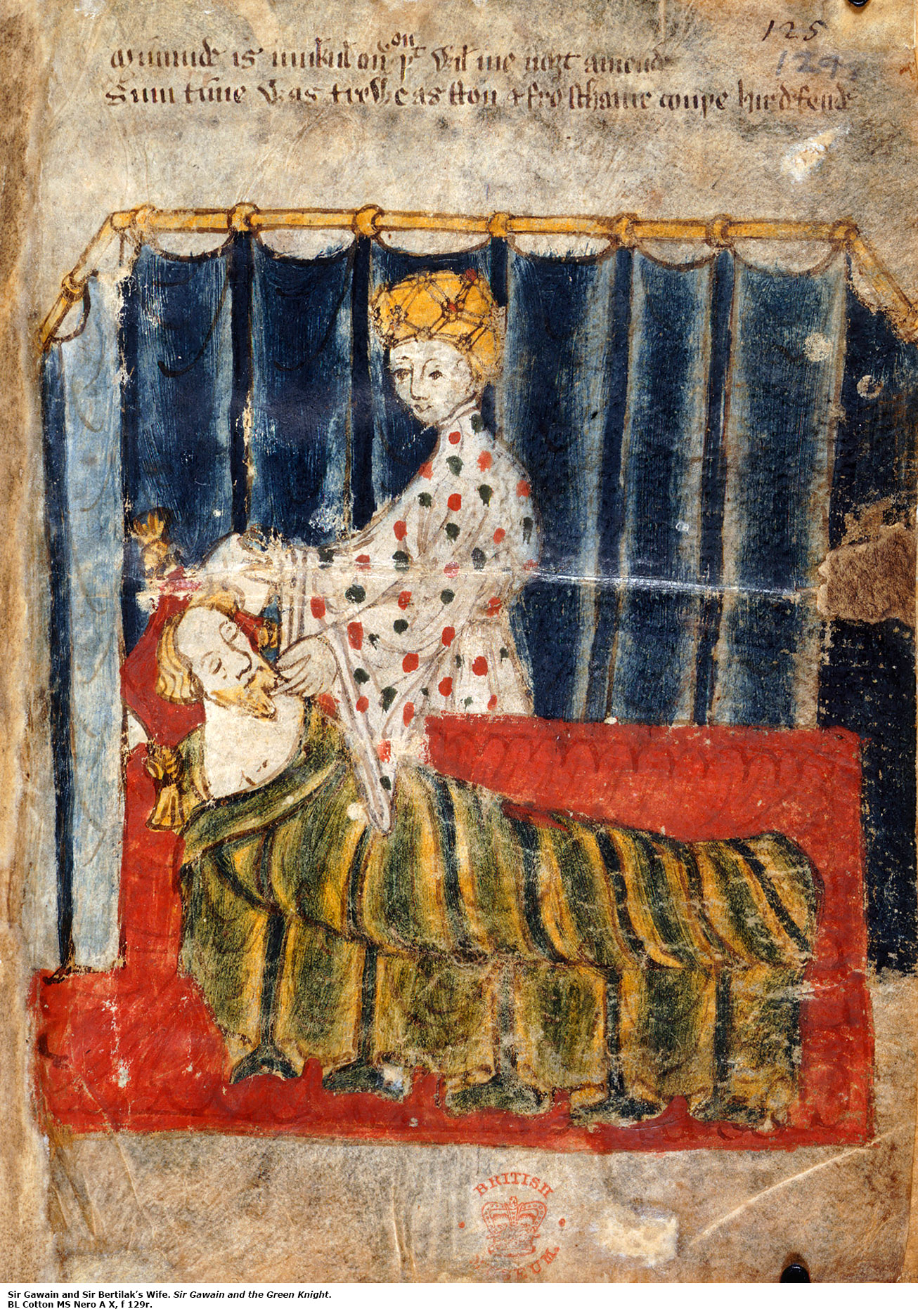
In honor of the holidays I thought I would talk about my favorite Christmas story – Sir Gawain and the Green Knight. Much ink has been spilt about Gawain and his verdant foe, but I thought today I would try and pull a Christmas message – and maybe some cheer – out of the notoriously grim story. The poem, an anonymous fourteenth-century alliterative tale, begins, fittingly enough, with a Christmas party, and no tacky office party, but a feast to go down in the history books. In the spirit of the season, the Green Knight bursts in on the party. Unlike Santa, though, he chooses to come in while everyone's awake, and to use the front door rather than the chimney. And instead of toys for the good and coal for the bad, he brings with him a bow of holly and an axe. Holly, which blooms bright red amid the frozen winter landscape, is a fitting gift of this holiday, a reminder of the hope that comes with the cycle of the seasons. Spring will come again, and color will return to the land. The axe, however, is a far more chilling gift. Even more dangerous than a Red Ryder BB Gun, it's a violent offering in conjunction with a violent game. While the young knights and ladies of the court have been playing flirtatious games where the stakes are kisses, the stakes of the Green Knight's game are life and death, severed head for severed head. (Of course, the Green Knight's game turns out to be a kissing game, too, but one with serious repercussions.) The light, superficial tone of the opening celebration is shattered as the Green Knight confronts the court and asks to test their pride. He offers the axe to anyone who will play his beheading game. He'll take a blow from a Round Table knight this evening in return for a blow from him in one year at the mysterious Green Chapel. When Gawain takes the challenge, he has no way of knowing that the Green Knight can pick up his head and keep talking once the blow is given. When the Green Knight departs, however, severed head in hand, the court returns to its frivolous ways.

As the year passes between that Christmas and the one in which Gawain will need to seek out the Green Knight and fulfill his promise, the court maintains a polite, artificial veneer. They are thinking that Gawain doesn't stand a chance, but they tell him that he'll be fine. They continue with laughter and games as Gawain's journey looms near. And when the day arrives for Gawain to set out, they spend pages and pages arming him beautifully, setting up a hard and beautiful exterior meant to define him as a knight. Little do they know that the true test is an interior one, and that the armor will not help him at all for that. As if to hint that Gawain's preparation is faulty, barely a line is given to the great monsters and foes that Gawain meets on the road. He dispatches dragon and troll with ease, but finds the cold harder to bear (armor doesn't provide much protection from a blizzard). When his prayers are answered and a castle appears, he thinks of it as a welcome respite from his trials. He doesn't realize that the true test will occur within the safety and warmth of the castle walls. In fact, he moves ever more into the interior of the castle – first to a private chamber and then into a curtained bed – signifying his personal move toward the interior as the test continues. The lord of the castle greets him warmly, as does his lady wife, a mysterious old woman, and everyone else in the castle. They've heard stories of the courtly Gawain and are pleased to welcome him to their holiday celebrations. The host tells Gawain to rest up before his continued journey. The Green Chapel that he seeks is near, and he can sleep away the days until the new year. In fact, the host will add some Christmas cheer with a game. He will hunt each day for three days and exchange his winnings for whatever the knight can win inside the castle.

While the lord's away hunting, the lady of the castle tempts our valiant hero in his bedroom, and the stakes of that temptation rise each day in conjunction with the stakes of the hunting going on outside the castle walls. The emotions Gawain feels during these scenes of temptation are many -- fear, anger, annoyance, lust. Yet he shows none of these. He remains diplomatic and polite, managing to refuse the lady without insulting her. Each day Gawain escapes with a chaste kiss (one more for each day), and passes those kisses on to his host in exchange for the fruits of the hunt. The last day, however, the lady manages to give him a gift as well, a green girdle. He refuses all her love tokens and rich offerings, but finally gives in when she tells him that the girdle will protect him from all violence. His love for his own life and fear of death win out, and he accepts the gift. He even promises not to tell anyone. That evening, when the lord asks him if he won anything besides kisses, seeing no way to honor both his word to the lady and the lord, he tells him that he did not. The next morning, he heads with a (terribly frightened) guide to the Green Chapel, which could perhaps be more aptly called a Green Mound, to meet the Green Knight. The Green Knight makes Gawain wait and listen while he sharpens the axe with which he'll behead him, and then comes to complete the year-long beheading game. He moves to strike Gawain with his axe, but stops when Gawain twitches. He moves to strike again, and stops again. He moves to strike a third time, and this time nicks Gawain on the neck. [SPOILER ALERT] Gawain is confused, but quick, and moves away to put shield and sword between himself and his giant opponent. Having fulfilled his obligation to the game, he'll not take another swing without a fight. But the Green Knight laughs and reveals himself to be the same man who has graciously hosted Gawain for the last three nights. The old lady in the Castle was Morgan La Fey, and she used her magic to transform him. The first two swings were for the first two days, in which Gawain resisted temptation and kept his word. The third swing, resulting in a cut, and a scar, was for the third day, in which Gawain failed just a little in not telling of his gift. A small cut for a small failing. Yet Gawain responds with shame and anger. His blush in response to the Green Knight's words is a physical response which can neither be hidden nor controlled. Its speaks of his shame in a way none of his carefully measured words could do. His angry outburst that follows his blush continues with the trend. Gawain finally has a completely honest communication, and though it's not pretty, it does signal a move to a new kind of authenticity.

When Gawain returns to his court, he wears the scar and the girdle as badges of his failing. Though he left as a representative of the court, his journey has taken him on an individual path that his fellow Round Table knights cannot fully understand. They all adopt the green girdle as a fashion statement, an act of seeming solidarity. But no one can truly comprehend what Gawain's been through. Maybe Gawain's too hard on himself, and maybe he misunderstands the lesson. It may even be that his attempt to render his newfound authenticity externally, the only way he knows how, is doomed to fail. The poem has been read as a social critique, as fatalistic, and even as apocalyptic. And it is all of these things. Yet there is something hopeful as well as dreadful in a story of one person's journey set against such a large backdrop. Seasons change, cities rise and fall, and yet amid all this we focus in on a single knight's struggle to know himself. Maybe he is too hard on himself, and maybe no one else in the court understands or learns anything. But Gawain learns. He learns some humility. He learns some honesty. He learns something about himself and about the kinds of battles that really matter in life. His is not a story of the knight in shining armor fighting a dragon, though that surely takes place on his journey, but rather the struggle of an individual to be a good person. Gawain grows introspective over the course of the poem. He reexamines his values and his intentions as well as his actions. Yes, this is a painful process, and he can't go through it for anyone else in the court, but it's a process that leaves him more aware of himself and the world. Perhaps we could all take some time this holiday season to be a little introspective, to take a moment's break from shiny wrapping paper and colored lights and think about what we've learned this year, what we've done well and what we could work on. And though Gawain doesn't seem to change the course of Camelot, perhaps his story can help make us think a little bit. And maybe that is the best gift of all.

Friday, December 2, 2011

Writing through Grief (or, How I got over critical distance and just started writing)

Kate's recent post on grief was inspiring and honest and brave, and the fact that it led to so much wonderful discussion, both in the blog comments and in other forums, indicates that others found it inspiring as well. Her ideas on grief specifically struck me, since grief has been a powerful force in my graduate career thus far, but I was also interested in her combination of the personal and the professional. I admire those people who admit their personal connection to their work, those people who admit that they have lives and loves and families and that those things don't just take away from their work but actually inform and influence it. Finding a way to do so can be tricky, and can also be scary, especially to grad students who are trying desperately to professionalize. However, I do think it's important and rewarding, so I will try it out here and see what people think.

* * * * * * * * * * * * * *

In my second year of PhD work, my father died. The loss was crippling. I didn't know how to function in the world, no less to go on with my work. My dad had believed I was intelligent, capable of anything, but I didn't know how to be these things once he was gone. Yet I simply returned to my courses and my work and tried to understand how to exist in a world without my father. I had been writing a seminar paper on a 15th century play, the Digby Mary Magdalene, and, though I forced myself to continue with my coursework, I couldn't return to that paper right away. I took an incomplete (something I would warn other grad students to avoid at all costs), and focused on my other work. When I came back to that paper, I saw it in a new way. Near the play's opening, Mary's father dies suddenly. I had previously seen this plot point as a clumsy bit of writing. Right after a perfectly nice conversation with his children, the father is struck down by death with no warning and no explanation. Before, this seemed far-fetched. But after my own father's death, I suddenly understood. Death is sudden, inexplicable, and terrible. Even in cases of lingering illness, death itself rarely feels anything but shocking. The timing is seldom right. I had been writing vaguely about the positive way in which Mary Magdalene is depicted in the play, but I was now able to understand what was so different about this depiction of the saint.

Though Mary Magdalene is meant to represent the redemption possible to every sinner, many medieval sermons discussed her early life in a decidedly misogynist way. Her early sins (completely fabricated, by the way -- there's no mention in the Bible that she was a prostitute) were represented as evidence of female weakness and wickedness. Fathers and brothers and husbands were warned not to give their daughters and sisters and wives too much freedom. If the Magdalene was any example, an unchaperoned woman couldn't help but turn to sin. (For more information on these sermons, see The Making of the Magdalen: Preaching and Popular Devotion in the Later Middle Ages by Katherine Ludwig Jansen.) But that's not how it was depicted in this play. In the Digby play, Mary's a sweet but naive young woman, a dutiful daughter. She grows lost not because of female weakness but because of human grief. The playwright never denigrates Mary, something that I'd noticed in my initial readings of the play. Yet now I saw something more. Mary says that grief has wounded her. She's struck down by the loss of her father and no longer knows how to exist in the world. Most everyone in the audience would have experienced some kind of grief. Her heartache would have made sense, particularly at a time when the infant mortality rate was high and the Black Death was still in recent memory. Mary's fumbling to recover from her loss and reclaim her identity, perhaps making a few mistakes along the way, would have evoked sympathy, not derision. Her mistakes are not those of a wicked woman, but a grieving human. What I had written off as an awkward side note turned out to be the key to Mary's positive characterization. Anyone who has experienced any kind of heartache can recognize a bit of him or herself in Mary, a point I find crucial for the play's message.

This is not to discount rigorous research or careful examination of the evidence in the play, but rather to demonstrate how I could see important aspects of the play better when I approached it as a human who had experienced loss as well. My attempt at critical distance had blinded me to those features of the play meant for a very human audience. Combining my own personal response to my research and analysis brought me a much fuller picture of the play, and allowed me to clear up my incomplete. That paper has turned into several presentations, an article, and a dissertation chapter. I had discovered a new way to engage with my sources, and people seemed to be responding to it as well. I used a similar tactic when writing about Joan of Arc. My own horror at the sight of my father's ashes turned into an examination of the symbolism of Joan's execution. Joan was burned twice, and her ashes were thrown in the river, and I wondered what to make of this horrifying spectacle. I found a great deal to say about the way in which Joan's enemies attempted to annihilate Joan's body and keep peasants from making relics out of her. More to the point, I found a great deal of fascinating evidence. By the time I finished, I felt better about my father's ashes, and about my research. Joan was a real human who lived and who died, and it seemed right to take her death seriously (and even a bit emotionally). Instead of keeping me from doing careful scholarship, my human response to Joan aided me once again.

I am not saying that I have any real answers. I'm still sometimes overwhelmed, confused, scared, sad. I'm still not sure how to write a dissertation. And I am not saying that my father died so that I could learn something or so that I could write better papers, but rather that the only way for me to survive the rush of emotion that flooded me in the wake of my father's death was to allow it to flow into my work. The texts I read were written by humans for other humans. I am, after all, in the humanities, and admitting that I was a human with all of my faults and feelings was a relief. Pretending to a kind of objectivity which I simply cannot (and don't really want to) have is neither honest nor productive. It's scary to admit my emotional connection to my work, but it feels right, too. It is not necessarily narcissistic to focus on one's own experiences. It may be self-centered to wallow indefinitely (though a little wallowing can be quite helpful), but I think that bringing personal emotions and experiences and traumas into a larger conversation is quite the opposite. It's a way that we can all connect and gain a greater understanding. We can't say that people or literature were just the same in the Middle Ages as they are now. We can't say that people around the world or even in our own neighborhoods experience anything in the same way as we do. Grief is particular, to be sure. Neither can traumas be compared. One child experiences war or genocide while another loses a beloved family pet. No, these situations cannot be equated. Yet anyone who has experienced heartache of any kind, from a first break-up to the death of a parent, has a share in human suffering. Such heartaches are soul-crushing, and yet they contain within them a gift: human empathy. All grief is different, and yet those who have experienced any grief can understand the depth of human emotion and therefore feel for others who suffer. Not everyone can accept this gift. Some turn inward and never look back out. Nor does this gift bring any final answers. But there's a beauty in caring for others. There's a beauty in bringing our own human vulnerabilities and offering them up to others and accepting their vulnerabilities in return. There's a beauty in caring about one's work enough to let it be emotional, imperfect, human.