Showing posts with label landscape. Show all posts

Tuesday, May 26, 2015

Writing Across Time and Space: My Paper about Elaine of Astolat at Kalamazoo 2015

*Before you read my Kalamazoo post, check out Kate's excellent Kalamazoo 2015 Round-up.*

I am just now recovering from the joyful exhaustion that characterizes the International Congress on Medieval Studies. Each year brings a more hectic schedule of events and reunions to the congress, with more people to see and more people I don't see enough. It always reminds me how lucky I am to be a part of such a wonderful and inclusive academic community. This congress was especially delightful and especially tiring. It's been a busy year for me so far. For those who don't yet know, I have some exciting news -- I've accepted a tenure-track position at Lyndon State College in Vermont, and I am focusing on finishing my dissertation and preparing to move. Perhaps, then, it makes sense that my Kalamazoo paper dealt with anxieties about writing and traveling. I presented on Elaine of Astolat, a woman who goes to great lengths to ensure that her words travel where/how she wants them to even after her death. I presented on a panel called "Sacred and Secular Road Trips in Middle English Romance," presided over by Eve Salisbury and organized by David Eugene Clark, Gina Marie Hurley, and Justin Lynn Barker. My panel was fantastic, featuring my co-blogger Leila (Kate) Norako, who presented on Virtual Pilgrimage, Elizabeth A. Williamsen, who presented on Sir Isumbras, and Amber Dove-Clark, who presented on Guy of Warwick.

My paper was called "Ascolat to Camelot, Guildford to Winchester: Narrative Travel in Malory’s Morte d'Arthur," and I've only just begin thinking on the topic. The q and a really gave me a lot of ideas, so the paper I give you here only represents my initial sketches on the geotemporalty in Elaine's story. Any ideas, questions, or critiques would be very welcome.

 *     *     *     *     *     *     *     *     *     *     *     *     *

Arthur Rackham image (1917)
courtesy of the Camelot Project
Elaine of Astolat may be dead, but she seems to be everywhere. Even as I speak, she is wending her watery way across the walls of museums, poster stores, and college dorm rooms worldwide. Her mythic status both fixes and unfixes her in time, allowing her to be always setting out for Camelot, always floating there, always arriving. She lives in the romance world and moves in romance time. Yet Malory's version of her tale connects her romance rivertrip from Ascolat to Camelot with real places, as Malory clarifies that Ascolat corresponds to contemporary Guildford and Camelot to Winchester. Elaine’s journey is a moment of geographical specificity in a text that often unfolds in a geotemporal haze. Her journey, despite its more fantastical elements, is granted a sense of real possibility, since the trip from Guildford to Winchester can be traced on a map. Guildford and Ascolat share the same ground, bringing the romance world and the historical world into startling proximity. Ever since Geoffrey of Monmouth, and perhaps before, Arthurian narrative has been sitting on the line between history and literature. How many of us have received questions from well-meaning friends and family members about whether or not Arthur was real? But the dynamic tension between history and romance takes new significance in Malory's version of Elaine's story, since her journey collapses clear boundaries between image and word, passive and active, here and gone.

I connect this overlapping with medieval world maps, in which historical timelines are arranged geographically, the meaning of each piece of text rooted in spatial relation to other pieces of text. (Here's where Lot's Wife looked back, here's where Alexander the Great camped, etc. [You can find more of my thoughts on medieval maps here and here.]) The visual and narrative are mutually constitutive on these mappae mundi. In Malory, space and time collapse in ways similar to medieval maps, as Elaine’s body and letter are inextricable as she moves through a romance landscape that looks very much like a real one (or, perhaps, a real landscape that looks like romance). Multiple geographies and temporalities overlap as she becomes both visual spectacle and narrative conduit. She chooses to travel by river, a linear, teleological mode of transportation in which currents lead to her destination. She moves into a center of power, and yet asserts her own version of events so strongly that they are literally set in stone on her tomb. I contend that the simultaneity of multiple geographic and temporal modes in Elaine’s story call attention to the complicated and contradictory way in which her most powerful moment is also the end of her life, her most visible moment is also the pinnacle of her narrative authority. The fact that Elaine is most active and authoritative when she is dead and unable to move or speak works well with the convergence of historical and mythic time, since she is static and in motion, an image and a narrative. She embodies her letter, and her body and her story find their resting place in Camelot.

Though Elaine’s story is linear in that she floats from one location to another, Malory’s telling is also cyclical. (Again, like the world maps, which presented a linear narrative in a spatial way.) In essence, we get her story three times (at least) and in different ways. As soon as we meet her, Malory tells us that “she keste such a love unto sir Launcelot that she cowde never withdraw hir loove, wherefore she dyed,” giving us the tragic end to her story before it even begins (623). This particular Elaine exists inside the larger myth of the fair maiden of Astolat. There is thus a cyclical quality to this narrative defined by clear teleology. The tale, which itself has been retold, is retold in the text. The first version is simply part of her introduction, but important because it renders her introduction narrative rather than visual. We learn who she is and what she does (and notice how active these verbs are — she cast her love, she died), but not what she looks like. And, for the first time in her tradition, we get a name for her character, which allows her a subject position to go with all those active verbs. 

As we continue with the largest portion of the narrative, Elaine consistently communicates her own thoughts and wishes. She tells Launcelot (and Gawain, and everyone else, for that matter) directly of her love. She asks Launcelot to wear her favor, and later asks him to be her husband ... or at least her lover. She seeks him in a quest when she takes over Gawain's search, and then she directly interacts with his body as she heals it. Even as she performs the more traditionally feminine role of healer, she is only able to do so because she has taken on a knight's quest given by King Arthur himself. Launcelot's body is the object of both her quest and of her healing. Though her most famous (and most illustrated) voyage is her post-mortem one, she also seeks Launcelot on land (while alive) and succeeds in reaching him where Gawain fails.

Launcelot tries to give her options other than death, but she'll have none of it. He, not seeing the insult in his offer, attempts to provide her with a dowry to marry another, but she responds matter-of-factly: "Alas! Than', seyde she, 'I must dye for youre love'" (638). Her assertion troubles the world of the romance, since she is not imperiled in a way that allows for masculine rescue. As Dorsey Armstrong explains, "the Pentecostal Oath constructs male and female in terms of a binary which opposes active, aggressive masculinity to passive, helpless femininity" (45). Knights gain honor by saving damsels in distress. Yet neither Launcelot nor her brothers nor her father nor anyone else can save her once she asserts her coming demise. Molly Martin has pointed out that Perceval's sister, another lady in a boat, chooses to die in such a way that her brother cannot rescue her, and Elaine’s death is similarly outside of the chivalric system.

Instead, her death forms a new narrative all her own. Walsh notes that "Malory does not let Elaine die offstage, as she does in both the sources" (144). And it is in fact her death (and the related fact that we see her voyage from her perspective and thus vicariously journey with her to Camelot rather than just seeing her arrive) in Malory's version that creates such a strong sense of her character. As Martin points out, "Malory carefully reworks the material surrounding her death to show a particularly active Fayre maydyn creating an image of her own dead body" (154). Knowing that she'll die, she first requests to dictate a letter, and then describes the way in which her father and brother should arrange her body.  All of these requests are meant to prepare a narrative for the court, and all are meant to give her authorial control. The fact that she mentions the letter first means that all arrangements are in terms of that letter. Gawain may send a deathbed missive to Launcelot, but Elaine sends her deathbed. Her deathbed is in fact part of the missive. She requests, "'And whyle my body is hote lat thys letter be put in my ryght honde, and my honde bounde faste to the letter untyll that I be colde" (640). The letter thus provides the link between living and dead maiden. The willful clasp of warm hand will be  followed by the inert touch of cold fingers, but the letter will witness the moment of transition and remain. The further details she requests, to be put on a bed with rich clothes, to be taken to the Thames, and to have her barge covered in black samite, all function as extensions of this request for a written message (640). All these details are meant to be read and understood by the court in conjunction with the letter and to properly convey her version of herself and her story. She'll make a spectacular entrance, but also an epistolary one.

There are a number of ways that she maintains control over her letter. She asks that a mute oarsman row her barge, assuring that someone will be present to ensure the barge goes where she wants but that no one can provide an alternate version of her story. She travels by river, which, unlike an ocean voyage, has a specific direction. If we see the linear movement of the river as historical time, then Elaine's movement in history is brief and tragic. Martin B. Shichtman points out that Elaine “has no real story beyond that which can be summed up in two sentences. Her entrance into the realm of historical time is brief, incomplete, and fatal” (261). And this is certainly true. Yet it's also true that historical time here is not wholly separate from a-historical romance time. Joseph D. Parry discusses the way in which Malory locates Elaine's story in both Guildford, specifically locatable to a 15th century reader, and also Astolat, "a place firmly inscribed in the Arthurian landscape of surprise adventures" (159). He notes that the text "locates the river down which the Fair Maid's funerary procession travels, in two settings. One can locate the river – the Thames . . . in Malory's fifteenth-century world. But Elaine's final river trip is also a journey elevated to mythical status." Her journey thus complicates both spatiality and temporality. Meg Rowland calls Malory's manner of pairing mythical and 15th century locations "pluralistic geography," in conjunction with the coexistence of chronicle and romance time. Elaine's journey functions in such geographically and temporally complex ways. The movement of a river is narrative in itself, and combines the static quality of Elaine's dead body with the narrative quality of her story. Word and image, text and body, fuse as she makes her first and last trip to Camelot. 

As she floats to Camelot, everyone's talking about her, and she is ultimately able to squash all the rumors and give the last word on the subject. At fist, Arthur only notices the spectacle -- the corpse's great beauty and riches -- without understanding its full import. He does observe that "she lay as she had smyled" (640). Sue Ellen Holbrook points out that "the smile . . . is the sign of a soul at rest," and I think this sign is legible to the knights of the court (177). It is the queen who notices the letter and points it out to Arthur and the knights, thus recognizing the body's full narrative potential. The letter then gets a public audience, her version of the story read directly to all. Alan Lupack explains that "her arrival is . . . an elaborately staged performance. … The public display is important because it provides the setting for Elaine's letter" (260). I would even argue that the performance, the spectacle of it all, is part of the letter. Her letter is inextricable from her cold hand, from her beautiful face, from her smile, from her lovely garments, from the strange mode by which she enters the court.

The letter is Malory's third iteration of the Fair Maiden's tale; as a deathbed epistle, Elaine's version of events holds some authority. Malory expands upon this authority by giving us the letter in its entirety:
'Moste noble knyght, my lorde sir Launcelot, now hath dethe made us two at debate for youre love. And I was youre lover, that men called the Fayre Maydyn of Astolate. Therefore unto all ladyes I make my mone, yet for my soule ye pray and bury me at the leste, and offir ye my masse-peny: thys ys my laste requeste. And a clene maydyn I dyed, I take God to wytnesse. And pray for my soule, sir Launcelot, as thou arte pereless.' (641) 
As many critics have noted, this version of her letter differs from those that place blame on Launcelot. Malory's version focuses not on vengeance, but rather on asserting Elaine’s own character and providing her personal narrative. As Georgiana Donavin explains, "Where the letter's narratio, or news, would ordinarily be, there is, instead, her assertion of identity . . . Elaine's subject position is the story in her epistle" (7). She wants a proper burial, she wants a mass-penny, and she wants everyone to know that she loved Launcelot and died a clean maiden. That she wants a mass-penny and prayers for her soul indicates a connection between the body in the barge and the soul of the maiden, even as her earlier deathbed assertion to a priest that she was a worldly woman coincided with preparation for her departure from the world. In short, the journey itself is a boundary collapse between sacred and secular road trips. Thus Elaine can not only assure that her story is understood but she can tell that story in such a way that it will have real efficacy for her, even after her death.

And Elaine's letter certainly rouses the crowd. By the time they call in Launcelot, "the kynge, the quene and all the knyghtes wepte for pité of the dolefull complayntes" (641). Public feeling is on the maiden's side before Launcelot even enters the scene. Even the queen pities Elaine and blames Launcelot. It's telling that even an audience as prejudiced against Elaine as the queen can see the pity in her narrative. It also seems that the queen can’t see outside of the chivalric system, assuming that Launcelot could have saved Elaine somehow, whereas Elaine herself resisted this model. Camelot is the geographical heart of the round table narrative, and the people of the court, epitomized by the queen, live by the chivalric system that Elayne has rejected. When she enters the court, her own identity and story collide with a realm she never knew in life, and her words become part of the official narrative.

Thus, the maiden's tale does not end with her death, but instead with her version of her story. The tale ends with a retelling of itself from her perspective only made possible by her journey in death. This cyclical method of telling a story with such a clearly linear direction (i.e. the river) furthers the complicated way in which Elaine's body and letter function as image-text. Simultaneous cyclical and linear movements render the maiden's story both ever-happening and ever-new, while the contemporary geographical details place it in the past as well. The past tense and the literary present collide and verbs fail to express the temporal possibilities of Malory's version of the tale. Elaine is both a static image and a moving narrative. Just as she has the ability to travel when she can no longer move and to communicate when she can no longer speak, her story is characterized by contradiction.We gain proper nouns to allow Elaine a subject position, but our verb tenses explode between already-happened and always-happening. Disrupting time and space in this way allows her to be fixed and moving, visual and narrative, all at once. Her funeral literally fixes the story she has told in stone and gives both her body and her tale a permanent place in the land to which she sailed.

Tuesday, November 4, 2014

Musings on Eyrbyggja saga

As promised in my last blog post, I've decided to post brief reflections after I finish reading a given saga. I was midway through Eyrbyggja saga when I started this particular reading challenge, and I finished it right before the quarter started at Stanford. I had every intention to write about it immediately, but the past six weeks have been a blur (however innervating), and my saga reading and blogging have taken a bit of a nose-dive in the process. With the start of National Academic Writing Month (or #AcWriMo), however, I've vowed to publish at least three times here at In Romaunce (in addition to tying the bow on a couple of projects). And so, without further ado, I'll offer up a few speculative musings on this particular saga.

It's rapidly become a favorite of mine for a few reasons:

1) It's packed to the gills with vengeful draugr. Thorolf Lame-foot, for instance, haunts the hills around Hvamm, causing -- among other things -- cows to "moo" themselves to death. He kills so many livestock (and people, but the text spends far more time describing the cows) that his son Arnkel has him reinterred at a place eventually dubbed Lame-foot hill, and said son builds a wall around the cairn so high that only birds can fly over it. The narrator tells us, at this point, that he rests in peace for the rest of Arnkel's life.

2) It includes perhaps the greatest scatological kenning in the history of kennings: álfrek, which means "elf-frighteners."

3) It includes a seal revenant. And yes. You did read that correctly. The episode is so spectacularly odd that I feel absolutely compelled to share it with you here:
During the winter just before Yule, Thorodd the farmer went out to Nes to fetch his dried fish. There were six men altogether in the ten-oared boat, and they spent the night out there. The same night that Thorodd had left, when the people at Froda came up to the fireside that evening, they saw a seal's head coming up out of the fireplace. One of the servants saw it first when she came in. She took a club that was inside the doorway and struck the seal on the head. But the seal rose up with the blow and reared up towards Thorgunna's bed-curtains. Then one of Thorodd's men went up and started beating the seal, but with every blow it rose up further until its flippers appeared, and then the man fell down unconscious. Everyone else who was present became very frightened.
     Then the boy Kjartan rushed forward and lifted up an iron sledgehammer and brought it down on the seal's head. It was a tremendous blow, but the seal just shook its head and looked around. Kjartan kept going, with blow after blow, and the seal went back down as if he were driving a nail. He kept beating until the seal went so far down that he hammered the floor over its head. And so it went on throughout the winter, with all the revenants fearing Kjartan the most. (Chapter 53). 
4) The fact that everyone (seriously, EVERYONE) is named after Thor. This is fascinating given that the saga begins with Thorolf Moster-beard relocating from Norway to Iceland and, once he settles on the Snaefellsness peninsula, rebuilds the temple to Thor (which he had overseen in his homeland) on Helgafell. This description of a pagan temple is a rarity in Old Norse literature, and the frequency with which Thor is evoked in this saga (mainly through nomenclature) certainly indicates his sustained popularity among this particular group of settlers. But it also makes it damned near impossible to keep everyone straight. Case in point:
He married Astrid, who was the daughter of Hrolf the hersir and the sister of Steinold the Short, and they had three children. Their son was Thorgrim the Godi and their daughter Gerd was married to Thormod the Godi, the son of Odd the Bold . . . . In his old age, Thorolf Moster-beard married a woman named Unn. Some people say she was the daughter of Thorstein the Red, but Ari Thorgilsson the Learned does not count her among his children. Thorolf and Unn had a son named Stein, whom Thorolf dedicated to his friend Thor, calling him Thorstein. The boy matured very quickly. Hallstein Thorolfsson married Osk, the daughter of Thorstein the Red. Their son was also named Thorstein, and he was fostered by Thorolf. Thorolf called him Thorstein Surt (Black) and his own son Thorstein Cod-biter. . . . (Chapter 7)
I rest my case.

5) The tendency of the characters to burst in to magnificently gory skaldic verse. Case in point:
I had to defend myself
against the valkyrie's derision:
the dart-of-wounds was driven,
and the raven delighted in gore.
When the sword of my father's son
rang against helmets in the field,
gashes spurted blood
and wound-streams ran. (Chapter 19.8)
Every time I read a saga, a not-so-small part of me wishes I lived in a world where bursting into opaquely metaphorical poetry was a perfectly normal way of expressing oneself.

All mirth and snark aside,  I plan to keep musing and writing on these aspects in the weeks and months ahead. This saga has, for instance, inspired a deep fascination with the way in which draugr function in Old Icelandic sagas, and once I surface from my current deluge of projects, I vow to do some research to figure out what fellow scholars have said about them. I have a feeling someone has to have done work in this area already, but I was particularly struck by how a draugr's presence seems to parallel/mirror the bloody conflicts that permeate a good deal of the saga's narrative action.

For now though, I want to spend a bit of time musing on the way in which ice functions in the text.
As I read the saga, I found myself fascinated by the persistent presence of ice in the saga, and the role it seems to play in anticipating, facilitating, and ultimately halting, the violence and feuding at the heart of this particular story.

The first significant reference to ice occurs in Chapter 40. Thorodd and Thorgrima Magic-Cheek attempt to thwart Bjorn's affair with Froda because Thorodd fears the dangers of Bjorn's continued association with her:
. . . but when he left to go home that evenings, the sky was overcast and it had started to rain, and he was rather late getting going. By the time he came up to the heath, the weather had turned very cold and there were snowdrifts. It was so dark that he could not see the path in front of him. After that a blizzard blew up with so much force that he could hardly stand up. His clothes, which were soaked through, began to freeze, and he had completely lost his bearings and did not know which way he was going. He came upon a cave jutting out of the land, and went into it to shelter for the night, but it was a cold campsite. (146)
Bjorn spends three miserable days in the cave — even composing an angsty poem about his experience — and decides to spend the rest of the winter at home after the storm abates. By implication then, Thorodd successfully halts Bjorn's pursuit of Thurid (at least for a time), one that would have easily led to feuding had it continued.

Another vivid description of ice occurs in Chapter 45, where a pivotal battle between Steinthor and his men and the Thorbrandssons occur Hofstadir bay, which had frozen over:
Hofstadir bay was completely frozen over right out to Bakki the Greater, so they walked across the ice and on over the isthmus to Vigrafjord, which was also entirely iced over. In that fjord the water ebbed all the way out until it was dry, so that the ice rested on mud at low-tide, and the rocks in the fjord jutted up out of the ice, which was broken up around them. There were a lot of uneven ice floes past the rocks, and powdery snow had fallen over the ice, making it very slippery. (Chapter 45)
The battle that ensues is brutal to say the least, and the narrator describes in detail how the iced-over bay makes for an environment by turns ideal and treacherous. Ice-sheets pushed up near a large rock make for good cover, for instance, but the ice's slipperiness makes for a difficult and slower battle. Interestingly, this battle serves as a follow-up to a major skirmish at Alftafjord. After this battle on the ice, the wounds and deaths from both sides are tallied up and -- given the roughly equal number of wounds and deaths on each side -- a settlement is reached that lasts for as long as Steinthor and Snorri the Godi live. This battle on the ice, by implication, ultimately allows for a crucial truce to occur.  Ice, then, acts in a strange way as an agent of circuitous/indirect peace-making.

Ice plays a final, significant role in Chapter 61, where another frozen bay forces Snorri to hold off on retaliating against Ospak (a marauding Norseman) and his band. But while it prevents Snorri from waging open war, it doesn't prevent him from summoning a supernatural ally, Thrand. Described as a former heathen and shape-shifter, Thrand makes his way through the snowy and icy terrain at a preternaturally fast pace once he receives Snorri's summons, and he proves a pivotal member of the band that eventually defeats Ospak and his men. In this passage, then, treacherous and icy landscapes force Snorri into the role of strategist rather than retaliator, and the waiting Snorri has to do seems to contribute rather directly to his victory.

Moving forward, I'm curious to see how ice and snow are represented in other sagas. The vividness of these rimy landscapes struck me unusual, because the sagas (at least in my current understanding) tend to leave a surprising amount unsaid when it comes to describing the landscapes in which these narratives occur. There's nary a mention of a volcano, for instance, and references to glaciers seem to be relatively few and far between as well. Like the draugr that populate the narrative, these landscapes -- when they are described in any detail -- seem to offer up some kind of tacit commentary on the feuding that takes place upon them. The kind of ice described, after all, is impermanent and seasonal, and so too, the saga narrator implies, are the resolutions and truces that are made in the snow or on the ice. Perhaps the harsh, hibernal setting emphasizes this point (one that the saga makes again and again) — and this possibility leaves me wondering how other saga landscapes might be made to reflect and anticipate the events that take place upon them. On a related note, I'm likewise intrigued by the frequency with which violent encounters take place on or around Yule in this saga (yet another thing to research and explore further), and I wonder whether the linkage is unique to this saga or whether it's part of a broader tradition (and, if it is, what that might signify/suggest). Certainly things to keep investigating in the weeks and months ahead!

Next up on the reading list: Gísla saga and Bárðar saga Snæfellsáss, given that both occur on or near to the Snaefellsness Peninsula as well.


Monday, August 4, 2014

Like Sun on a Troll's Back: Tales of Iceland and the New Chaucer Society Congress

View of Reykjavik from Hallgrímskirkja
This summer I had the chance to visit Iceland for the Nineteenth Biennial International Congress of the New Chaucer Society. I am still processing the experiences I had, which loom like fantastical peaks in my memory. I went a week ahead of the conference so that I would have time to explore Reykjavik and spend some time in the surrounding country as well. As the conference grew nearer, I began to run into more and more familiar faces around the city, and it was exciting to feel that sense of connectedness in this beautiful new place. The conference was fantastic. I heard excellent papers and conversed with friends old and new. The energy of the conversations I had is helping to motivate me as I work through the final period of dissertation writing/revising. The congress also included excursions, so I got to see some stunning things both in and out of the city. The landscape in Iceland is startlingly, unbelievably beautiful. I asked my Romanticist friend if the word "sublime" applied, and she said that it did. Driving through the country there feels like driving out of this world and into a world of myth. I fell in love with Iceland. I immersed myself in sagas before and during my trip, and then the landscape of the sagas vivified and challenged  and confirmed everything that I had read or wanted to read.

Black sand beach at Vik
(The sea stacks may be trolls who
were petrified by the sunrise)
An incredible feature of the landscape is that every place I visited was interwoven with stories. These stories bridge the gaps between myth and history with growing grass and trickling water and surging lava. A cliff was a troll who'd been petrified by the rising sun. A pool of water  once splashed with the bodies of women hurled there to drown for adultery or incest or infanticide. The terrain there seems indifferent to humans (though maybe not to elves). Its beauty delights and beckons, but it seems like it isn't really meant for us either. I cannot imagine how the first settlers survived. Yet the stories that surround every topographical feature manage to lend it a narrative texture. Reykjavik, for example, exists where it does because Ingólfur Arnarson threw his high seat pillars into the ocean in 874 when he saw Iceland's coastline materialize on the horizon. The pillars landed in a spot made steamy by hot springs, leading to the name Reykjavik, meaning "smoky bay."

The city, then, functions as the living answer to a question from story: where will these pillars land? And other built environments are connected to stories as well. Visiting the turf houses of Keldur was a thrill, having read about them in Njál's Saga. The host, a stoic lady who grew chatty as we showed her our enthusiasm for the location and its history, told us that the foundation was a thousand years old, but that people had lived in the house we we're standing in until 1946. We could see the layers of construction; we could feel the temporal rift as we moved between two sections of the house that had been built 600 years apart. We looked at the mixed construction -- wood and stone -- that our host explained combined building practices from Viking and Celtic cultures, a sign that the settlers from Norway often stopped off in Ireland and Scotland to pick up slaves. Not only geographical movements, but sociocultural realities of the past leave their mark.


Turf houses at Keldur
Detail from Njáls saga fragment, c. 1300


But architectural wonders are not the primary attractions in Iceland. The people who settled there built no massive castles or cathedrals. And much of what they did build has disappeared under layers of time. The remains of  a longhouse, for example, feature in the Settlement Museum. The ruins were discovered during a construction project, and the museum is carved out around them in an underground space. As incredible as this museum is, most of the impressive buildings I saw are not medieval, but modern: the Harpa concert hall, Hallgrímskirkja church. The most dazzling remains of times past in Iceland are manuscripts and the recorded sagas and laws and history and myths they contain. And those narratives are written onto the landscape as surely as any wood or stone constructions could be. 

Leif Erikisson and Hallgrímskirkja
Inside Harpa


Outside of the city, the landscape seems to swallow up built structures with its shifting and boisterous geological demeanor. In the landscape of Þingvellir, fissures and cracks in the earth proliferate and separating plates reveal a path between the continents. In such a space, who could hope to locate the famed rock where The Law Speaker stood to recite the laws to the people? Grass-covered outlines of booths are the only traces of the lively gatherings that once crowded the space. Yet the story of the law rock and of the yearly general assemblies that took place there from 930 to 1798 still brings us to Þingvellir en masse. The description of the general assembly as a place to adjudicate disputes and visit friends and relatives is vivid in texts like Njál's saga. The land is steeped in the intersected narratives of geological and historical time.

The earth splits at Þingvellir

The multiplicity of temporal narratives written onto the landscape there reminds me of medieval mappa mundi, which feature Biblical and classical and contemporary history arranged spatially over the world. Medieval travel narratives (and Icelandic sagas, for that matter) connect their stories to locations, while the maps connect the locations to stories, but in each case there remains a strong sense that narratives and places are mutually constitutive. Since I was presenting a paper on this very idea, the location of the conference and my adventures there ended up connecting to my presentation in ways that I couldn't have anticipated. In my paper, "'By Sun and by Shadow': Narrative Mapping in The Canterbury Tales," I considered the frame of the The Canterbury Tales as a travel narrative and thought about the function of the tales in relation to travel. I guess it was inevitable that my own experience of traveling would link to my paper.

Walking behind Seljalandsfoss
In one memorable moment, for example, as I scrambled into a cavern behind the waterfall called Seljalandsfoss, I found myself rethinking how time is conceived in The Canterbury Tales. The power of the water was palpable, so palpable that I emerged from the experience drenched. Water rolls off of the mountain inexorably; currents and gravity converge so that the water travels forcefully in one direction, a teleological natural wonder. (Though I was later told that the wind is sometimes so strong that it can send a waterfall upward ...) Anyone who gazes into the heart of a waterfall can see that its movements are beyond human control. Harry Bailey evokes such an image in the prologue to the Man of Law’s Tale, when he laments wasted time:

Lordinges, the tyme wasteth night and day,
And steleth from us, what prively slepinge,
And what thurgh necligence in our wakinge,
As dooth the streem, that turneth never agayn,
Descending fro the montaigne in-to playn. (21-25).

The host’s description of time expresses the movement from one moment to the next in a strikingly geographical way. Time is like a stream, whose current only moves one way. The progression of time is like gravity, flowing down the mountain in a way that we mortals are powerless to fight. We are always in the flow of time; it’s not so visible or tangible as the waterfall, but its movement is just as relentless. The pilgrims’ trip to Canterbury might be meandering and, ultimately, incomplete, but time moves along as they tell their tales and we read them.

This description of time as a geographical feature connects temporal movement, often seen as linear and narrative (at least in many Western cultures), with the more spatial and visual. Since the frame of The Canterbury Tales is a travel narrative, this connection between narrative and landscape makes sense. Medieval travel narratives, all along the spectrum from real to fictional, follow a model of connecting locations to stories of things that have happened there (or may have happened there). And my travel the week before had been the same. The part of the gorge leading to Seljalandsfoss, for example, is named Troll’s Gorge for an old troll woman who tried to cross it. Other places I visited connect to people and events from the sagas, and the sagas in turn are consistently connected to topographical features that we can visit today. A hill or city or waterfall links us with things that happened there a thousand years ago. Travel narratives more generally serve to yoke stories and locations. Medieval mappae mundi take this connection even further, collapsing past and present by presenting all of their details in
Babylon and Tower of Babel from Ranulph Higden’s Polychronicon
(From the British Library's Medieval Manuscripts Blog)
terms of space: here is where Lot’s wife looked back, here is where the Tower of Babel was constructed, here is where Alexander crossed the Hellespont. In Maps of Medieval Thought, Naomi Reed Kline describes the medieval world map as "a visual encyclopedia of images and disparate facts" which she contrasts with the "linear and discursive" nature of language (89). The depiction of historical narratives on these maps is spatial rather that teleological; bits of text only make sense in terms of their location on the map. Pilgrimage both relies upon this sense of narrative location and imposes a linearity to it, as pilgrims create an itinerary to a place because of the story associated with it. You go to Canterbury because that is where Thomas Becket was martyred. (And many of us, in turn, go to Canterbury because of The Canterbury Tales.) Chaucer's pilgrims perpetually travel the road to Canterbury, always moving toward it and never arriving. Yet The Canterbury Tales do not describe the journey itself, do not recreate the landscape or experience of travel in words. Rather, the text employs a kind of narrative mapping to move the characters along via stories. Tales whose subject matter spans the globe serve to paint a line between two distinct locations in England.

I argue that Chaucer's use of narrative mapping in The Canterbury Tales serves to reexamine the ways in which time and space function together in the act of traveling. Chaucer specifically calls attention to the connection between story and travel in the prologues to The Man of Law's Tale and The Parson's Tale. In each prologue, the host notes the position of the sun and the shadows it creates in order to ascertain the time and thus to decide how many tales may yet be told that day. Each tale is told as a result of these calculations, and thus each tale begins with a specific sense of correlation to the journey at hand. Unlike the bits of narrative on mappae mundi, these stories do not directly concern the location of their telling, but instead represent the movement through time and space that constitutes travel itself. To map the progress of these pilgrims, then, is only possible by engaging with acts of storytelling.

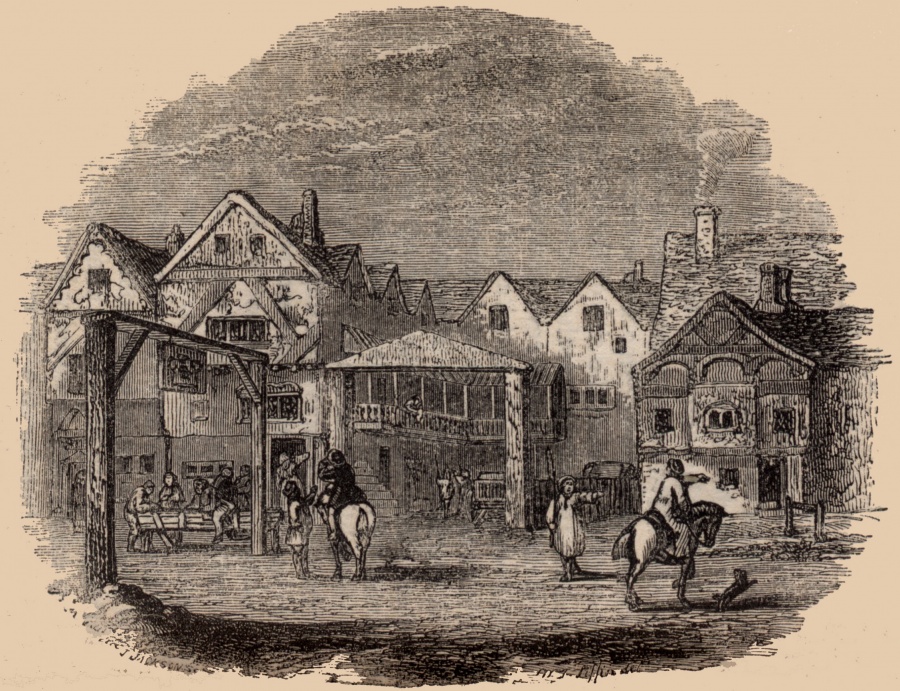
The Tabard, Urry's edition of Chaucer (1720)
(Courtesy of Visualizing Chaucer)
In the prologue to the Canterbury Tales, the narrator takes pains to give us “Th' estaat, th' array, the nombre, and eek the cause/ Why that assembled was this compaignye/ In southwerk at this gentil hostelrye/ That highte the tabard, faste by the belle” (716-19). The people on the trip are clear to us, so much so that my students came in angry with the Wife of Bath one semester. We get details about them that give context to the stories they tell, and many of the stories (such as the Wife’s) are deeply rooted in the character who tells them. The places are far less clear. My colleague Kara McShane has recently created a website called Visualizing Chaucer, and it features a constantly increasing number of images of the pilgrims and their tales. Under the heading “places,” however, only two locations are mentioned: the Tabard Inn and Canterbury Cathedral. Since the pilgrims never seem to actually make it to Canterbury, the Tabard Inn is the only place in the text well-defined enough to illustrate. And even the inn is simply placed “fast by the belle.”  Despite the frame’s implied movement, the stories could be told anywhere (though the pilgrimage gives a reason for the disparate group to be together, and starting in Southwark may increase the possibility of mixing such a cross-section of society). Once the tale-telling begins, the movement from Southwark to Canterbury recedes into near invisibility as we’re treated to tales with locations that are both specific and general but that do not in any way correspond to the landscape through which the pilgrims move.

Because of this lack of topographical detail, the moments when the host does seem to call attention to the surroundings are striking. Before introducing the Man of Law’s Tale, we are told that
           
           Our Hoste sey wel that the brighte sonne
The ark of his artificial day had ronne
The fourthe part, and half an houre, and more;
And though he were not depe expert in lore,

He wiste it was the eightetethe day
Of April, that is messager to May;
And sey wel that the shadwe of every tree
Was as in lengthe the same quantitee
That was the body erect that caused it. (1-9)
Photo from my own pilgrimage to
Canterbury in 2011

The passage continues for some time, as the host notices many things about the shadows and infers many things about the time on account of what he sees. Josie Bloomfield pointed out last year at the Plymouth Medieval and Renaissance Forum (in a talk titled "Walking with an Astrolabe: Measuring Time on Chaucer’s Pilgrimage") that his information is not particularly accurate and is more cumbersome than it needs to be. If the host wants to know the time, listening to church bells would be much easier. And yet Chaucer chooses to write it this way. The details he includes might not describe a specific location on the journey to Canterbury, but they do describe sun and tree and shadow in order to define a specific point on the journey. As Helen Cooper explains in The English Romance in Time, “A phrase such as ‘a day’s journey’ is in fact tautologous, since ‘journey’ derives from journée, how far can be covered in a day. Distance itself was hard to measure, and the conversion of space into time provided a functional and accessible approximation. The ease of the conversion is itself an indication of how one-dimensional travel appeared, like time itself. The conversion worked in the other direction too, to represent time as space. Dante famously claimed to have had his vision of Hell, Purgatory, and Heaven mid-way along the pathway of his life, in the thirty-fifth year of his allotted seventy” (68). To travel is to move through space and time simultaneously, and to pilgrimage is to ultimately to collapse the two. We go to the place where Becket was killed in the past because that location has meaning for us in the present. The host further connects location to time when he uses the waterfall metaphor I mentioned above. The conclusion of his astronomical musings is to ask the Man of Law to waste no more time and tell his tale. There is some irony in how much time the host spends in trying to move things along, but the sustained focus on scenery and time and story-telling functions to remind us of the connection between travel and narrative in the Tales.

The tale the Man of Law tells is itself full of travel, as Custance sails from east to west and back again. Kathy Lavezzo argues in Angels on the Edge of the World that "since Custance's journey begins in Syria, the cartographic territory evoked in the tale . . . suggests a map of the world" (95). Both we as readers and the pilgrims as listeners can follow Custance’s voyages while the Man of Law describes them. Stories, after all, are a kind of travel, as reading about travel to holy places sometimes functioned as virtual pilgrimage for those who
Detail from Gustaf Tenggren illustration
to the Man of Law's Tale (1961)
couldn’t make the actual journey. Yet as John F. Plummer noted the same day as my own talk in a fantastic paper called "Figures of Geo-political Spaces in the Man of Law's Tale," 
Custance’s journey is not as specific geographically as it is in Chaucer’s sources. The Man of Law often cannot name the castle or island on which Custance lands. At one point he explains that her boat goes "Som-tyme West, som-tyme North and South,/ And som-tyme Est, ful many a wery day" (948-949). So, basically, her boat goes in every direction. Nothing could be farther from the image of the forcefully direct waterfall. And time is no less clearly defined. Custance’s ship is carried back and forth across the ocean for "Yeres and dayes," a time that seems specific, with the addition of days, and yet is nonetheless vague (463). How many years? How many days? Later, her ship is at sea for "Fyve yeer and more" -- we do get a number of years this time, but the "and more" undoes that precision (902). The sense of movement over space and through time is almost magnified by this unspecificity, as our heroine’s movements could cover any distance we could imagine. Yet the passage of time is indelibly linked to the oceanic spaces through which she is traveling. Everything about her tale is rooted in her landscape (or rather oceanscape).

The second mention of sun and shadows comes before the Parson’s Tale, which is further removed from physical travel than the Man of Law’s choice of material. In this second instance, the geotemporal reflections in this scene come not from the host, but from the narrator Geoffrey. He begins with reference to the previous tale, which places the observations explicitly between tales:

By that the maunciple hadde his tale al ended,
The sonne fro the south lyne was descended
So lowe, that he nas nat, to my sighte,
Degreës nyne and twenty as in highte.

Foure of the clokke it was tho, as I gesse;
For eleven foot, or litel more or lesse,
My shadwe was at thilke tyme, as there,
Of swich feet as my lengthe parted were
In six feet equal of proportion. (1-9)

 My own interaction with sun and mist and
flowers at the base of Gullfloss
With the shift from host to Geoffrey, we also get a more personal interaction with the landscape, as the calculations are made not in terms of trees, but in terms of his own shadow. As before, the landscape is vague and general, and yet it is nonetheless there, and both time and tale-telling are defined by it. And the implications of sun and shadow must be clearly evident, since the host responds to them even as Geoffrey tells us about them. The narrator explains that it is because of the telling length and angle of the shadows that the host addresses the pilgrims:

                      … 'Lordings everichoon,
Now lakketh us no tales mo than oon.
Fulfild is my sentence and my decree;
I trowe that we han herd of ech degree.
Almost fulfild is al myn ordinaunce.' (15-19)

The tale-telling is meant to accompany the trip to Canterbury, so the idea that all but one pilgrim has told a tale and that the host’s ordinance is almost fulfilled gives us a clear sense of movement. If this many tales has been told while riding along, they must have been getting somewhere. And again this knowledge of movement and this request for another tale comes from observations about the play of the sun on the world, details about their surroundings so clear that the host could speak up even as the narrator muses to us about his own shadow.

The Parson’s Tale that follows is, to put it mildly, different from the Man of Law’s. In response to the host’s invitation to give the company a fable, the parson retorts “Thou getest fable noon ytoold for me” (31). And not only is it not a fable, but it’s not even really a tale at all.  It’s more of a sermon. While the Man of Law, responding to a similar request from the host, sends us around the world with his narrative, the parson wants us to instead look inward and examine our souls for a different sort of pilgrimage. As he explains,

          And jhesu, for his grace, wit me sende
          To shewe yow the wey, in this viage,
          Of thilke parfit glorious pilgrymage
          That highte jerusalem celestial. (48-51)

The parson wants to achieve the perfect pilgrimage of celestial Jerusalem, which isn’t physical but is rather spiritual in nature. Even though tales like the Man of Law’s don’t
John's vision of Christ and heavenly Jerusalem, Revelation 21: 2-8
from Yates Thompson 10 f. 36
(Courtesy of the British Library)
directly relate to the voyage at hand, they’re still part of a shared game of tale-telling that is associated with the time it takes to get from one place in England to another. The Parson, on the other hand, yanks us out of the temporal realm and leads us to a kind of pilgrimage that is related to a Canterbury pilgrimage spiritually (at least ideally speaking – some pilgrims seem to have more spiritual reasons than others), but is distinct in more practical ways. As Helen Cooper notes, “The pathway of life is also the journey of life; life as quest” (68). We’re all moving from birth to death, and many hope that death will be followed by a pleasant afterlife. As the narrator in Pearl just can’t help but try to cross the river in his vision, it’s easy to mistake geographical movement as the way to achieve that ultimate pilgrimage, but the parson insistently reminds us that we must look inward and turn our minds to higher things. It is perhaps telling that a “tale” with so little connection to either narrative or location follows an extended musing on the visual cues of the passage of time.  We might long for the eternal, but in the meantime we’re stuck in the temporal realm.

As we read these moments where time and space rise to the surface of the Canterbury Tales’ frame narrative only to be followed by tales with an increasingly vague sense of physical locatedness, the connection in narrative between time and space becomes both apparent and richly complex. It is impossible to separate the one from the other, and yet neither is fixed. Whether we read a story or travel to Iceland or just sit and wait, things change. Time passes. The earth shifts, and landscapes are built and rebuilt. The simultaneously uncertain and sure movement of those pilgrims as they wend their way and tell there tales both removes us from time and space and reminds us that we can never escape them. Except, perhaps, in the afterlife.


Layers of lava rock look heavenly to me

Friday, August 9, 2013

"How can you have boundaries if you fly?"

On a recent cross-country flight I was lucky enough to have a clear day and thus a beautiful view. I snapped photos with the kind of obsessive fervor that only a too-early morning and the knowledge that I should be writing can elicit. The more I looked at the landscape below me, the more I found myself grasping to identify the topographical features that would result in such strange shapes. I especially marveled at my ignorance when we flew over areas where I had lived (and hiked and driven around and explored) for many years. This made me think, in turn, about how familiar the Mercator Projection map looks to me, even though it bears little resemblance to the actual earth or landscape (see my earlier post, "Tales of Land and Sea"). It is the appearance of the land itself from above that surprises me. I was reminded of The Once and Future King, when little Arthur/Wart, transformed into a bird, is confused by the lack of boundaries on the land he sees from above (chapter 18 of The Sword in the Stone). In what way, then, do maps represent the land they depict? To what extent are they meant to? Will programs like Google Maps and Google Earth change how we imagine the world? What does a birds-eye view teach us that being on the ground cannot (and vice versa)? I don't yet have answers to these questions, but I would love to hear your thoughts as I begin to consider them.

Here are a few of the photographs I took from the air:  

Patchwork Landscape
Filled with beautiful swirls
And surprising colors
Landing, the shapes reorganize into something more familiar ...
Only to be obscured by fog