Showing posts with label Christmas. Show all posts

Thursday, December 26, 2013

"Thou met'st with things dying, I with things new-born": On Seasons and Genres in The Winter's Tale

I found a flower in the snow
The last play I taught in my Shakespeare class this semester was, appropriately to the season,  The Winter's Tale. A strange play that few of my students had read or seen before, Winter's Tale spends its first three acts as a tragedy and then makes a surprising and bittersweet comeback by the end. The play begins with King Leontes's unfounded jealousy over an imagined relationship between his wife Hermione and best friend Polixenes. This jealousy serves to tear apart his family and friendship and country. His heir dies, his wife dies, and his newborn child, whom he wrongly believes to be illegitimate, is left out in the cold and bear-filled landscape to face the elements. Antigonus, the man sent to leave the baby, receives one of the most famous stage directions in history: Exit, pursued by a Bear. Perhaps Antigonus is punished by nature for abandoning the child, perhaps this is a lesson in conflicting loyalties (loyalty to the king's orders vs. loyalty to personal morality), or perhaps he is a scapegoat figure. In any case, the last we see of Antigonus he is running for his life. Offstage, he dies a terrible death (while the bear, presumably, gets a good meal). Also offstage, a young man observes the violent mauling, while onstage the man's father, a shepherd, finds the baby. And here, at the end of act three, we get the first moment of real hope in the play. The play has been filled with jealousy and despair and death and cold and darkness, but the baby lives. At this time of year, when days are short and temperatures are cold and it feels like spring may never return, a glimmer of hope can mean life. (I never really understood this when I lived in California, but I certainly get it in upstate New York.) To survive winter, we need something to look forward to. A celebration. A winter holiday. A candle or a sprig of holly. And, of course, the shortest day of the year means that each subsequent day will be longer. The play, tied to seasonal change, is rooted in such inevitable cycles. A tragedy or a comedy, the play suggests, is only a matter of where you stop the tale. And this play keeps going into spring.

The shepherd is amazed by his discovery of the helpless child, and his son is horrified by the violence he has witnessed, and their conversation brings despair and hope, death and life, into contact. It is no accident that it is the old man who finds the new life. The pivotal moment of the play is this one of life and death, beginnings and endings. At the same time as father saves a new life, the son can do nothing to stop a life from ending. Hope, it seems, comes at a price.


I won't go into lengthy summary or analysis (though I have much more to say on the play), nor will I give away the ending. Instead, I just want to say a few words about the play in terms of this holiday season. In keeping with my Christmas posts from the past two years (one on Gawain and the Green Knight and another on The Second Shepherd's Play), I want to think here about how The Winter's Tale might help us contemplate this time of year. It's a play in which hope comes just as things seem the most tragic. Death is everywhere and we are sure this must have been mislabeled as comedy or romance. Surely it's a tragedy. In Act 2, the doomed little heir Mamillius explains to his mother that "A sad tale's is best for winter" (II.i.25). And what we get is indeed a seasonally-appropriate sad tale. But then something miraculous happens. A baby is born; a baby lives. Time passes, and it is winter no longer.

One of the many things I love about this play is that it manages to bring together genres in the way that seasons come together, not as separate entities but as parts of a larger, interconnected cycle. Even the play's ending, which allows for resolution, reconciliation, and even joy, is not completely free from the sorrow of the first three acts. Time has passed, bodies once young are now wrinkled. The years cannot be regained anymore than the wrongs can be forgotten. People have died, people have been slandered and exiled. And though some wrongs can be righted, others never can. Leontes regrets and learns and gets some redemption, but none of this erases what he's done. His happy ending is truly happy, but also bittersweet. The characters value their happiness because they know how dearly-bought it is. Likewise, we can always do better and the world can always do better for us, but what we've done and experienced won't just go away. It makes us who we are. The baby grows into a woman, but this doesn't eliminate the fact that her father intended her death. Her name, Perdita, means "the lost one," indicating that if she's found she will nonetheless represent that which has been lost. It is in this lost one, this Perdita, that we find hope, and the hope is real, but that doesn't disconnect it from the circumstances that required hope in the first place. This looking forward as well as backward, this Janus posture fitting to the new year, helps us to see that joy and sorrow are not always distinct, nor do they need to be. As redemption is only possible after a fall, hope only means anything in times of despair. This holiday season, as we move to a new year, let's think on the fact that looking for joy and hope and goodness in the world need not mean that we've forgotten the bad and the sad. Instead, let us try to see the bigger picture, to learn from mistakes and to understand that sometimes our gain comes from another's loss. And as the happiness found at the end of Winter's Tale is more meaningful to the characters in that they've known such sorrow, perhaps we can remember that life has no simple happy endings. Happiness is tangled and complicated, and life very often continues even after marriages or deaths that would make such neat conclusions to comedies or tragedies. And even the times of year we associate with joy can be filled with loss as well. I shine with love for those around me, but I also ache with fresh grief for those I have lost. I know I am warm and safe inside, but others are stuck in the cold. Part of being in the spirit of the season, I think, is in realizing what it means to celebrate light in the middle of the winter. In the spirit of The Winter's Tale, then, I wish for more joy and compassion for you all this holiday season. Merry Christmas and Happy Holidays and Happy New Year!

Tuesday, December 25, 2012

In fields where they lay: The Second Shepherds' Play as the original Christmas special

In keeping with my tradition of writing a holiday blog (started last year with Gawain and the Green Knight), I would like to write this year on another of my favorite medieval Christmas stories, The Second Shepherds' Pageant. The Second Shepherds' Pageant, also called The Second Shepherds' Play, has been burdened with its confusing title simply because it's the second play on shepherds in the Towneley manuscript (though the two weren't necessarily meant to be performed as a pair). Though the play is anonymous, the author has become known as the Wakefield Master. The play inserts common shepherds into the nativity story, and it combines social commentary and humor with piety. Simultaneously medieval England and biblical Bethlehem, the play is a beautiful example of the ways in which biblical stories were alive for medieval people through medieval dramatic practices.

The play opens with a lone shepherd's complaint. The weather is cold, and conditions are intolerable for poor men, who are beaten down by hard living and made submissive to the gentry. Both the weather and the social structures described sound an awful lot like late medieval England. As other shepherds arrive on the scene, squabbling (good-natured and otherwise) ensues. When Mak, a man of unsavory reputation, makes an appearance, the shepherds greet him with suspicion. Their suspicion soon proves well-founded, as Mak slips away while the shepherds nap and steals a prize sheep. He takes it to his wife, Gill, and the two concoct a plan. If the shepherds come looking for their missing sheep, they will put the lamb in their cradle and Gill will pretend to be in childbirth. Mak and Gill are known for having children constantly (sometimes twice a year, Mak complains earlier in the play), so her sudden condition shouldn't take any one by surprise. The trick works well at first. The shepherds do show up quickly (and angrily) to seek their lost lamb, but Mak begs them to pity his wife in her childbed while Gill makes terrible moans. The shepherds finally leave, and Mak and Gill breathe a sigh of relief. But then one shepherd realizes that he gave the new baby no gift, and the others respond in kind. Their generosity proves troublesome for our thieving couple, when the shepherds return and pull the swaddling clothes aside to present the child with birthday presents. They cry out that the child is a monster, and then recognize that monster as their own missing lamb. It's no accident that they only discover their lamb once they turn from anger against Mak and Gill to generosity toward the "child." At this point the play, so farcical in tone, could turn deadly. The shepherds have a right to execute Mak for what he's done. After some deliberation, they turn merciful and decide to toss him up in a blanket instead, a humorous solution to the problem. Tired out, they lie in their field to sleep. As if in response to their mercy, a star appears and an angel tells the shepherds of the birth of a savior. They go to seek the Christ child in his manger, and this time they do remember gifts. They give cherries, a bird, and a ball (meant to symbolize life in a time of death, the holy spirit, and a royal orb, respectively). This story, an alternate to the Magi, shows us not wise men, but everymen. They are common shepherds, people the audience might know, granted entrance into the joyous and miraculous scene of the nativity itself.

The setting of the play is particularly resonant, since it is always both Yorkshire and the Holy Land. The characters talk of walking on the moors, and mention many English locations throughout the play. When Mak first arrives, he pretends to speak with a southern English accent, and the others tease him until he resumes his customary Yorkshire speech. People and place all seem firmly located around Wakefield itself. Yet when the star appears, the shepherds need not travel far to find Bethlehem. And, as David Bevington notes in his Medieval Drama, there would have been two platforms for the play. Mak and Gill's house would have been parallel to the manger on the set, with the shepherds' field in between, connecting the two and presumably holding the audience as well. Bevington explains how the staging gives "a visible form to the parallelism of the farcical and serious action. Although the Wakefield Master never calls explicit attention to the resemblance between the two births, the stage itself would help make the point" (384). The playing space would have visually enacted the themes of the play, yoking together sacred and profane, past and present, there and here. For many people in medieval England, the Bible itself was inaccessible. Books were expensive and the Bible was in Latin. Medieval Drama was thus an important way in which people of the period engaged with scriptural material in a highly interactive way. They wrote and acted in these plays. They stood in their city centers among biblical set-pieces and cheered and laughed and booed and cried. Perhaps they threw things at devils and perhaps they sang along with songs they knew. Puritans were horrified by such spectacles, wanting people to have access to scripture itself instead. But the plays give us insight into the way people of late medieval England saw these as living stories, as stories that were real parts of their own lives and with which they could engage actively. Real emotions, including humor, could be part of sacred drama. Biblical time and place collapsed with contemporary English spaces. The Second Shepherds' Play takes the collapse of time and place to an extreme as the play inserts Yorkshire shepherds into the nativity. In fact, the majority of the play follows these shepherds, who could be anyone from anywhere and anytime, and yet are also clearly from Yorkshire. It's not until the star appears near the end of the play that we get any overt hint that this is a Christmas story. The play seems to suggest that even mundane moments can be part of a miraculous larger narrative, that we are all part of this narrative together and that it thus continues to have real existence in the world.

I had the good fortune to see the play performed at the Folger Institute several years ago when my good friend and colleague Dan Stokes and I participated in an Early English Drama workshop there, and the performance was engaging, beautiful, hilarious, and moving. I laughed; I cried. I know that sounds cliché, but I really did laugh and cry over the course of the production. And I wasn't the only one. The most amazing part was the mixed audience. Scholar of medieval drama sat next to families with small children, and all were captivated. Dan and I were having a pint at the pub after the performance, and we saw the actor who played Mak there. When we told him how much we'd enjoyed it, he was thrilled and offered to buy us a round. Apparently, the actors had been terribly nervous that night, since they knew that the academics were coming to the show. We reassured him that they had managed to make the play both wonderfully accessible and scholarly fascinating. In fact, I found it fitting that this play had remained so engaging to so wide an audience. The way in which the play infuses the familiar and yet incredible story of the nativity with everyday people and their hijinks is striking even to modern audiences. The way that these quarreling, complaining, scheming characters can be so moved by the baby in the manger lends the final scene a real sense of awe.

As funny as the play is, the ending is surprisingly poignant. These characters we have come to know seem a bit awkward in the holy scene, but they are so genuinely enamored with the baby that it's hard not to feel a shared sense of joy in the moment. Their gifts to the child may be simple, but they are heartfelt. And the manger is a humble space not unfamiliar to our common shepherds. A play that could have ended in death (either of the sheep or of Mak), ends instead in miraculous birth. And while the symbolism of the lamb in not lost, nor is the audience unaware of the larger story which includes the Passion, we are allowed for a moment, like the shepherds, to just enjoy the scene. Affective piety was popular in the later Middle Ages, and holy people imagined themselves at the foot of the cross and felt the pain and sorrow of that moment. The Second Shepherds' Play gives us a chance for a different kind of affective engagement, one in which we place ourselves instead in the manger and feel the shared joy. After I saw the play performed, the group of us remarked at how moving it was to all of us, despite our different belief systems. The message is one of mercy and joy and hope, a sense that any one of us could play a part at any moment in something greater than ourselves. This year has been difficult for many, and these last few weeks filled with unimaginable heartache (see Kate's recent beautiful post on the Coventry Carol). I only hope that we can respond to tragedy with compassion. Like the red cherries picked in the frozen white winter, like the baby born when nights are longest and days are coldest, even the bleakest moments are available to hope and beauty. And the beauty of basic human compassion is that we all have the power to bring it into the world. Perhaps this is the perfect time to think about how the simplest things can be miraculous. Even moments that are common or silly or petty or sad can be made precious if we remember to treat each other with kindness. With that in mind, I wish you all a season filled with love.

Sunday, December 16, 2012

A Coventry Carol

"The Coventry Carol" always seemed a terribly odd, and terribly eerie song for the Christmas season, given that Christmastime — as one commentator on the Sandy Hook tragedy poignantly lamented — is supposed to be joyful. Full of good cheer. This particular carol, however —the sole survivor of a now-lost 16th-century mystery play— tells an important part of that story. A bleaker part. It is sung from the perspective of a mother lamenting the loss of her child, one of many slaughtered on Herod's orders: 

Lully, lullay, Thou little tiny Child,
Bye, bye, lully, lullay.
Lullay, thou little tiny Child,
Bye, bye, lully, lullay.
O sisters too, how may we do,
For to preserve this day
This poor youngling for whom we do sing
Bye, bye, lully, lullay.
Herod, the king, in his raging,
Charged he hath this day
His men of might, in his own sight,
All young children to slay.
That woe is me, poor Child for Thee!
And ever mourn and sigh,
For thy parting neither say nor sing,
Bye, bye, lully, lullay.

On this day, as the updates on the incomprehensible Sandy Hook killings continue to come in — and as the press performs their shameful, but predictable, pandering for ratings by dwelling on the killer's story — I am struck by the fact that while we know and remember Herod for the awful orders that he gave, we have no names of those he ordered to be killed. We only know them by their epithet: the Innocents. Little children killed on the orders of — according to the stories that come down to us — a single, scared, hubris-addled man. 

And yet, though we have no names for the children of this legendized narrative, their story survives and is told again and again. In a gospel. On the church floor of Siena's Duomo. In countless other artistic renderings. In medieval mystery plays. In "The Coventry Carol." Their deaths are inextricably wrapped up in the Christmas season, and they remind us of the profound sadness that can, and does, course through the clamoring joys of the season. 

Its haunting melody gently challenges the very idea that Christmas is supposed to be filled with simple joy. I've grown to strongly distrust the word "supposed" and its cousin "should." Having spent the better part of a very brutal year chiding myself because I "should" be happier, I can definitely attest to how inertia-inducing (even damaging) the word can be. The fact is, for many people -- certainly the survivors and the families of the innocents killed this week -- this time of year could not be further from joyful. This time of year, for them, has become something to be survived, and it becomes so at least in part because of the cultural pressures that insist on joy as the only acceptable feeling of the season. 

"The Coventry Carol," however, reminds those who suffer in this time that they are certainly not alone. That a long time ago, as magi came to Bethlehem to find a babe in a manger and rejoice in the finding, and as hosts of angels sang of his birth to bedraggled shepherds, there were also many families weeping for a loss too profound and too final to comprehend. It forces those of us fortunate enough to experience joy at this time of year to remember those with bleaker stories to tell. And, hopefully, to remember to be that much more grateful for our joys because they are so very fragile. 


Sunday, January 1, 2012

The Twelve Days of Dissertation Chapter Editing . . .

Given that we're right in the middle of the twelve days of Christmas, we decided that a special present was in order for all of our lovely readers. Kate has been toiling away on her Arthur and the Crusades Chapter, and submitted it to her advisor before the holidays. While lamenting to Kristi over its decrepit state, the two of them began discussing the ups and downs of the writing process, and the fruits of that conversation can be found (in story-book form) below. It is, in part, an homage to one of our all-time favorite blogs, Hyperbole and a Half, but also the best way we knew how to cope with and describe the highs and wretched, wretched lows of the dissertation process.

And so, here is your Christmas story.

Wasshail!
-- Kate and Kristi


Day 1: MOTIVATED!!! (i.e.WRITE ALL OF THE CHAPTER!!!!)


Day 2: Photocopy the mother******* articles like an adult! (censored for the children).


Day 3: Sharpening Pencils (I mean business!)


Day 4: Despair, Part 1 (What does my introduction even MEAN?!)


Day 5: Stalling (Icecream and Netflix!!)


Day 6: RALLYING!


Day 7: Cut and Paste?!


Day 8: Senseless Destruction or Sensible Destruction?


Day 9: Despair, Phase 2 (Control, Alt, Delete?)


Day 10: Purchase oddly appropriate t-shirt that mocks your crushing sense of inadequacy. 


Day 11: After copious revisions (and assurances from your fire extinguisher-wielding partner in ice-cream misdemeanors), send to advisor. 


Day 12: Holiday party -- advisor says he's received chapter and your knee-jerk response is "I'm sorry . . ."


Monday, December 26, 2011

I'm Dreaming of Green Christmas: Sir Gawain and the Green Knight's Most Dangerous Christmas Game

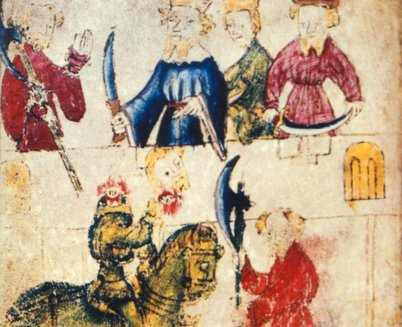
In honor of the holidays I thought I would talk about my favorite Christmas story – Sir Gawain and the Green Knight. Much ink has been spilt about Gawain and his verdant foe, but I thought today I would try and pull a Christmas message – and maybe some cheer – out of the notoriously grim story. The poem, an anonymous fourteenth-century alliterative tale, begins, fittingly enough, with a Christmas party, and no tacky office party, but a feast to go down in the history books. In the spirit of the season, the Green Knight bursts in on the party. Unlike Santa, though, he chooses to come in while everyone's awake, and to use the front door rather than the chimney. And instead of toys for the good and coal for the bad, he brings with him a bow of holly and an axe. Holly, which blooms bright red amid the frozen winter landscape, is a fitting gift of this holiday, a reminder of the hope that comes with the cycle of the seasons. Spring will come again, and color will return to the land. The axe, however, is a far more chilling gift. Even more dangerous than a Red Ryder BB Gun, it's a violent offering in conjunction with a violent game. While the young knights and ladies of the court have been playing flirtatious games where the stakes are kisses, the stakes of the Green Knight's game are life and death, severed head for severed head. (Of course, the Green Knight's game turns out to be a kissing game, too, but one with serious repercussions.) The light, superficial tone of the opening celebration is shattered as the Green Knight confronts the court and asks to test their pride. He offers the axe to anyone who will play his beheading game. He'll take a blow from a Round Table knight this evening in return for a blow from him in one year at the mysterious Green Chapel. When Gawain takes the challenge, he has no way of knowing that the Green Knight can pick up his head and keep talking once the blow is given. When the Green Knight departs, however, severed head in hand, the court returns to its frivolous ways.

As the year passes between that Christmas and the one in which Gawain will need to seek out the Green Knight and fulfill his promise, the court maintains a polite, artificial veneer. They are thinking that Gawain doesn't stand a chance, but they tell him that he'll be fine. They continue with laughter and games as Gawain's journey looms near. And when the day arrives for Gawain to set out, they spend pages and pages arming him beautifully, setting up a hard and beautiful exterior meant to define him as a knight. Little do they know that the true test is an interior one, and that the armor will not help him at all for that. As if to hint that Gawain's preparation is faulty, barely a line is given to the great monsters and foes that Gawain meets on the road. He dispatches dragon and troll with ease, but finds the cold harder to bear (armor doesn't provide much protection from a blizzard). When his prayers are answered and a castle appears, he thinks of it as a welcome respite from his trials. He doesn't realize that the true test will occur within the safety and warmth of the castle walls. In fact, he moves ever more into the interior of the castle – first to a private chamber and then into a curtained bed – signifying his personal move toward the interior as the test continues. The lord of the castle greets him warmly, as does his lady wife, a mysterious old woman, and everyone else in the castle. They've heard stories of the courtly Gawain and are pleased to welcome him to their holiday celebrations. The host tells Gawain to rest up before his continued journey. The Green Chapel that he seeks is near, and he can sleep away the days until the new year. In fact, the host will add some Christmas cheer with a game. He will hunt each day for three days and exchange his winnings for whatever the knight can win inside the castle.

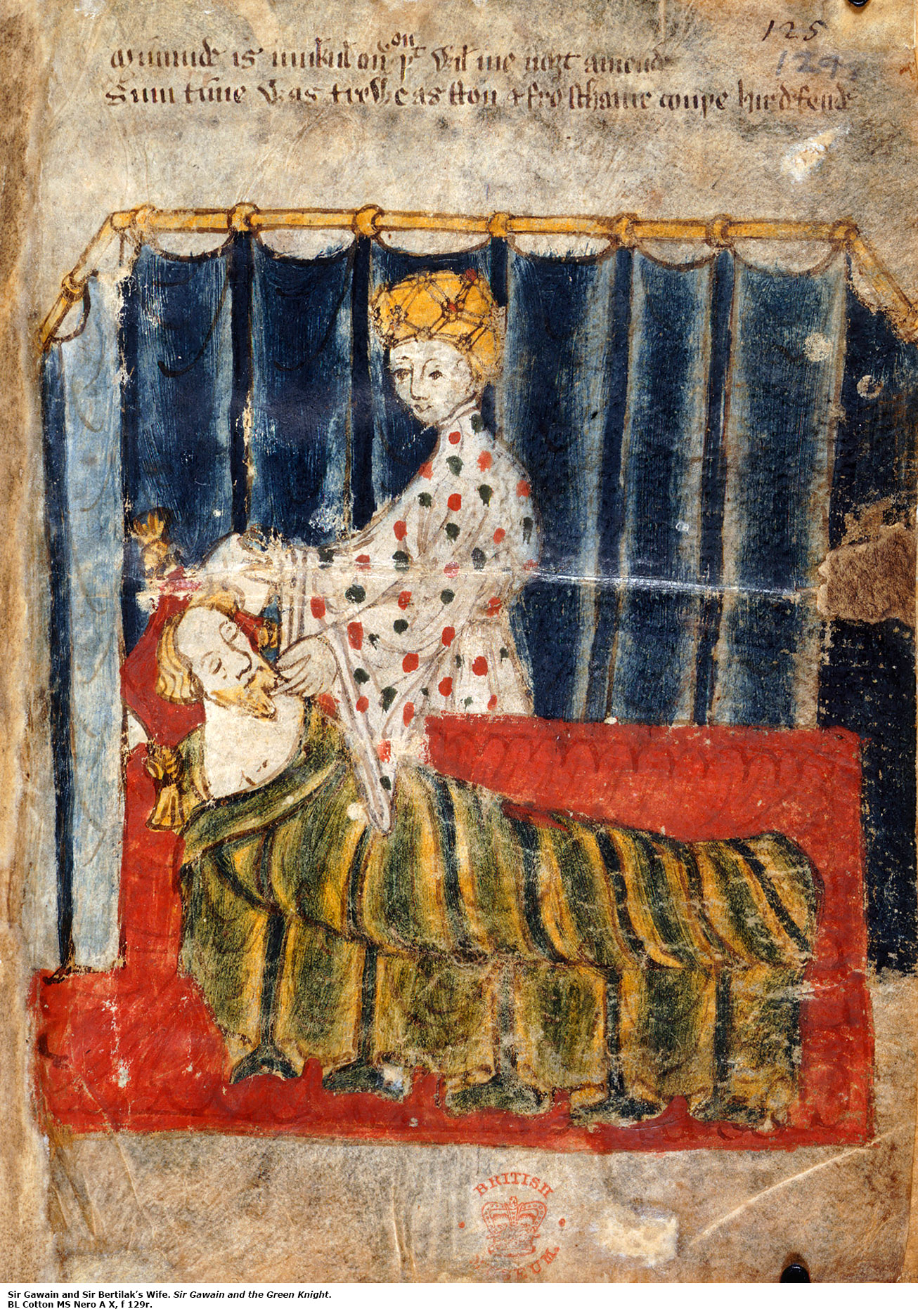
While the lord's away hunting, the lady of the castle tempts our valiant hero in his bedroom, and the stakes of that temptation rise each day in conjunction with the stakes of the hunting going on outside the castle walls. The emotions Gawain feels during these scenes of temptation are many -- fear, anger, annoyance, lust. Yet he shows none of these. He remains diplomatic and polite, managing to refuse the lady without insulting her. Each day Gawain escapes with a chaste kiss (one more for each day), and passes those kisses on to his host in exchange for the fruits of the hunt. The last day, however, the lady manages to give him a gift as well, a green girdle. He refuses all her love tokens and rich offerings, but finally gives in when she tells him that the girdle will protect him from all violence. His love for his own life and fear of death win out, and he accepts the gift. He even promises not to tell anyone. That evening, when the lord asks him if he won anything besides kisses, seeing no way to honor both his word to the lady and the lord, he tells him that he did not. The next morning, he heads with a (terribly frightened) guide to the Green Chapel, which could perhaps be more aptly called a Green Mound, to meet the Green Knight. The Green Knight makes Gawain wait and listen while he sharpens the axe with which he'll behead him, and then comes to complete the year-long beheading game. He moves to strike Gawain with his axe, but stops when Gawain twitches. He moves to strike again, and stops again. He moves to strike a third time, and this time nicks Gawain on the neck. [SPOILER ALERT] Gawain is confused, but quick, and moves away to put shield and sword between himself and his giant opponent. Having fulfilled his obligation to the game, he'll not take another swing without a fight. But the Green Knight laughs and reveals himself to be the same man who has graciously hosted Gawain for the last three nights. The old lady in the Castle was Morgan La Fey, and she used her magic to transform him. The first two swings were for the first two days, in which Gawain resisted temptation and kept his word. The third swing, resulting in a cut, and a scar, was for the third day, in which Gawain failed just a little in not telling of his gift. A small cut for a small failing. Yet Gawain responds with shame and anger. His blush in response to the Green Knight's words is a physical response which can neither be hidden nor controlled. Its speaks of his shame in a way none of his carefully measured words could do. His angry outburst that follows his blush continues with the trend. Gawain finally has a completely honest communication, and though it's not pretty, it does signal a move to a new kind of authenticity.

When Gawain returns to his court, he wears the scar and the girdle as badges of his failing. Though he left as a representative of the court, his journey has taken him on an individual path that his fellow Round Table knights cannot fully understand. They all adopt the green girdle as a fashion statement, an act of seeming solidarity. But no one can truly comprehend what Gawain's been through. Maybe Gawain's too hard on himself, and maybe he misunderstands the lesson. It may even be that his attempt to render his newfound authenticity externally, the only way he knows how, is doomed to fail. The poem has been read as a social critique, as fatalistic, and even as apocalyptic. And it is all of these things. Yet there is something hopeful as well as dreadful in a story of one person's journey set against such a large backdrop. Seasons change, cities rise and fall, and yet amid all this we focus in on a single knight's struggle to know himself. Maybe he is too hard on himself, and maybe no one else in the court understands or learns anything. But Gawain learns. He learns some humility. He learns some honesty. He learns something about himself and about the kinds of battles that really matter in life. His is not a story of the knight in shining armor fighting a dragon, though that surely takes place on his journey, but rather the struggle of an individual to be a good person. Gawain grows introspective over the course of the poem. He reexamines his values and his intentions as well as his actions. Yes, this is a painful process, and he can't go through it for anyone else in the court, but it's a process that leaves him more aware of himself and the world. Perhaps we could all take some time this holiday season to be a little introspective, to take a moment's break from shiny wrapping paper and colored lights and think about what we've learned this year, what we've done well and what we could work on. And though Gawain doesn't seem to change the course of Camelot, perhaps his story can help make us think a little bit. And maybe that is the best gift of all.